For nearly 60 years, Warren Buffett helped turn Berkshire Hathaway (BRK.A 0.30%) (BRK.B 0.13%) into one of the most importsant financial institutions in modern history. With long-run compound annual gains of 20% -- virtually double that of the S&P 500 -- I think it's fair to say that Buffett's investing prowess is nearly unrivaled.
Regardless, Buffett's final moves before his retirement may have actually been a veiled warning to investors. Let's dig into some of the bigger decisions made by Berkshire during the past year or so and assess whether investors should follow suit.
Image source: The Motley Fool.
1. Berkshire sold its S&P 500 ETFs
Despite his illustrious track record, Buffett himself has admitted that picking stocks is a daunting task. Not only do you need to be correct in your fundamental analysis, but you also need to keep a close eye on the company's performance over time. This can be a major contributor in deciding when to sell your stocks and take gains.
Against this backdrop, Buffett has long been a supporter of owning passive S&P 500 index funds. Two particular exchange-traded funds (ETFs) Berkshire long held were the Vanguard S&P 500 ETF (VOO +0.67%) and the SPDR S&P 500 ETF (SPY +0.70%).
However, Berkshire's 13F filings reveal that the firm exited its stakes in these funds during the fourth quarter of 2024.
2. Berkshire's been selling stock like there's no tomorrow
Buffett didn't build his fortune by trading stocks. Rather, many of Berkshire's largest and most successful positions have been staples in the portfolio for many years -- if not decades.
Nevertheless, since the end of 2022, Berkshire has been steadily trimming its portfolio. Some of the more notable moves include exiting Citigroup, as well as consistent selling across core positions such as Apple and Bank of America.
In roughly two years' time, Berkshire has been a net seller of stocks to the tune of $184 billion.

NYSE: BRK.B
Key Data Points
3. A $382 billion position that couldn't be any louder
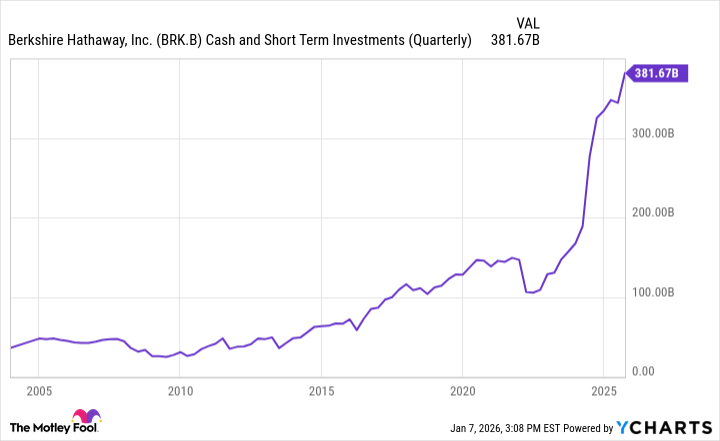
Given Berkshire's transition to a net seller, it's not a surprise that the company's cash stockpile is on the rise. At the end of the third quarter, Berkshire held a record $382 billion in cash and equivalents on its balance sheet.
BRK.B Cash and Short Term Investments (Quarterly) data by YCharts.
For a couple of years now, Berkshire has chosen not to follow the crowd into the bull market -- instead relying on steady interest earned on Treasury Bills.
Perhaps the only headline-worthy news out of Berkshire in recent months was the company's decision to initiate positions in UnitedHealth Group and Alphabet -- which barely comprise a combined 2% of the total portfolio.
What should investors make of all of this?
Taken together, here's what I gather from Buffett's final decisions: He might think the S&P 500's current level is unsustainable; therefore, hoarding cash until a reasonable time to buy presents itself is the prudent move.
Remember, Buffett is both a contrarian and a value investor. He certainly isn't going to mindlessly follow the crowd into an overheated market propped up by artificial intelligence (AI) euphoria. Furthermore, chasing stocks at a premium has never been a pillar of Berkshire's investment philosophy.
While stocks have gotten off to a hot start this year, smart investors understand that as expectations rise, so too do the possibilities of a correction. Clearly, even Berkshire still bought stocks in this bull market -- the nuance was that its allocations were modest and done so in reasonably valued businesses compared to their peers.
Given these dynamics, a good strategy right now could be to take a page out of Buffett's playbook and begin accumulating cash while also keeping an open mind about owning a basket of established, quality businesses trading at a reasonable price.