For more than a century, stocks have stood atop the pedestal on Wall Street. While bonds, commodities, and real estate have also helped investors grow their nominal wealth, no other asset class has come close to matching the average annual return of stocks over the long run.
The stock market has been especially fond of having President Donald Trump in the Oval Office. During his first term in the White House, Trump oversaw cumulative gains of 57%, 70%, and 142% for the Dow Jones Industrial Average (^DJI +0.23%), S&P 500 (^GSPC -0.35%), and Nasdaq Composite (^IXIC -1.04%), respectively.
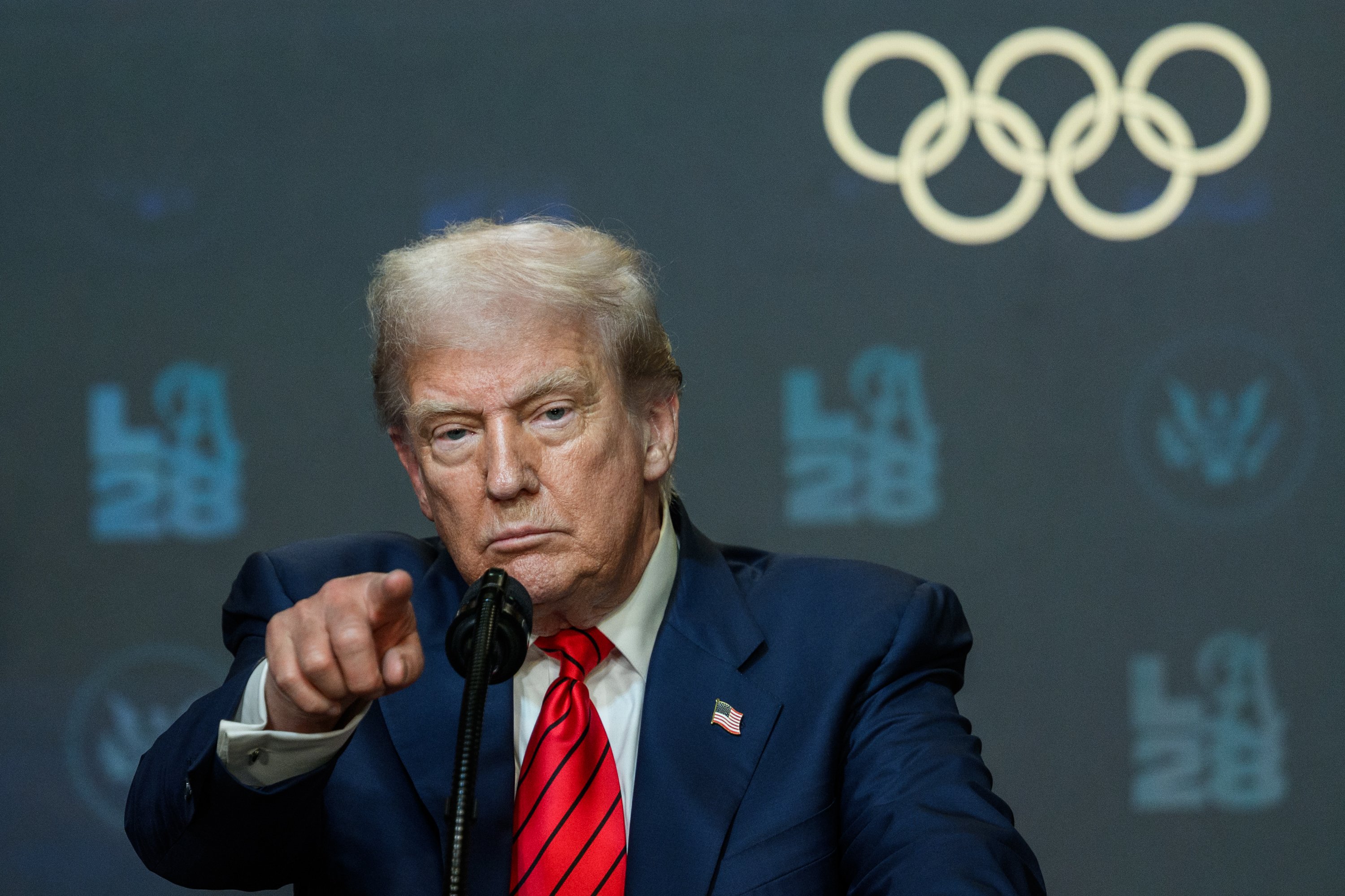
President Trump delivering remarks. Image source: Official White House Photo by Joyce N. Boghosian.
Last year, the stock market delivered an encore performance. With President Trump inaugurated for his second, non-consecutive term on Jan. 20, 2025, the Dow, S&P 500, and Nasdaq Composite finished the year higher by 13%, 16%, and 20%, respectively. It marked the third consecutive year of 15% or greater gains for the S&P 500, which is a feat the benchmark index has accomplished only three times in its existence.
The question is: Can annualized S&P 500 returns under Donald Trump accelerate?
Trump is overseeing one of the strongest bull market rallies in 129 years
To better understand just how impressive stock market returns have been during Trump's second stint in the White House, let's take a closer look at how his early returns compare to 22 other presidencies, including his own first term, dating back to March 1897.
The post below on X (formerly Twitter) from Carson Group's Chief Market Strategist, Ryan Detrick, annualizes the returns of the Dow Jones Industrial Average or S&P 500 across all 23 presidencies, two of which are Donald Trump's.
President Trump has been in office for nearly a year and the S&P 500 is up 16.4% so far.
-- Ryan Detrick, CMT (@RyanDetrick) January 13, 2026
Here's the past 22 Presidents and how stocks did under them. pic.twitter.com/Z1SsrNU1e3
Through nearly one year in office during his second term, the S&P 500 has delivered an annualized return of 16.7%, which is the second-highest average return over the last 129 years. You'll also note that Trump's first term in the White House ranks fourth in annualized return rate at 13.8%.
Donald Trump having two of the four highest annualized stock market return rates among presidents over the last 129 years isn't an accident. It's a combination of Trump's policies and technological trends that's exciting investors.
Admittedly, not every action taken by President Trump has pleased Wall Street. For instance, the unveiling of his tariff and trade policy on April 2, 2025, sent the Dow, S&P 500, and Nasdaq Composite into a very short-lived tailspin. But when it comes to tax and spending laws, corporate America has been more than satisfied.
In December 2017, Donald Trump signed his flagship Tax Cuts and Jobs Act into law. It permanently reduced the peak marginal corporate income tax rate from 35% to 21%, marking the lowest level since 1939. Businesses being able to retain more of their net income has fueled share buyback activity and incentivized innovation and acquisitions.
In addition to favorable tax policy, Trump's second-term presidency has coincided with the rise and early maturation of artificial intelligence (AI). According to PwC analysts, consumption-side effects and productivity improvements from AI can add an estimated $15.7 trillion to global gross domestic product by 2030. AI appears to be the biggest technological leap forward since the advent of the internet.
Perhaps it's no surprise that five of the seven highest annualized returns of the last 23 presidencies have occurred since 1993. The proliferation of the internet and now AI have fueled corporate growth.

Image source: Getty Images.
Outsize stock returns under Donald Trump may be unsustainable
While Trump has overseen outsize stock returns, he looks to have little chance of catching former President Calvin Coolidge's 25.5% annualized return. Moreover, maintaining a 16.7% annualized return rate for his second term is likely to prove challenging.
To preface the forthcoming discussion, no investor can guarantee what's to come for the Dow Jones Industrial Average, S&P 500, or Nasdaq Composite over the short term. Nevertheless, certain data points and events exist that have strongly correlated with sizable moves in Wall Street's major stock indexes throughout history. It's these correlations that can occasionally predict the future.
Arguably, the most prominent headwind to President Trump overseeing an ultra-high annualized return is the stock market's historically high valuation. The S&P 500's Shiller Price-to-Earnings (P/E) Ratio, also known as the cyclically adjusted P/E Ratio, or CAPE Ratio, entered 2026 at its second-highest valuation spanning 155 years.
Whereas the Shiller P/E has averaged a multiple of 17.33, dating back to January 1871, it ended the Jan. 15 trading session at a multiple of 40.83. There have been only six occurrences in 155 years where the CAPE Ratio has surpassed 30, including the present, and the previous five were followed by declines in one or more of Wall Street's broad-market indexes of between 20% and 89%. In short, history makes clear that extended valuation premiums aren't sustainable.
S&P 500 Shiller PE Ratio hits 2nd highest level in history 🚨 The highest was the Dot Com Bubble 🤯 pic.twitter.com/Lx634H7xKa
-- Barchart (@Barchart) December 28, 2025
Unfortunately, historical precedent isn't just limited to the stock market's valuation. Next-big-thing technologies also have a terrible habit of eventually disappointing investors.
Over the last three decades, the internet, genome decoding, nanotechnology, 3D printing, blockchain technology, and the metaverse have all endured early stage bubble-bursting events. These bubbles popped because investors didn't allow adequate time for these game-changing technologies to mature and evolve. While few investors deny AI has long-term potential, AI solutions aren't anywhere close to being optimized as of yet. If history repeats itself and the AI bubble bursts, the wind will be sucked right out of Wall Street's sails.
The stock market also has a Federal Reserve problem. At no point over the last 35 years has the nation's central bank been as divided as it is now. Each of the previous two Federal Open Market Committee (FOMC) meetings has featured dissents in opposite directions.
While the Fed has been known to err on occasion, investors often take solace in the fact that the 12 members of the FOMC share a common vision for our nation's monetary policy. With the FOMC divided and Jerome Powell's term as Fed Chair ending in May 2026, this normally stabilizing force has transformed into a liability for the stock market.
Suffice it to say, Donald Trump will face an uphill battle to maintain the second-highest annualized stock market return rate of any president over the last 129 years.