Broadly speaking, Vanguard exchange-traded funds (ETFs) are popular. Really, really popular. Over $4 trillion in U.S. ETF assets under management (AUM), good for the second-highest tally among all issuers, confirms as much. So do year-to-date inflows of $91.4 billion.
Under any circumstances, those are impressive data points and even more so when considering that Vanguard sponsors just over 100 ETFs, a lineup that's far smaller than those of some of its nearest competitors. The other side of that coin is that the stable is large enough for a couple of products to slip through the cracks.

Image source: Getty Images.
Arguably, that's what's happening with the Vanguard U.S. Minimum Volatility ETF (VFMV 0.15%), but this fund merits more attention.
A better low-volatility mousetrap
This ETF possesses some of the superficial characteristics that some investors look for with ETFs. It turned eight years old last week and manages $340 million in assets, so it's neither new nor so small as to imply it lacks a following.
Regarding why this Vanguard ETF isn't as well-known as so many of its stablemates, well, that's a matter of debate -- particularly because the fund outpaced a couple of popular competitors over the past five years.
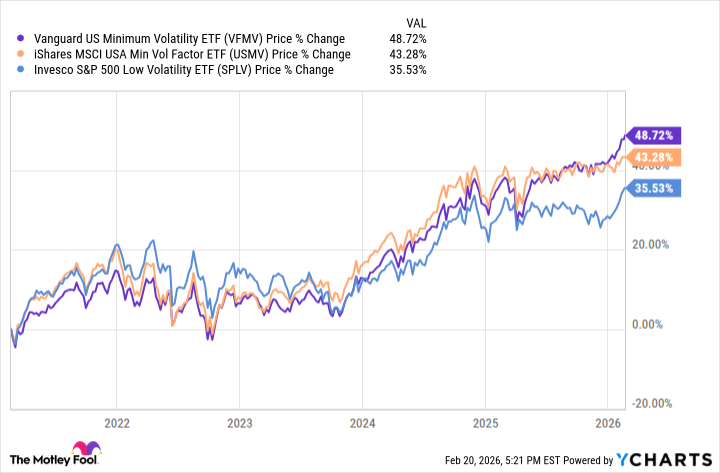
Perhaps that outperformance is an endorsement of the marriage of active management and low volatility investing. While Vanguard pioneered the index fund revolution, it also offers a broad suite of actively managed funds, including the minimum-volatility ETF. In this case, a quantitative model is used to identify domestic stocks with favorable volatility traits.
For investors who care more about the end product than how the sausage is made, it should be noted that this Vanguard ETF departs from some of its passive competitors. While the fund is overweight on typical "low vol" sectors, such as consumer staples, real estate, and utilities, relative to the Russell 3000 index, it allocates more than a quarter of its weight to tech stocks. Additionally, just 28% of this ETF's holdings are also members of the S&P 500 Low Volatility index, confirming that this Vanguard refreshes the minimum volatility investing proposition.

NYSEMKT: VFMV
Key Data Points
This ETF has long-term appeal
One mistake many new investors make is conflating higher risk with better rewards. The reality is the opposite: Lower-beta stocks have delivered better risk-adjusted returns over long holding periods, potentially highlighting the value of this Vanguard ETF.
Speaking of value, lower-beta stocks currently trade at discounts relative to their higher-volatility peers, indicating investors don't have to pay up to access this ETF's perks. There's more value to be had because the annual fee on this fund is just 0.13%, or $13 on a $10,000 position, which is well below average for actively managed funds.