Right now, one of the biggest debates in the stock market is this: Are artificial intelligence (AI) stocks overvalued? A new survey of institutional credit investors from Bank of America sheds some light on this debate.
According to Bloomberg reporting from Tuesday, Feb. 24, research from BofA strategists found that 23% of investment-grade credit investors say "the threat of an AI bubble" is their biggest concern. That's up from 9% in December 2025.
Let's look at why this credit investor survey could be bad news for AI stocks.
Image source: Getty Images.
AI companies might be borrowing too much money
The BofA survey tracked the opinions of credit investors from big institutions like insurance companies, hedge funds, and pensions, who are getting worried about an AI bubble. That matters, because these big investors manage significant amounts of money and buy lots of bonds. They follow industry trends and how much money companies are borrowing.
Investment-grade corporate bonds are generally seen as low risk for credit investors because they rarely default on their debts. Big, stable, profitable companies that have steady cash flow are usually able to repay their debts. That's why they can issue bonds (borrow money) at low rates of interest.
But if a company starts to borrow more money than it can comfortably afford to repay, or if the economy changes in a way that damages the company's business model or reduces the company's valuation, bond investors get nervous. The company's debt starts to look riskier. Interest rates on the company's debt go up. Some companies might see their credit rating downgraded by ratings agencies from investment-grade to high-yield speculative-grade (or "junk") bonds.
Big tech companies are spending $700 billion on AI in 2026
Based on recent announcements, CNBC reports that the four largest AI hyperscalers, Alphabet (GOOG 1.69%)(GOOGL 1.67%), Microsoft (MSFT 0.73%), Meta Platforms (META 2.52%) and Amazon (AMZN 1.52%), are on track to spend about $700 billion in 2026 on AI-related capital expenditures. That includes costs like AI data centers, semiconductor chips, and networks.
None of these big, profitable companies has seen their credit rating downgraded so far. But all four hyperscalers' share prices are down year to date.
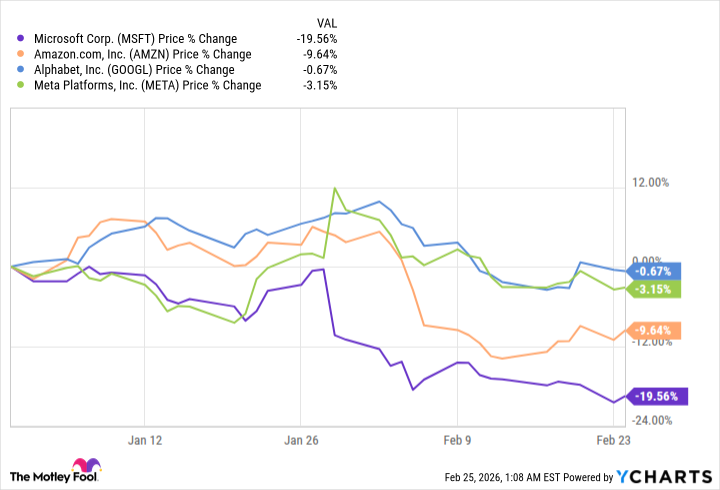
Stock investors are showing signs of concern that these expensive investments in AI infrastructure might not pay off. If $700 billion of AI data centers and digital infrastructure don't lead to profitable products and big ROI sometime soon, that would be bad news for AI company shareholders and bondholders.
How to protect yourself from an AI bubble
If you're worried about an AI bubble but don't want to leave the stock market, here are two possible moves. You might consider shifting some of your portfolio toward value stocks, like the Vanguard Value ETF (VTV 1.20%), or small-cap stocks like the iShares Russell 2000 Growth ETF (IWO 2.69%).

NYSEMKT: VTV
Key Data Points
Both ETFs let you own thousands of stocks in different areas of the stock market that should have less exposure to AI, and both are outperforming the hyperscalers year to date. There's no such thing as a "safe" stock or ETF. But if you want an easy alternative to AI stocks, these stock ETFs could be a good choice for long-term investors.