When it comes to the artificial intelligence (AI) boom, few companies are as central to it as Nvidia (NVDA -1.84%) and Amazon (AMZN +0.27%). Even more, both companies have seen their revenue growth rates accelerate recently.
Still, if you were to judge strictly by the two companies' growth rates alone, choosing between the two would be easy. Nvidia posted a staggering 73% year-over-year revenue increase to $68.1 billion. And Amazon's sales rose 14% to $213.4 billion, reflecting a more diversified operational base.
Of course, there's more to the story.
Let's look closely at the underlying businesses to see which stock is the more compelling buy.

Image source: Getty Images.
Nvidia: Incredible growth but high expectations
There is no denying that Nvidia's business momentum is astounding. The chipmaker's fiscal fourth-quarter results were driven by its data center segment, which saw revenue rise 75% year over year to a record $62.3 billion. This segment, driven by AI demand, now accounts for the vast majority of the company's overall sales.
Interestingly, however, the stock actually fell after the company reported these impressive results late last month -- a reaction that highlights a core challenge for the stock: expectations are high.
Fortunately, management expects continued strong growth in the near term. It expects fiscal first-quarter revenue of about $78 billion, representing 77% year-over-year growth. This would mark yet another quarter of accelerating top-line momentum for the company.
But there's concern about Nvidia's longer-term growth prospects, given the semiconductor industry's cyclical nature. If cyclical demand for AI infrastructure eventually cools, or if hardware competitors chip away at Nvidia's pricing power, the company's elevated profit margins could compress. The stock's higher valuation of 37 times earnings, combined with the market's concerns about the sustainability of these growth rates in a cyclical industry, means that any misstep could lead to a significant rerating of the stock's valuation multiple.
Amazon: Diversified resilience
Amazon's AI story is anchored by Amazon Web Services (AWS), its cloud computing division. AWS is the critical infrastructure layer where many enterprises actually build and deploy their AI applications.
The financial momentum in this segment is clear. In Q4, AWS sales increased 24% year over year to $35.6 billion -- an acceleration from 20% growth in Q3.
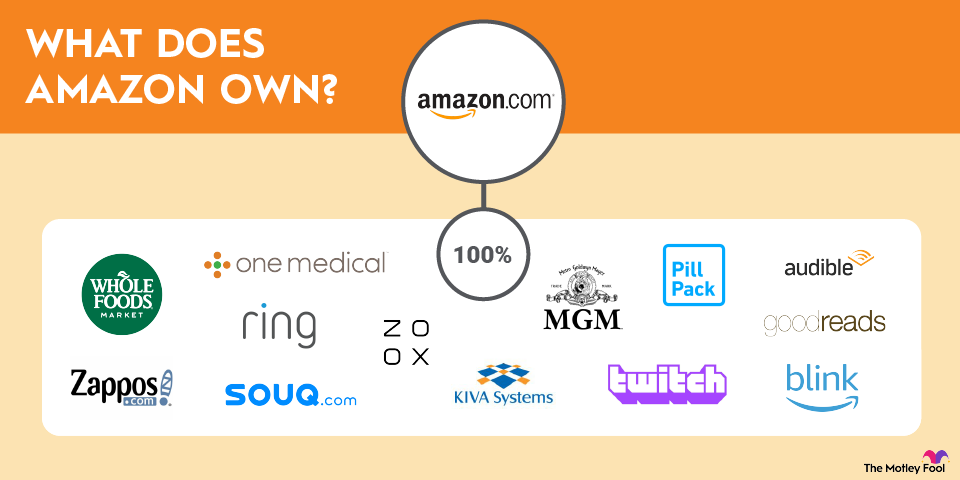
Not only is its cloud business benefiting from an impressive acceleration, but Amazon's strength is broad-based.
Not only is its cloud computing business growing rapidly (the fastest in 13 quarters), but its e-commerce sales rose 10% year over year, third-party seller services increased 11%, advertising revenue increased 23%, and subscription services rose 14%.
In addition, unlike Nvidia, Amazon's business is built on lower margins. While this might sound like a disadvantage, it means there is significantly less room for margin compression compared to Nvidia, which boasts a 75% gross margin.
Which is the better buy?
Both companies are undeniably strong businesses riding massive technological tailwinds.
However, investing is about balancing potential upside with the likelihood of long-term durability.
Nvidia is a phenomenal enterprise, but its financial results are heavily concentrated in a single, highly cyclical sector. As history in the semiconductor industry has shown, boom cycles are often followed by periods of digestion and slower growth.
Amazon, on the other hand, offers investors more durability. Its business is less cyclically sensitive and vastly more diversified across different sectors of the global economy. And by anchoring its retail operations in low pricing, it minimizes the risk of pricing power erosion over time. And, not to mention, the stock trades at a cheaper valuation of 30 times earnings.
If I had to choose between the two stocks, I'd buy Amazon. The company's diverse revenue streams and structural resilience arguably make it the more durable investment for the long haul.