Investors face a psychological issue when considering Carvana (CVNA +0.84%). It has obliterated the market over the past three years soaring right around 4,300%, compared to the S&P 500's respectable 70% gain.
Which raises the question: Have investors missed the boat on riding the stock higher? Let's look at two graphs that emphasize how much more room Carvana has to run, and where it's heading in the near term.
Carvana's margins on the rise
Carvana has mostly completed its pretty impressive transformation. Three years ago, the used-car retailer was on the brink of bankruptcy, as you can see in the plunge in net income below, and had to reverse its growth-at-all-costs strategy to double down on more profitable sales and growth.
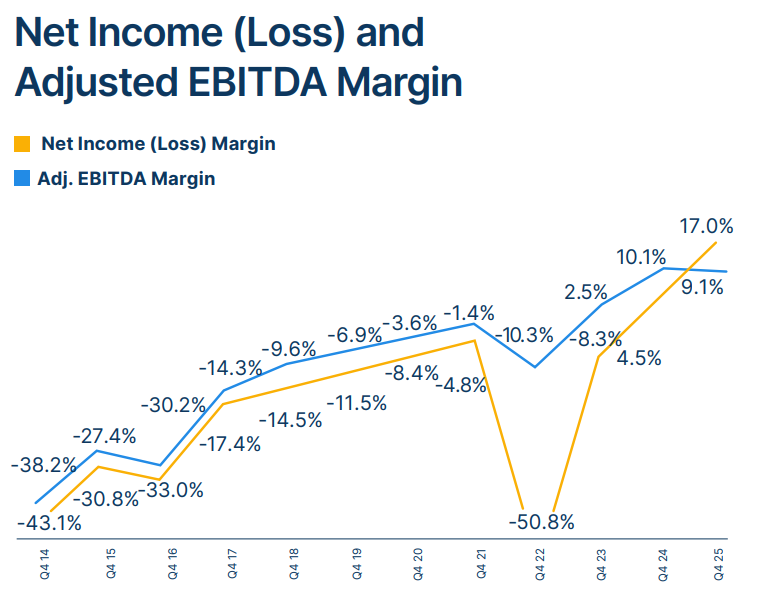
Image source: Carvana introduction presentation. EBITDA = earnings before interest, taxes, depreciation, and amortization.
Rather than vaguely say Carvana can improve operations to further boost margins, let's look at one of many examples. Its reconditioning costs came in higher than expected during the fourth quarter of 2025, and management often found higher reconditioning costs linked to locations with the lowest management tenure.
This is an opportunity to use data-driven software, perhaps with an artificial intelligence (AI) buzzword or two, to help streamline workflows and decisions. If the company can use such software to improve performance, investors will see margins rise.

NYSE: CVNA
Key Data Points
For context, if all its production locations had per-unit costs in line with the top quartile of locations, the fourth-quarter reconditioning cost per unit would have been $220 lower during the quarter. Those costs can add up, especially considering fourth-quarter total gross profit per unit (GPU) was $6,427, a decline of $244 per unit compared to the prior year.
Consolidation is coming
The automotive industry is many things, but it is certainly a massive chunk of the U.S. economy, and it's also highly fragmented and can be regional. Carvana is the U.S.' second-largest used-car retailer, and the company still accounts for only a paltry 1.6% of the industry.
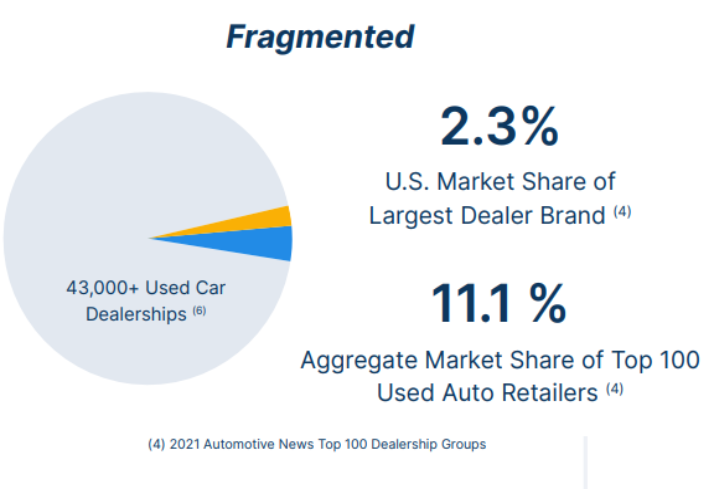
Image source: Intro to Carvana presentation.
It is a huge advantage for Carvana that a consumer visiting a typical dealership primarily only has access to that lot's inventory, and that simply logging on to the company's e-commerce platform can skyrocket that number to tens of thousands of vehicles in its inventory that can be delivered as if they were at a dealership near you.
Currently, larger dealership groups, which are still small and often regional, are working to build more effective e-commerce platforms to try to provide the value Carvana offers. And one of its recent moves was to buy six Stellantis dealerships, opening the door to new-car sales but -- more importantly -- trade-in inventory and parts and service recurring revenue with higher margins.

Image source: Carvana.
There is a clash coming between traditional brick-and-mortar retailers and e-commerce retailers that will force industry consolidation, and Carvana is well-positioned with its national branding, distribution network, and e-commerce-focused platform working as efficiently as they ever have.
What does it all mean for Carvana stock?
The graphs featured above are two indicators of where the business is currently, as well as where it can go from here. There is plenty of opportunity for growth to continue at a high level between low-hanging fruit in operational efficiency (remember the reconditioning-cost example) and from industry consolidation that will boost market share and scale.
Carvana's stock has soared over the past three years, and while investors might have missed those gains, there could be plenty more ahead.