It's a myth that you need to trust your money with Wall Street pros -- the "suits," as some call them -- to make a profit in the stock market. The truth is that investing often works best when you keep things simple.
There's no better illustration of that than the S&P 500 index, a basket of 500 of America's most prominent companies that has arguably become the most famous investing benchmark for the U.S. stock market.
One popular, low-cost exchange-traded fund (ETF) that tracks the S&P 500 is the Vanguard S&P 500 ETF (VOO -0.43%). Its 0.03% expense ratio amounts to just $0.30 per $1,000 invested, and you can invest as little as $1 at a time if you want. Here are two reasons it could outperform those fancy actively managed funds this year.
Image source: Getty Images.
1. The S&P 500 wins, and wins frequently
Studies have shown that over 80% of actively managed funds fail to outperform their benchmarks over 10 years, and I'd wager that percentage shrinks the further you look out. Why? Two reasons.
First, active managers typically charge higher fees, as high as 1% or more. That's virtually an entire percentage point compared to the Vanguard ETF. It doesn't look like much, but that single point can compound into a sizable drain on your portfolio over many years.
Second, no investing strategy or market sector works all the time. Growth and value stocks will take turns performing well, as will different companies in various industries.
As smart as the professionals might be, even they cannot know for sure what will happen in the future. Therefore, it's almost impossible to predict and invest accordingly. And even if you guess correctly, getting the timing wrong can make that irrelevant.

NYSEMKT: VOO
Key Data Points
2. The index has already shown its resiliency in a chaotic market
Just think about all of the uncertainty in the world right now:
- There is war in the Middle East, with headlines frequently moving markets.
- Oil prices are all over the place, potentially impacting prices throughout the economy.
- Artificial intelligence is rapidly improving, and it's uncertain how that might affect workers or entire companies.
- Many Americans are struggling financially, and some might argue that the U.S. economy is already in a recession.
The "Magnificent Seven" stocks, megacap tech companies that account for about one-third of the S&P 500, are down significantly from their highs. Yet the S&P 500 index itself is still down by only 6%.
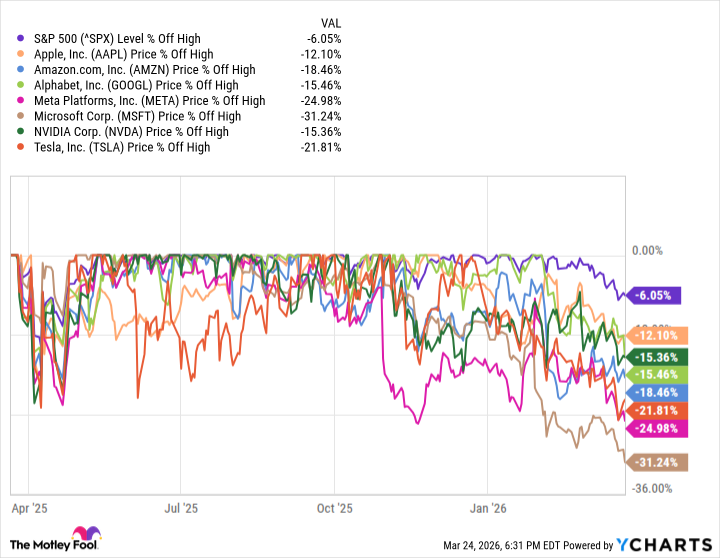
Fund managers have their work cut out for them this year, navigating all the chaos. If anything, it seems a good defense is the smartest strategy. The S&P 500, and by extension the Vanguard S&P 500 ETF, are certainly not immune to declines, but the ETF seems likely to fare better than fund managers trying to guess what might happen next in this market.