As the world embraces artificial intelligence (AI), and companies that provide development infrastructure are thriving, AI stocks are driving higher market gains. As a group, the industry is outperforming the market. One standard signal is the Nasdaq-100, which features trending tech stocks and is beating the S&P 500 this year. Many exchange-traded funds (ETFs) that focus on AI are doing even better. Consider the Roundhill Generative AI and Technology ETF, the iShares U.S. Power and Infrastructure ETF, and the Pacer Data and Infrastructure Real Estate ETF.
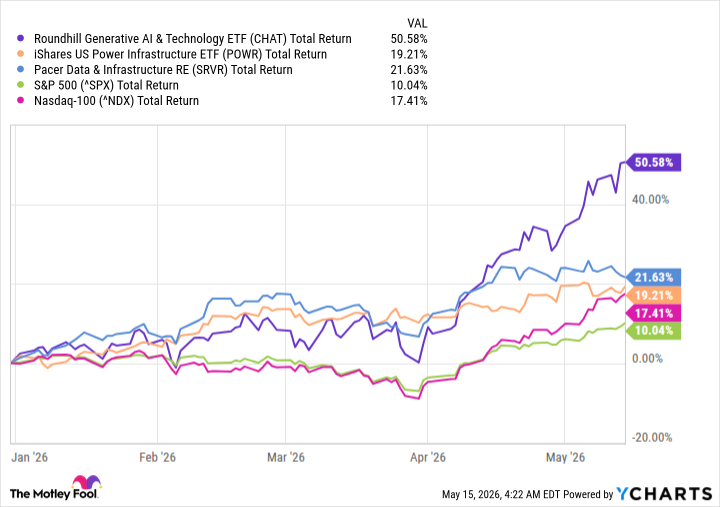
CHAT Total Return Level data by YCharts
It's only May, but several hot artificial intelligence stocks have already more than doubled. Take a look at Bloom Energy (BE +0.31%), Sandisk (SNDK -0.01%), Lumentum (LITE +6.48%), Micron Technology (MU -0.20%), and Intel (INTC -0.72%).
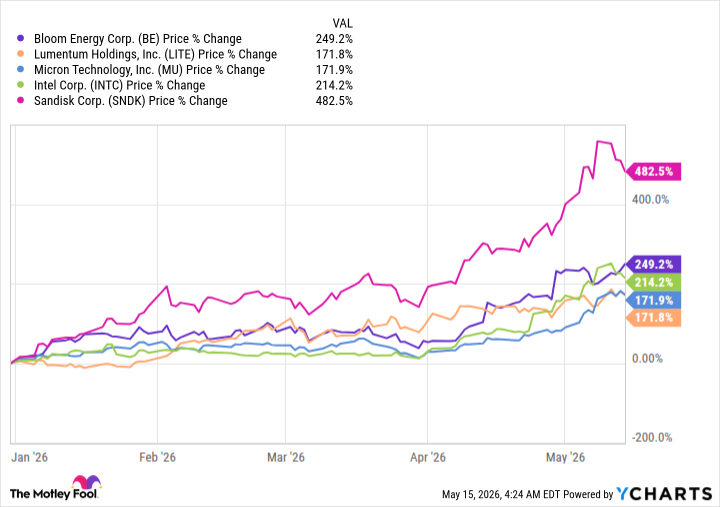
Here's why they can still go higher.
1. Bloom Energy
Bloom Energy makes stand-alone energy servers using its proprietary fuel cell technology that can power organizations off the electric grid. It has been in operation for 25 years, serving a wide range of industries, from retail to space. However, it's exploding in the AI era, as it can be easily deployed and scaled to power high-performance data centers.

NYSE: BE
Key Data Points
It has been reporting phenomenal performance. In the first quarter, revenue inreased 130% year over year, and management raised full-year guidance from a 60% increase to an 80% increase. Operating cash flow turned positive, increasing $184.3 million to $73.6 million. Bloom has been unprofitable for most of its life, and this sales jump is finally pushing it into profitable territory, with $70 million in net income in the quarter.
2. Sandisk
Sandisk has been the AI story of the year as its NAND flash memory products become more in demand for data storage. While AI companies need a wide range of memory products, SanDisk's specific technology can retain data without a continuous power source.

Image source: Sandisk.
Revenue has been accelerating as demand soars and prices rise. In the 2026 fiscal third quarter (ended April 3), revenue increased 251% year over year, driven by a 233% increase in data center revenue. Operating income increased 319% to more than $4 billion.
So far, management is expecting this to continue. It's guiding for revenue to grow sevenfold in the fourth quarter, and for adjusted earnings per share (EPS) of around $30, up from a $0.30 loss per share last year.
3. Lumentum
Lumentum makes optical products that are crucial for high-speed data centers. It's one of the infrastructure providers that help move large amounts of data over broadband networks, connecting servers at a lower cost.
Like the other companies on the list, Lumentum had a completely different business servicing other technologies, like medical equipment and manufacturing, but data centers are driving the business right now.

NASDAQ: LITE
Key Data Points
In the 2026 fiscal third quarter (ended March 28), revenue increased 90% year over year, and the company reported a generally accepted accounting principles (GAAP) operating profit, up from a loss last year. CEO Michael Hurlston said, "As our key growth drivers of co-packaged optics and optical circuit switches begin to kick in, we would expect further increases in earnings power."
4. Micron Technology
Micron also makes memory chips, and it's been in this business for a long time. Many types of technology rely on memory chips to operate, such as computers and smartphones, and Micron makes DRAM memory chips that power short-term memory and high-bandwidth memory (HBM) chips. It also sells NAND memory chips.

Image source: Micron.
Since these are necessary components of AI chips, the business has been skyrocketing. Revenue increased 70% year over year in the 2026 fiscal second quarter (ended Feb. 26), and earnings per share rose from $4.60 to $12.07.
The company is benefiting from high demand and low supply, and management expects that to continue in the short term.
5. Intel
Intel had a massive technology business prior to the AI boom, but it began to fade into irrelevance when it failed to anticipate and respond to the changing tech landscape. Tech giants moved from Intel's central processing units (CPUs) to graphics processing units (GPUs) and other AI chips to drive AI development, and revenue was falling while margins contracted.

NASDAQ: INTC
Key Data Points
However, CPUs are in high demand again as they're necessary for high-inference workloads. Intel has made some important deals with large AI companies, and it's getting back to growth. Intel is backed by decades of tech leadership, and this could be a strong turnaround story in the coming months and years.