It's time to revisit the investment case for ON Semiconductor (ON +2.50%). The stock is up 114% year to date as I write, and many of the factors that made it a top stock to buy for 2026 remain in place today. However, valuations still matter, so is ON Semiconductor still a great stock for long-term investors? I think the answer is yes, and here's why.
The case for buying ON Semiconductor stock in 2026
The company's silicon carbide (SiC) and gallium nitride (GaN) power and sensing chips make it a leading player in the electrification of the economy. SiC and GaN possess properties that make them ideal for use in high-voltage and high-switching applications.
ON ON Semiconductor
NASDAQ · As of 4:00 PM ET 10/26/26

Going into 2026, the case for buying the stock was based on the near-term catalyst of the company passing an inflection point in both its automotive (electric vehicles, or EVs) and industrial end markets (such as factory automation). In addition, the company has a small but rapidly growing exposure to data centers (revenue up 30% sequentially in the first quarter), not least through its partnership with Nvidia to create chips for a new high-voltage class of AI data centers.
The chart below shows how the company has now returned to year-over-year growth, with all three of its end markets reporting growth. For reference, data center revenue is reported under "other" revenue.
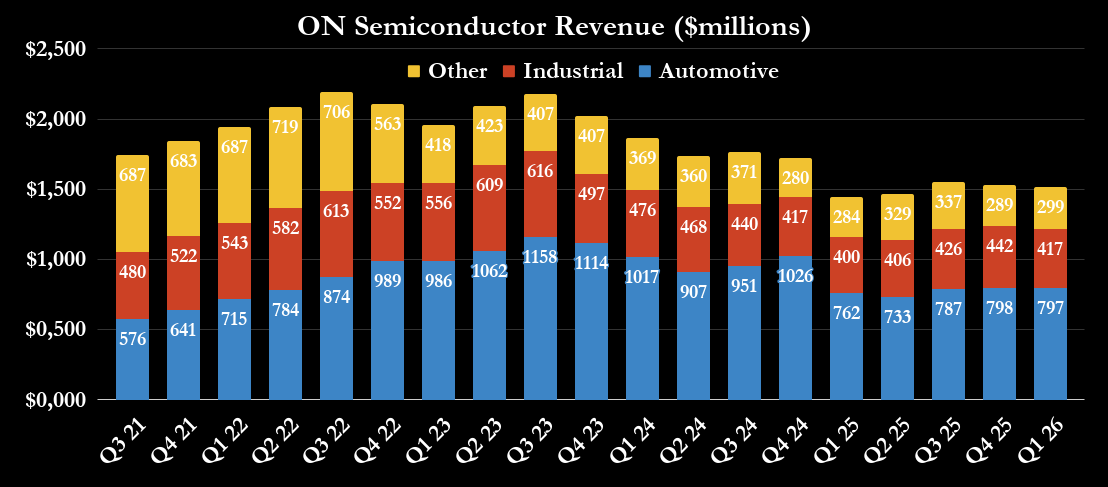
Data source: ON Semiconductor presentations. Chart by the author.
The long-term growth case for ON Semiconductor
The good news is that investors can expect revenue growth based on its exposure to the EV market. For example, CEO Hassane El Khoury disclosed that its "silicon carbide share of new EV models deployed at the 2026 Beijing Auto Show in April is approximately 55%," and he expects the company's "AI data center revenue to double year over year in 2026." AI spending is also supporting growth in the industrial sector's energy storage revenue, and ON Semiconductor has long-term exposure to growth in renewable energy and factory automation.
Valuation matters
Revenue growth is extremely important for a business like ON Semiconductor because it has relatively high fixed costs, so when revenue increases, more of it tends to flow through to profits. The key metric to follow is manufacturing utilization (output divided by full-capacity output), which El Khoury said increased to 77% in the first quarter.

Image source: Getty Images.
CFO Thad Trent believes a low 90% utilization represents "fully utilized," and the company will get there with a 25%-30% revenue increase in the coming years. That increased utilization will result in significant margin expansion before the company even needs to invest in expanding capacity.