For most of the 16 years since the end of the global financial crisis, the U.S. stock market has been perhaps the best place to invest. American companies from Silicon Valley to Wall Street have generated high profits, fast growth, and strong returns.
America's democracy, rule of law, leadership in science and innovation, and strong independent institutions like the Federal Reserve have created an investor-friendly climate. And people from around the world have wanted to send their money to America. Investors in U.S.-allied countries like Japan and Canada have bought significant amounts of U.S. stocks and bonds.
U.S. stocks have generally outperformed the rest of the world's. This trend in markets has been called "U.S. exceptionalism." You can see it by looking at the past 15 years of S&P 500 index returns vs. the returns of the Vanguard Total International Stock ETF (VXUS +0.86%):
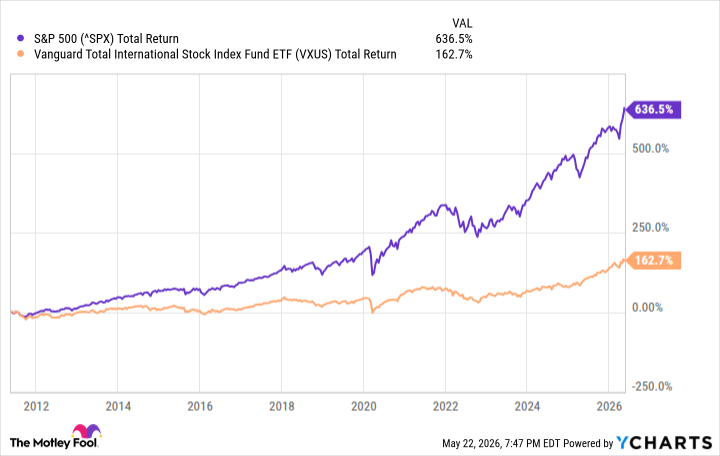
But America's investor-preferred status could be facing new threats. Fidelity research published in April says the U.S. exceptionalism narrative might have peaked.
Let's look at why the end of U.S. exceptionalism might be coming soon -- and why international stocks could be a better buy today.
What the end of U.S. exceptionalism could mean for investors
Fidelity research found that in 2025, America had a record-high "international investment deficit" of more than $25 trillion. That means the amount that other countries had invested in America was $25 trillion more than the amount America had invested in other countries. The biggest foreign holders of U.S. long-term securities are Europe ($17.3 trillion), Canada ($3.1 trillion), Japan ($3.0 trillion), and China ($1.2 trillion).

Image source: Getty Images.
What if those trillions of dollars of foreign capital inflows start to flow away from America? That could mean a weaker U.S. dollar. It could mean a decline in U.S. stock markets or slower growth for U.S. stocks than for international stocks.
This doesn't mean that America is doomed. The rest of the world can grow and prosper even if America stays "exceptional." But you might want to get in on this trend and buy international stocks.
IXUS: More than 4,000 global stocks, three years of 17.7% annualized returns
The iShares Core MSCI Total International Stock ETF (IXUS +0.90%) is a broadly diversified ETF that holds 4,162 international stocks from more than 20 countries. For the past three years (as of April 30), this international ETF has delivered average annual returns of 17.7%.

NASDAQ: IXUS
Key Data Points
In the past year it returned an impressive 33.7%, outperforming the S&P 500. And its expense ratio is low: 0.07%, which includes a management fee.
One concern that some investors have about the U.S. stock market today is that it's heavily weighted with just a few major tech names. The iShares Core MSCI Total International Stock ETF has broad diversification across sectors. Its top holdings are in financial stocks (22.2% of the fund), information technology (19.2%), industrials (15.2%), consumer discretionary (8.3%), and materials (7.7%).
American investors don't have to be 100% invested in American stocks. The iShares Core MSCI Total International Stock ETF could be worth adding to your portfolio.