Markets have been surging since April 1, which has created renewed concerns about the market's valuation. Some of the leading metrics, like the Shiller price-to-earnings (P/E) ratio, have spiked to near historic highs. Typically, when the market reaches a valuation that high, a correction or downturn follows.
By now, investors should know that volatility comes with the territory, but it has been even more pronounced in the past two years, as the wild swings in the CBOE's VIX volatility index would attest.
Thatʻs why itʻs more critical than ever to have a balanced, diversified portfolio. Within the equity universe, there are no better diversifiers than dividend- or income-generating stocks and exchange-traded funds (ETFs).
Image source: Getty Images.
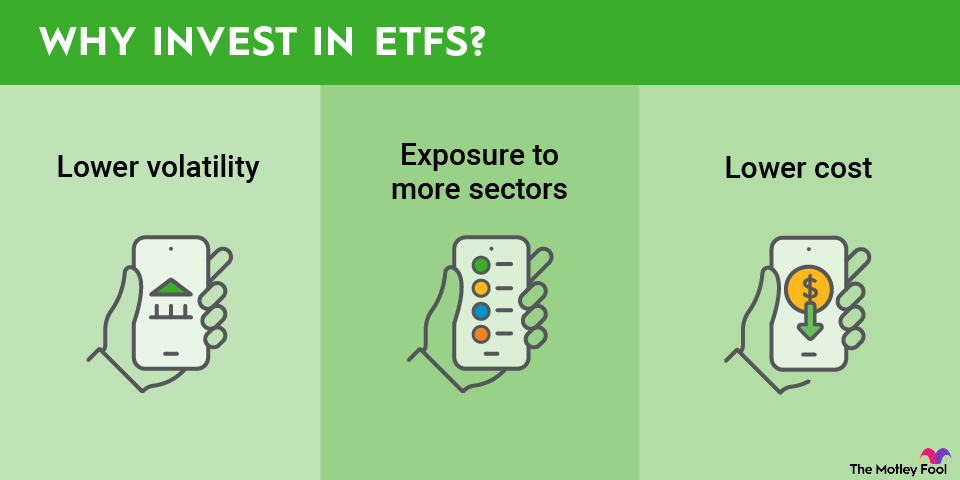
Dividend ETFs not only invest in more stable, highly liquid companies that tend to outperform when the market goes south; they also generate income. The high dividend yields can then be reinvested back into the fund to generate higher total returns. Here are two high-yield, dividend-paying ETFs that are perfect prescriptions for a volatile market.
1. Schwab U.S. Dividend Equity ETF
The Schwab U.S. Dividend Equity ETF (SCHD -0.33%) has been one of the top performers this year and not just among dividend ETFs. The fund is up about 18% year to date, as investors have flocked to its safety and reliable dividend income amid turbulent markets.
The ETF tracks the Dow Jones U.S. Dividend 100 index, which features high-yielding stocks of companies that have sustained at least 10 straight years of dividend payments and meet liquidity requirements. But then, that universe is whittled down to about 100 based on four fundamental screens -- cash flow to total debt, return on equity, dividend yield, and a 5-year dividend growth rate. They are weighted through a modified market cap approach.
Currently, the top-three holdings are Qualcomm, Texas Instruments, and UnitedHealth Group.

NYSEMKT: SCHD
Key Data Points
In addition, the ETF pays out a healthy dividend with a 30-day yield of 3.22% and a trailing-12-month yield of 3.29%. Thatʻs considerably higher than the roughly 1% average yield on the S&P 500. The yield can be reinvested back into the ETF to boost the total return, which could help if the market heads south.
To see the difference, SCHD has returned about 24% over the past 12 months; but with the dividend reinvested, it's 29%. Over the past 10 years, it has an average annualized return of 9%, but with the dividend reinvested, it's about 13%. That 4% to 5% per-year boost from the dividend reinvestment can make a huge difference, particularly when markets are down.
2. Vanguard High Yield Dividend Index ETF
The Vanguard High Yield Dividend ETF (VYM +0.32%) tracks the FTSE High Dividend Yield index, which is made up mostly of large- and mid-cap companies that pay higher-than-average dividends. The portfolio starts with stocks that have the highest projected 12-month yields, but then it includes stocks by descending rank until it reaches 50% of the universe's market capitalization, excluding real estate investment trusts (REITs). Then the portfolio is weighted by market cap,
So, the ETF holds about 608 stocks at present. It is predominantly made up of large-cap value stocks. Its top-three holdings are Broadcom, JPMorgan Chase, and ExxonMobil. While the latter two pay higher-than-average dividends, Broadcom is swept in by the 50% rule, and it becomes the largest holding because of its cap size.

NYSEMKT: VYM
Key Data Points
The Vanguard ETF has a lower dividend distribution rate than the Schwab ETF because of its structure. It has a 30-day yield of 2.25%. This year, the ETF is up about 11% year to date, and it has returned 26% over the past year on a total return basis. Over the past 5 years, it has had an average annualized return of about 11%, and over the past 10 years, it averaged a 12% return.
These are two tremendous dividend ETFs that capture different corners of the dividend universe. Both produce better-than-average yields and solid long-term returns, serving as terrific diversifiers in a portfolio.