Dividend ETFs can be some of the most productive parts of anyone's portfolio because you have guaranteed income (without the risks that come with individual stocks), as well as the chance for stock price appreciation. It's a two-for-one win in many cases.
For many people, one dividend ETF is enough to get the job done, but two popular dividend ETFs complement each other well and can be productive pieces in your portfolio. They're the Schwab U.S. Dividend Equity ETF (SCHD +0.00%) and the Vanguard Dividend Appreciation ETF (VIG +0.47%). If you're able to invest in both, you can get exposure to the best of both dividend worlds.
Image source: Getty Images.
Approaching dividends from different angles
A good dividend ETF does more than just look for companies with the highest yields and put them together in a fund. They have set methodologies for choosing companies that make their specific fund unique. SCHD emphasizes "high-quality" companies. To be eligible, a company must check the following boxes:
- 10 consecutive years of dividend increases
- A good financial standing (good cash flow compared to debt, a good return on equity, etc.)
- Be a minimum size and have high liquidity

NYSEMKT: SCHD
Key Data Points
VIG places greater emphasis on companies with impressive dividend growth records. That doesn't mean it doesn't care about quality. A company must still be in good financial health and show dividend consistency. However, its approach means its make-up is a bit different than SCHD and others. Here is how the two ETFs are divided by sector:
| Sector | Percentage of VIG | Percentage of SCHD |
|---|---|---|
| Information technology | 28.4% | 11.1% |
| Financials | 20.3% | 9.0% |
| Healthcare | 16.5% | 18.8% |
| Consumer staples | 9.5% | 19.4% |
| Industrials | 11.7% | 11.5% |
| Consumer discretionary | 4.2% | 6.4% |
| Energy | 3.1% | 16.9% |
| Materials | 3.4% | 0.0% |
| Utilities | 2.9% | 0.04% |
| Communication services | 0.0% | 6.9% |
Data sources: Vanguard and Charles Schwab. Percentages as of May 31.
Why these ETFs complement each other well
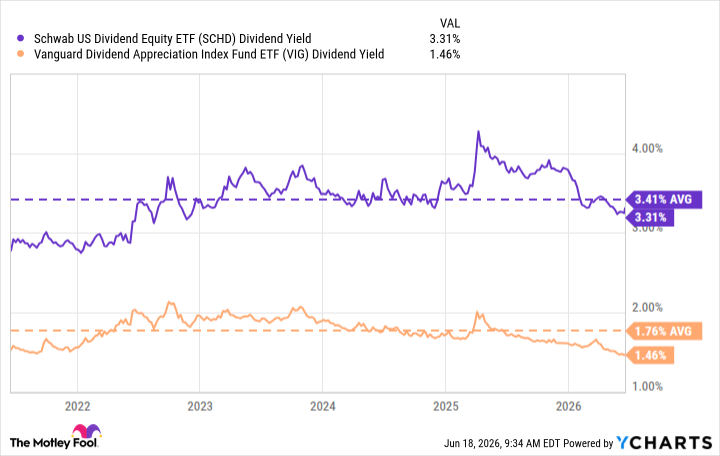
SCHD has consistently offered a higher dividend yield than VIG and, ironically, has increased its dividend by much more over the past decade (143% versus 87%).
SCHD Dividend Yield data by YCharts
What VIG has going for it, though, is that it has been much better for stock price appreciation due to its concentration in tech stocks. VIG's top three holdings are Broadcom, Apple, and Microsoft, all of which have grown impressively over the years.

NYSEMKT: VIG
Key Data Points
SCHD's top three holdings are Texas Instruments, Qualcomm, and UnitedHealth Group, which have also grown impressively, but not at the consistent rate of the big-name tech stocks that VIG holds.
By investing in both SCHD and VIG, you get the high guaranteed income that comes with SCHD and the stock appreciation opportunities that come with VIG. Having both in your portfolio is the best of both worlds, and you don't have to worry about too much overlap between them.