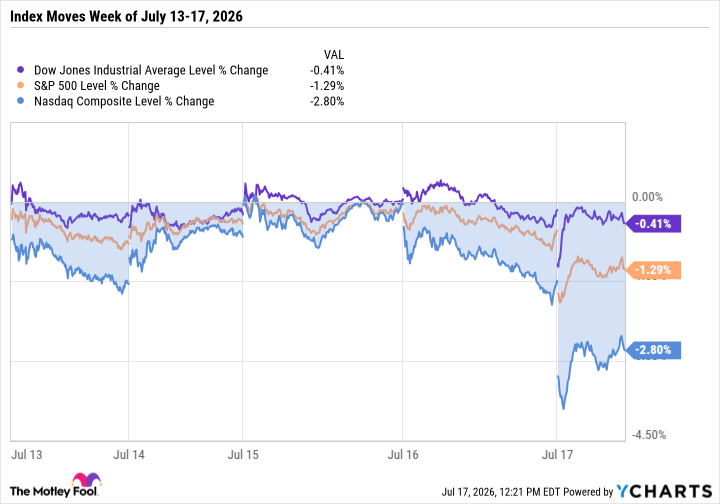
Friday morning started on a bearish note. The Nasdaq Composite (^IXIC -2.15%) was down 1.1% as of 12:21 p.m. ET after dipping as much as 2.2% around 10 a.m. ET, capping a week that chip stock investors would probably like to forget. The S&P 500 (^GSPC -1.09%) fell 0.7%, while the Dow Jones Industrial Average (^DJI -0.34%) held its losses to just 0.3%, thanks largely to an insurance company having a very good quarter.
For the week, the Dow is nearly flat with a 0.4% drop. The S&P 500 is down 1.1%, and the Nasdaq has dropped 2.5%. If you owned an equal-weighted index fund, you barely noticed. If you owned the mega-cap tech darlings, it's been a painful week.
From the Korean crash to a Friday fall
Let's start with a quick recap of the week.
- It began with a historic crash in South Korean markets that triggered circuit breakers and sent the recently U.S.-listed SK Hynix (SKHY -6.58%) stock tumbling.
- Tuesday brought IBM's (IBM -0.85%) worst day since 1987 after the company admitted customers were redirecting software budgets toward hardware purchases.
- Wednesday's encouraging inflation data sparked a morning rally that faded by midday.
- Thursday's sell-off accelerated after Taiwan Semiconductor Manufacturing (TSM -2.28%) raised its capital expenditure forecast to as much as $64 billion, stoking fears that AI infrastructure spending is becoming unsustainable.
There's plenty of drama in Friday's session, too.
Alphabet (GOOG -2.32%) (GOOGL -2.47%) fell 2.2% today, its third straight decline after reports that its Gemini AI model is running months behind schedule. Meta Platforms (META -3.72%) dropped 2.9% as investors digested an employee lawsuit over AI-assisted layoffs and continued to worry about the company's $125 billion to $145 billion spending plans.
Space Exploration Technologies (SPCX -1.74%) tumbled 5%, now trading around $125 after going public at $135 just weeks ago. A lockup expiration looms after the company's first earnings report, potentially flooding the market with nearly a billion additional shares.
Netflix (NFLX -2.87%) dropped 8.5% after delivering results that met expectations but apparently weren't exciting enough. The company also said it would publish its engagement reports less frequently, which investors interpreted as "we'd rather you not look too closely." Most streamers never issue detailed viewing reports at all, but it's still hard to overlook a sparser reporting schedule.
Image source: Getty Images.
The Dow's savior was Travelers (TRV +1.47%), which jumped 7.9% after posting earnings of $10.26 per share. That's nearly double what analysts expected. UnitedHealth Group (UNH -1.29%) added 2.2%, continuing its bounce from earlier weakness.
Oil prices surged 3.6% as the U.S.-Iran conflict showed no signs of cooling. The U.S. completed its sixth consecutive night of strikes, Iran expanded attacks to Syria and Bahrain, and reports emerged that Tehran has asked Houthi allies to close the Red Sea if Washington targets Iranian power plants.
In the day's strangest reversal, SK Hynix swung from down 6.7% to up 7.1% -- a 13-percentage-point round trip that captures the week's mood perfectly.
NASDAQ Composite Index
Key Data Points
Stepping Back
This week, investors started asking uncomfortable questions about AI spending. Strong earnings from banks and insurers couldn't offset the anxiety around chip stocks and mega-cap tech.
The Dow's resilience is cold comfort if your portfolio is heavy on Nvidia, Alphabet, and SpaceX. The AI investment thesis hasn't changed, but the market is demanding more evidence that the spending will pay off.
It's a familiar lesson for long-term investors. Volatility is the cost of owning growth stocks.