Some things just don't make sense. Why is Widow's Bay considered a comedy? I just watched it on vacation. It's a great show, but it got an Emmy nomination for best comedy, and it's not one -- at least, not to me.
It is also somewhat perplexing to see Walmart (WMT +0.71%) stock down 17% since May and only up 1% year to date. Its fortunes have improved somewhat over the past week, as it had been down 1% for this year as of late July.
It's a head-scratcher because main rivals Target and Costco Wholesale have seen double-digit returns year to date. Also, Walmart had a strong first quarter, with revenue up 7% and comparable-store sales rising 4% year over year. A 26% spike in e-commerce helped fuel the gains. In addition, adjusted operating income rose 5%, and adjusted earnings per share increased 8%.

Image source: Getty Images.
It also doesn't make much sense, since this is the type of environment where Walmart outperforms. Its low prices and discounts tend to attract more customers when inflation is high and growth is slower, as people are looking to cut back on expenses.
It should be a perfect storm for Walmart, but for some reason, it's not. Here's the only reason I can think of now.
Down from an all-time high
On May 18, Walmart stock reached an all-time high of $135 per share, and on May 19, it closed at $134 per share. This was in anticipation of strong first-quarter results, expected to be released on May 21. The results were strong, as noted, but the stock price dropped about 8% after earnings were released and continued to fall to a recent low of $108 per share on July 23.
The reason it has dropped since then is multiple. Walmart's P/E ratio spiked to a five-year high of 48 on April 30 following a great stretch for the stock that brought it to an all-time high. For the five years leading up to the May 19 all-time closing high, Walmart stock averaged an annualized return of 23%, beating both the S&P 500 and Nasdaq Composite.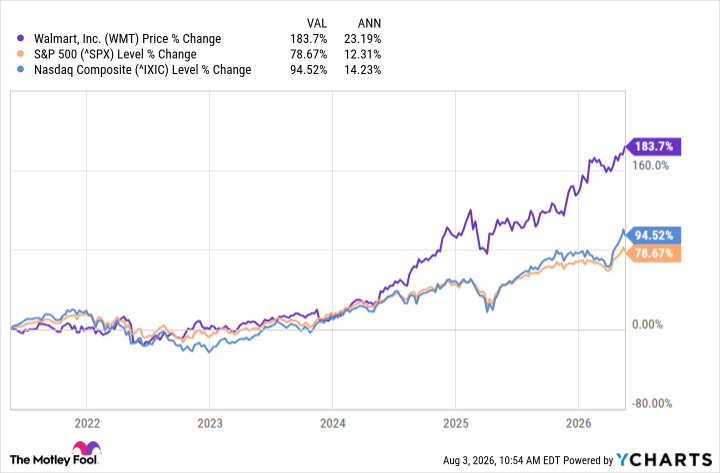
And over the past three years, from May 19, it had an annualized return of 39%, nearly doubling the S&P 500's 20% performance and beating the Nasdaq's 27%.
So, given the extremely high valuation and somewhat tepid outlook for the rest of the fiscal year, investors decided to cash out. While Walmart didn't change its sales, operating income, or earnings guidance for the full fiscal year, all were below analysts' estimates. Given the high multiple, investors were hoping for Walmart to raise its guidance to sustain the high P/E ratio, but it didn't happen.

NASDAQ: WMT
Key Data Points
So, is Walmart a buy now on the dip? I still don't think so. The valuation is too high for a mature consumer staples stock with steady, consistent, but not spectacular growth numbers. Walmart is currently trading at 39 times earnings, well above the 10-year average of 32. It makes sense to hold off and wait for a better entry point.