Micron Technology (MU -0.27%) is an odd stock. While it has risen an incredible amount this year (up 214% in 2026), its valuation on multiple metrics still looks dirt cheap. There are a few reasons for this, and it raises the question: Has the stock become too cheap to ignore?
Let's take a look at why Micron's stock appears as cheap as it does and see whether this is a generational buying opportunity or a value trap.

Image source: The Motley Fool.
Micron's business is cyclical
Micron produces memory chips, which are used in just about every computing device. It produces both types of memory: DRAM and NAND. DRAM is high-speed memory that's utilized in computing devices for rapid memory access, while NAND is often used in long-term storage applications. Regardless, both types are in high demand thanks to AI data center build-outs. The primary issue here isn't demand.

NASDAQ: MU
Key Data Points
There isn't one factor that sets Micron's product apart from its competitors. Most memory products are interchangeable, and end users don't care if they're using memory from Micron or another supplier. This makes the memory chip industry commoditized, which can be difficult to operate and invest in.
The reason for Micron's latest success is soaring memory chip prices. There is currently a supply shortage, so prices are moving higher. Micron is building some additional production capacity, but not enough to meet the growing demand. So its revenue and profits are soaring as customers outbid each other to gain access.
This supply/demand imbalance won't last forever, as either demand will drop or supply will increase enough, and prices will stabilize. Micron is actively working to increase its production capacity and plans to have another factory online between mid-2027 and late 2028. This increase in production capacity is the right thing to do, although it could cause the price of its products to fall.
As a result, the market doesn't fully value Micron's stock because it's worried about an inevitable demand drawdown. So, it has a low valuation of 5.7 times fiscal year 2027 earnings (ending August 2027).
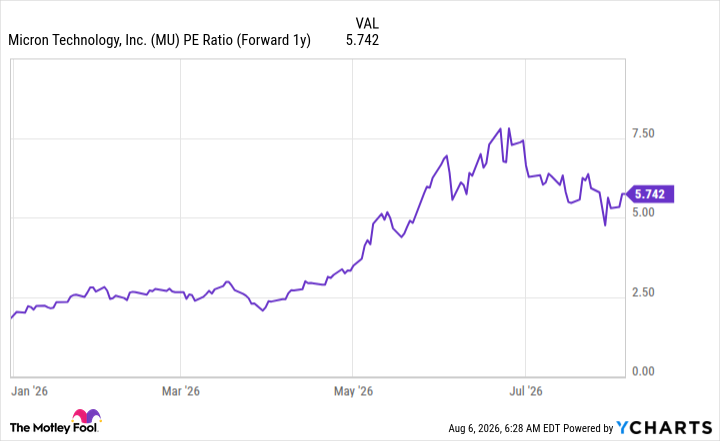
Data by YCharts.
However, if you look at Micron's average trailing P/E ratio over the past decade, it's 22. So, even if Micron's stock rises to half of its average valuation, the stock could double by the end of fiscal year 2027.
Any time you can secure a stock that doubles in the next year, it's a no-brainer buy for investors. However, this isn't a set-it-and-forget-it stock. Instead, investors must monitor the situation in the memory chip market. If prices start to tumble, Micron's stock will follow suit, and it will be time to re-evaluate.