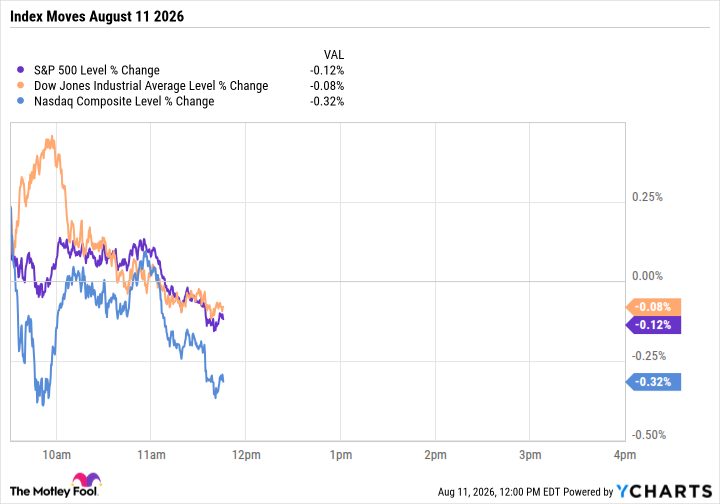
Wall Street is saving its energy for Wednesday morning's inflation report, which should decide where this calm market goes next. Meanwhile, the top stock market indexes look pretty quiet again.
The Dow Jones Industrial Average (^DJI -0.31%) is down 0.08%, the S&P 500 (^GSPC -0.02%) has given up 0.12%, and the Nasdaq Composite (^IXIC +0.01%) is off by 0.32%. The Dow got out to a 0.4% lead early and spent the rest of the morning giving it back, while the Nasdaq never really got going. None of the moves is particularly large.
Oil climbs while Alphabet and Amazon drag
Energy remains the macro story to watch.
Iran restated that the Strait of Hormuz will remain shut until its conditions are met, including sanctions relief and compensation. President Trump answered by demanding 50 years of reparations. Those two positions are not particularly compatible, and oil prices edged higher in response. West Texas Intermediate crude rose about 1.4% past $83 per barrel, and the United States Oil Fund (USO +2.86%) gained 0.9%.
Two mega-caps account for most of the index's downdraft today. Alphabet (GOOG +1.20%) (GOOGL +1.34%) fell 2.2%, subtracting roughly 47 Dow points and 0.17 percentage points from the Nasdaq Composite. Amazon (AMZN +0.04%) matched that 2.2% drop, taking another 0.12 points off that index. Together, they account for nearly the entire 0.32% Nasdaq decline. Neither company reported major news this morning, and their moves were still low-single-digit market noise.

Image source: Getty Images.
Memory chips are a mixed bag. Micron Technology (MU +0.81%) chief business officer Sumit Sadana spoke at KeyBanc's tech conference on Monday, saying the memory shortage will extend well past 2027. Customer demand signals have climbed since the last earnings report, and data center buyers often cannot get even half of the DRAM they request.
That's from an industry where the leading names run their own chip manufacturing lines rather than relying on third-party foundries. Memory makers aren't waiting in line for manufacturing capacity.
Nvidia (NVDA -0.41%), meanwhile, is reportedly considering using less high-bandwidth memory in a forthcoming chip design to protect its margins. That story moved markets yesterday.
But Micron's and Nvidia's narratives don't seem to align, so memory-stock investors are hedging their bets. SK Hynix (SKHY -1.54%) jumped 2.6% while Micron slipped 0.8%.
On the Dow, Caterpillar (CAT -0.83%) rose 1.4% and added roughly 72 index points, the day's largest positive contribution. Honeywell International (HON -0.37%) fell another 3.3%, costing about 48 points as it works through last Thursday's earnings miss. In total, that offset is why the Dow held up better than its peers.
S&P 500 Index
Key Data Points
Why the indexes are red while most stocks are green
The most interesting number today isn't in the headline indexes. The Invesco S&P 500 Equal Weight ETF (RSP -0.50%) rose 0.31% while the cap-weighted Vanguard S&P 500 ETF (VOO -0.09%) fell 0.12%. The typical stock is up; the largest ones are dragging the averages down.
That's a full reversal of July, when two or three mega caps often propped up indexes while the average stock was swooning. Same market, opposite machinery.
Wednesday's Consumer Price Index (CPI) (CPI) report is the week's actual event. Forecasters expect headline inflation near 3.4%, down slightly from 3.5% in June, though rising crude prices complicate that outlook. A soft print supports the case for the Fed to keep holding interest rates steady; a hot one would revive the hawkish argument.