The American consumer has been carrying this economy for months. Friday morning brought two reports suggesting the load is getting heavy. Stocks responded with a slow, unglamorous slide.
The Nasdaq Composite (^IXIC -0.40%) is down 0.44% as of 12:00 p.m. ET, the Dow Jones Industrial Average (^DJI -0.11%) has slipped 0.21%, and the S&P 500 (^GSPC -0.21%) is off 0.19%. All three hovered around the flatline for the first half hour, turned negative shortly after 10 a.m. ET, and ground steadily lower until about 11:30. The Nasdaq broke away from the other two mid-morning and fell roughly twice as far.
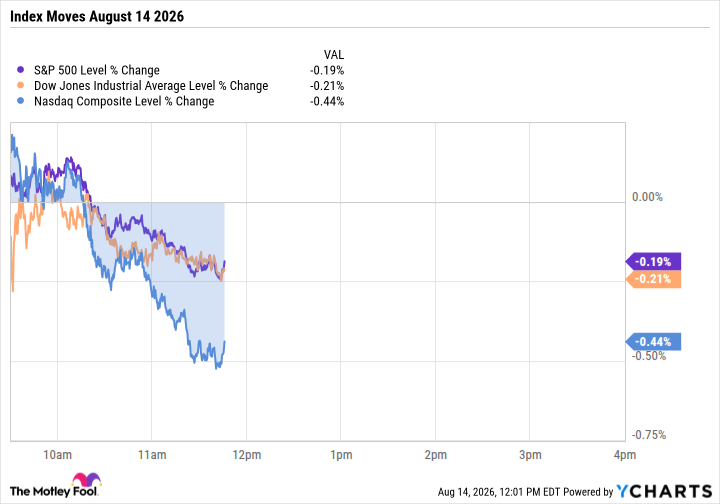
Weak consumer data pushes market indexes lower
Retail sales dropped 0.6% in July, showing the first decline in nine months and the biggest in 14. Economists had forecast a 0.1% gain. Core retail sales, which most closely correspond to the consumer spending component of GDP, dropped 0.4% versus expectations of a 0.3% increase.
Some of that is a technicality. Amazon (AMZN -0.66%) moved Prime Day to June this year, which pulled sales out of July and knocked nonstore retailers down 2.2%. Many e-tailers followed Amazon's shift, keeping their own discount events close to the e-commerce titan's calendar. The less comfortable explanation is that this spring's generous tax refunds were already spent.

Image source: Getty Images.
The University of Michigan's preliminary consumer sentiment index for August came in at 51.0, well below the 54.5 consensus and down from 55.2 in July. One-year inflation expectations ticked up to 4.3%. Weak confidence paired with persistent inflation expectations is an uncomfortable combination for the Federal Reserve.
Chip stocks did most of the damage to the index today. Broadcom (AVGO -6.78%) fell 5.6% and gave up roughly $105 billion in market value, the single largest drag on both the S&P 500 and the Nasdaq. Yesterday, Broadcom was up on the memory chip story; today, it's the biggest weight. Applied Materials (AMAT -5.55%) dropped 4% despite guiding revenue above expectations, a familiar pattern this week.
On the Dow, Goldman Sachs (GS -0.22%) slipped 0.7% for about 43 points and Amgen (AMGN -0.91%) fell 1.3% for another 33. It was a quiet day across the Dow, not just among its heavyweights. I don't see a single move of 2.5% or more on the Dow today.
NASDAQ Composite Index
Key Data Points
Consumers are growing tired
Meanwhile, the Strait of Hormuz has essentially closed. Two ships passed through on Friday, down from a daily average of 130 before the war. Two more vessels were attacked Thursday night, and the U.S. says its naval blockade can run indefinitely. Oil prices are up slightly again.
Friday's consumer numbers make sense in that light, and not in a good way. Gasoline prices have been elevated for months, tax refunds are gone, and households are getting choosier. Consumer spending is more than two-thirds of the American economy, so this number is a crucial market driver.
Even so, both the S&P 500 and the Nasdaq remain on track for a third consecutive weekly gain, their longest streak since early April. The S&P 500 is up 14% this year following a 16.4% gain in 2025. A quarter-percent pullback after a record close is not much of a reversal.
The thing to watch isn't really today's market action. It's whether next month's August report shows a consumer who's genuinely closing all e-commerce tabs or one who simply took a break from shopping in July. Those two stories end very differently. Stay tuned.