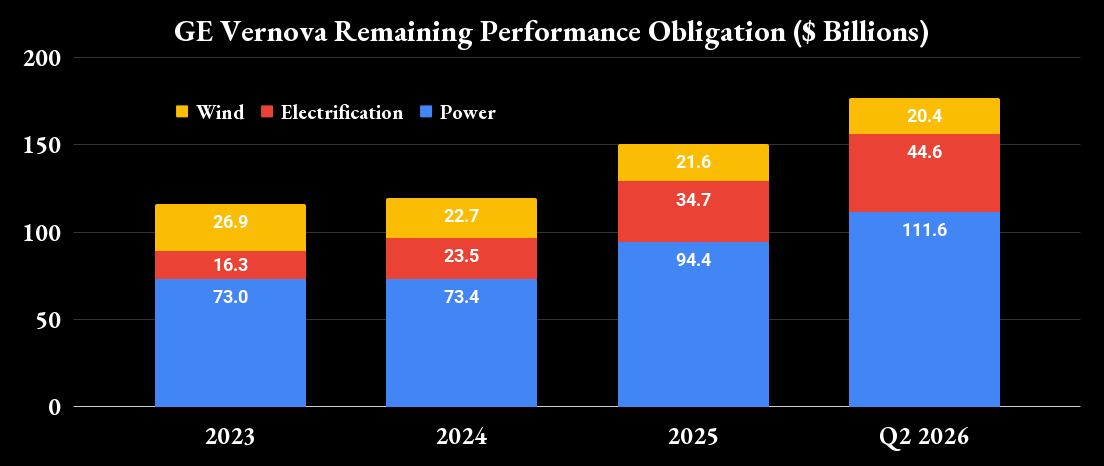
GE Vernova's (GEV -1.50%) backlog is massive. If its $176 billion backlog were a country, it would rank as the 62nd-largest country by GDP, ahead of Kuwait, Ecuador, and Slovakia. That is huge, especially for a company that generated $38 billion in revenue last year.
GE Vernova's growing backlog reflects incredibly strong demand for its power equipment amid the AI data center boom. Here's what sits inside its massive backlog and what it ultimately means for investors.
GEV GE Vernova
NYSE · As of 4:00 PM ET 10/23/26

GE Vernova's massive backlog is driven by an energy investment supercycle
GE Vernova's backlog, which it tracks as remaining performance obligation (RPO), surged higher to $176 billion at the end of the second quarter. This backlog grew by another $13 billion since the second quarter and is up 37% year over year, driven by a global electricity investment supercycle, providing the company with visibility into earnings well into the 2030s.
What makes GE Vernova particularly appealing right now is its position in the electricity and power generation industry. The company has a massive power generation footprint, thanks to its extensive gas turbine, wind, steam, and nuclear assets. The company supplies roughly half of the world's gas turbine capacity, and its equipment base roughly one-quarter of the world's electricity.
Demand for gas turbines is driving GE Vernova's rapid expansion
The key driver of GE Vernova's massive backlog is the rapid build-out of artificial intelligence infrastructure, which is creating historic demand for its power and grid infrastructure equipment, such as grid transmission, switchgear, and transformers.
In addition, the company's gas turbine equipment is seeing especially strong demand. These turbines utilize natural gas to produce electricity. Natural gas is viewed as a "bridge fuel" that emits 50% less carbon than coal and provides flexible and reliable power to stabilize grids that rely on intermittent renewables.
GE Vernova is a major player in the gas turbine industry, thanks to its HA-Class turbines and aeroderivative turbines. Its HA-Class turbines provide large-scale, 24/7 baseload power (400 megawatts (MW) to 800 MW per block). Meanwhile, its aeroderivative turbines are well suited to meeting peak energy demand, backing up intermittent renewables, and providing on-site power for data centers or other remote facilities.
Its backlog is evenly divided between equipment sales ($87.8 billion) and services ($88.4 billion), showing robust demand for its power generation equipment and long-term service agreements.
Image source: The Motley Fool.
Demand for GE Vernova's equipment stretches out years in advance
During the second quarter, GE Vernova signed 20 GW of new gas equipment orders, which include 18 GW of slot reservation agreements and 2 GW of firm orders. Slot reservation agreements require upfront deposits from customers to hold a place in line for future gas turbines, around three to five years out. They signal strong demand but are not yet booked in the backlog.
Due to capacity constraints and soaring global demand, GE Vernova is mostly sold out of gas turbine production slots through 2030. It expects to have over half of its 2031 production slots under contract by the end of 2026.
GE Vernova's massive backlog gives investors visibility into future earnings. Its equipment RPO is recognized in the near term, with 36% expected within one year and 97% within five years.
Meanwhile, its services backlog provides a much longer time horizon for visibility. Here, only 16% of this backlog will be recognized within a year, and 54% within five years. This growing services backlog is a major driver of GE Vernova's future growth, and it will continue to expand as equipment sales increase.
What's next for GE Vernova
Looking ahead, GE Vernova projects its backlog to reach $200 billion by 2027. To meet this demand, the company is increasing its output. The company's annualized gas turbine production run rate is expected to reach 20 GW by the third quarter and scale up to 24 GW by 2028. The company is incorporating automation and lean manufacturing, and hopes to achieve 30 GW of capacity by 2030.
GE Vernova is experiencing unprecedented demand, supported by the data center build-out and the reshoring of U.S. industrial capacity. Given this robust demand and customers' commitments stretching years in advance, GE Vernova is an excellent stock for long-term investors to play the energy demand boom.