In the words of Carson Group's Chief Market Strategist, Ryan Detrick: "Death, taxes, and Nvidia (NVDA -0.52%) beats on earnings are three things we can always count on in life."
For the 11th time in the last 12 quarters, the infrastructure backbone of the artificial intelligence (AI) revolution demolished Wall Street's consensus sales and profit expectations in its fiscal second quarter (ended July 26). Sales more than doubled to $96.2 billion, with (surprise, surprise!) the data center segment leading the way (117% year-over-year revenue growth).

Image source: Nvidia.
Furthermore, the company projects that full-year sales will skyrocket by another 70% in fiscal 2028. This compares to Wall Street's revenue growth estimates of 44%.
Oh boy. $NVDA guided next year revenue growth to at least 70%. The street was at 44%.
-- Gene Munster (@munster_gene) August 26, 2026
CEO Jensen Huang proclaimed, "AI has reached its inflection point" and made clear to investors that "demand is accelerating." Given Nvidia's aggressive innovation cycle -- it's aiming to bring a new advanced AI-accelerating chip to market annually -- and the compute superiority of its multiple generations of graphics processing units (GPUs), it's not a shock that Nvidia has made a habit of leapfrogging even the loftiest expectations on Wall Street.
Nevertheless, Nvidia's fiscal second-quarter operating results aren't perfect. The company's guidance highlighted a glaring flaw that Wall Street and investors have been content to overlook. However, history says that attempting to sweep this flaw under the rug would be a mistake.
Gross margin: This is as good as it gets for Nvidia
The glaring flaw in question is Nvidia's gross margin forecast for the fiscal third quarter.
In addition to Nvidia's GPUs sporting well-defined competitive advantages over its peers, Huang's company has benefited from persistent GPU supply shortages. Despite Taiwan Semiconductor Manufacturing's best efforts to expand its chip-on-wafer-on-substrate capacity, demand for GPUs continues to substantially outstrip their supply. The result is otherworldly pricing power for Nvidia and a historically high gross margin of 75% in the fiscal second quarter.
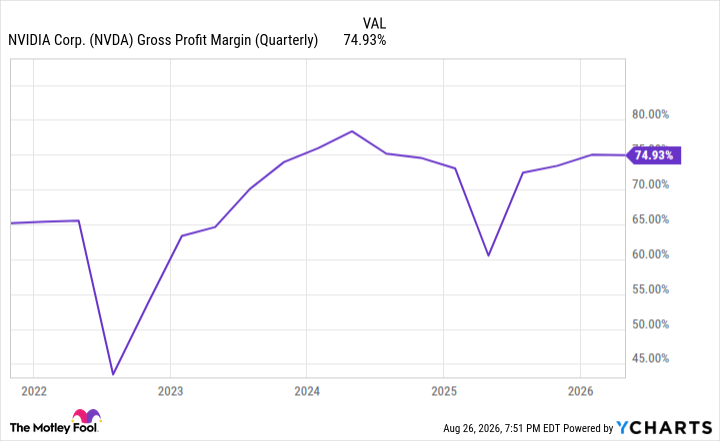
NVDA Gross Profit Margin (Quarterly) data by YCharts.
Nvidia's outlook calls for a fiscal third-quarter gross margin of 74% (+/- 50 basis points). A one percentage point sequential quarterly decline from what's nearly an all-time high might not seem like much, but it signals two very worrisome realities for Nvidia and its shareholders.
Firstly, this may be as good as it gets for Nvidia. You couldn't ask for a better set of circumstances for the face of the AI revolution. It has first-mover advantages, compute advantages, and a GPU supply shortage, all bolstering its pricing power. And yet, the company's outlook calls for a modest dip in its gross margin in the coming quarter.
Secondly, Nvidia's margin outlook speaks to the history of next-big-thing innovations. Even though none of the company's external or internal competitors are anywhere close to rivaling the compute capabilities of Blackwell Ultra or Vera Rubin, external competitors such as Advanced Micro Devices are ramping up GPU production. Likewise, several of Nvidia's top customers are internally developing AI chips that can occupy valuable data center real estate.
Even if Nvidia retains its compute advantages, the steady increase in available GPUs can offset the scarcity that's fueled its pricing power.
If this is as good as it gets for Nvidia's gross margin, the company's share price (vis-à-vis an underperformance of the benchmark S&P 500) may begin to reflect potential margin weakness.