Although the peak of earnings season -- the six-week period in which most S&P 500 companies report their quarterly operating results -- is in the rearview mirror, what's arguably the most important earnings report of the entire quarter is set to be unveiled after the closing bell tomorrow, Aug. 26.
Wall Street's largest public company, Nvidia (NVDA -0.74%), is set to lift the hood on its fiscal second-quarter operating results. Given that Nvidia's graphics processing units (GPUs) are the backbone of the artificial intelligence (AI) data center build-out, the company's sales, profits, margins, and guidance have a significant bearing on this game-changing technology.
While Nvidia should deliver another outstanding report on Aug. 26, the stars appear to be aligning for yet another pullback.

Image source: Nvidia.
Nvidia usually crushes Wall Street's consensus
If Nvidia is anything, it's consistent. The company has surpassed Wall Street's consensus earnings per share estimate in 10 of the last 11 quarters by an average of almost $0.06 per share.
Additionally, Nvidia's fiscal second-quarter sales are expected to have surged 97% to a hair over $92 billion. Given that many of Wall Street's most influential AI stocks have blown past consensus expectations, Nvidia's sales projections have been steadily climbing.
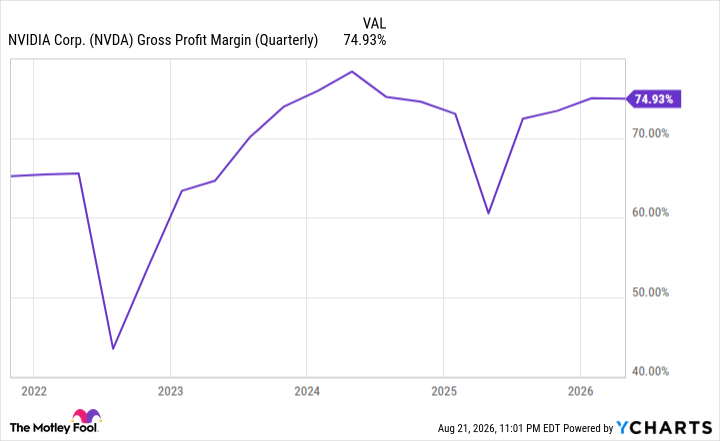
NVDA Gross Profit Margin (Quarterly) data by YCharts.
It's certainly not hard to understand why Nvidia has investors excited. The company's several generations of GPUs, including Hopper, Blackwell, Blackwell Ultra, and Vera Rubin, are unrivaled on a compute basis. Businesses have demonstrated a willingness to pay a premium for Nvidia's AI hardware, lifting the company's gross margin comfortably into the mid-70% range.
Furthermore, demand for GPUs continues to outpace their supply by a significant margin. Even with concerted efforts by Taiwan Semiconductor Manufacturing to increase its chip-on-wafer-on-substrate capacity, the limited supply of GPUs is bolstering Nvidia's (and its peers') pricing power.

Image source: Getty Images.
Nvidia's shares have a dubious post-earnings track record
While past events can't guarantee what's to come on Wall Street, history has a way of rhyming. In Nvidia's case, earnings reports are rarely well-received. While the company's shares occasionally move up in after-hours trading, these gains rarely stick.
Nvidia's stock has declined on the trading day following its earnings report in six of the last eight quarters:
- Q1 2027: (1.8%)
- Q4 2026: (5.5%)
- Q3 2026: (3.2%)
- Q2 2026: (0.8%)
- Q1 2026: 3.2%
- Q4 2025: (8.5%)
- Q3 2025: 0.5%
- Q2 2025: (6.4%)
My prediction is that we'll see this post-earnings downtrend extend for a fifth consecutive quarter for one simple reason: investors' expectations are too lofty.

NASDAQ: NVDA
Key Data Points
For more than 30 years, investors have consistently overestimated the pace of adoption and/or optimization for game-changing innovations with large addressable markets. Although demand for Nvidia's GPUs has been exceptional, businesses aren't particularly close to optimizing their AI solutions. In other words, the puzzle pieces for a bubble-bursting event remain in place.
Nvidia may also be a victim of its own success. Growing external and internal competition makes it unlikely that the company's margins will push higher. With several of Nvidia's top customers by net sales developing AI chips for use in their data centers, Nvidia could lose out on valuable data center real estate and/or see persistent GPU scarcity wane over time.
In short, a utopian scenario has already been priced into Nvidia's shares, leading to persistent sell-offs after earnings.