The "Magnificent Seven" stocks have been the driving force behind the market's current bull market. Right near the beginning of the bull market in April of 2023, Roundhill Financial launched an exchange-traded fund (ETF) that sought to capitalize on the strength of these seven magnificent megacaps -- Nvidia (NVDA -2.94%), Microsoft (MSFT -1.35%), Apple (AAPL +1.11%), Alphabet (GOOG -0.72%), Meta (META -0.06%), Amazon (AMZN -2.25%), and Tesla (TSLA -0.74%).
The Roundhill Magnificent Seven ETF (MAGS -0.90%) became the first ETF to invest solely in these seven stocks. And it's had a great run the past three years, returning 55% on an annualized basis in 2023, 62% in 2024, and 21% in 2025. It has a three-year annualized return of 31% as of Aug. 25.
But this year has been a different story. The ETF has barely been above water, up about 2% year to date, while the Nasdaq Composite and S&P 500 are each up 12%.
So why is the MAGS ETF underperforming? And is this a buying opportunity for investors?

Image source: Getty Images.
Why MAGS is a good buy
The underperformance of the MAGS ETF speaks to one of the major risks of investing in a concentrated portfolio, particularly one concentrated on similar megacap growth stocks. The lack of diversification means that when markets go down, this ETF will go down with them.

NYSEMKT: MAGS
Key Data Points
But with those same risks come rewards. When markets are up, MAGS will likely outperform the indexes, as it did in 2023, 2024, and 2025 -- and by massive margins in 2023 and 2024.
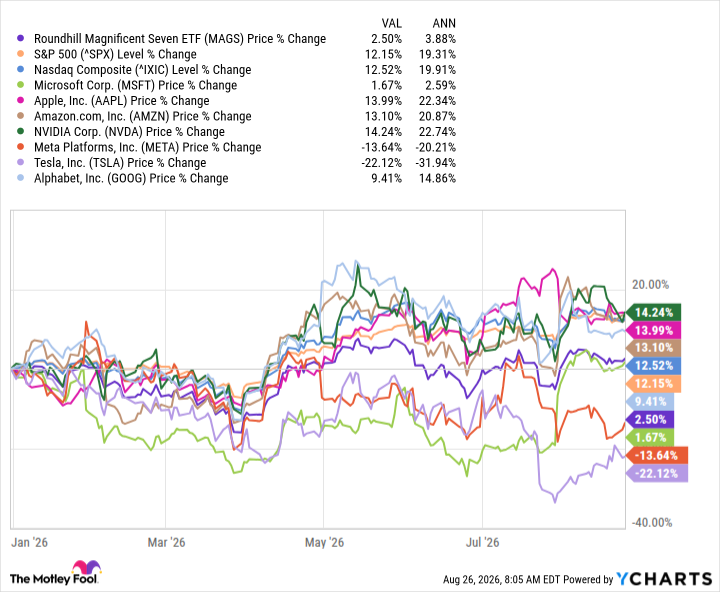
This year, in particular, the Magnificent Seven have been a mixed bag, as the chart below shows.
Data by YCharts.
Tesla and Meta have had double-digit negative returns, bringing down the performance of the ETF. Apple, Amazon, and Nvidia are all beating the benchmarks, but not by much. Alphabet and Microsoft have positive but single-digit returns year to date.
Even though the ETF has underperformed, it's still trading at almost $68 per share, near a 52-week high of $71 per share. Its average P/E ratio is 29, which is on par with the S&P 500's and lower than the Nasdaq-100's, which is 34.
But here's why investors are still buying the Roundhill Magnificent Seven ETF. Despite its still elevated price/earnings (P/E) ratio, five of the Magnificent Seven stocks -- Amazon, Microsoft, Nvidia, Alphabet, and Meta -- are relative bargains and strong buys, trading at below-average valuations. The MAGS P/E ratio is thrown out of whack by Tesla, which is trading at a ridiculously high P/E of 323.
Considering that a strong majority of Magnificent Seven stocks are good buys at reasonable valuations, this ETF is in a good position.
I would not allocate the majority of my portfolio to this ETF because of its extremely concentrated focus and its high potential for volatility. But setting aside a smaller allocation for this type of alpha might not be a bad idea, especially with many of the Magnificent Seven stocks looking attractive.