

Sandisk and Micron Technology have been the biggest beneficiaries of the artificial intelligence (AI)-fueled memory boom. The demand for their memory products has exceeded supply by a wide margin, which explains the solid jump in revenue and earnings for both companies.
However, the memory trade isn't just restricted to Sandisk and Micron. There are other companies that stand to gain from the secular growth of the memory market in the long run. Semiconductor bellwether ASML Holding (ASML +0.45%) is one such company that can win big from the healthy memory demand.
Let's see why I think that ASML could be a better way to play the memory market compared to Sandisk or Micron.
Image source: ASML.
ASML's memory business is growing at a solid clip
ASML makes advanced chipmaking equipment that helps foundries, memory manufacturers, and integrated device manufacturers (IDMs) to make cutting-edge chips. The memory industry is now a major catalyst for ASML, which isn't surprising, given the incredible demand for these chips.
ASML ASML
NASDAQ · As of 4:00 PM ET 10/15/26

ASML management noted on the July earnings call that memory accounted for 49% of its system sales in Q2. What's more, ASML sees a 75% increase in its memory-related net system sales in 2026. The company credits this big bump in memory sales this year to the additional capacity being brought online to support the healthy demand for high-bandwidth memory (HBM) and dynamic random-access memory (DRAM).
There is an acute shortage of these memory chips due to their mission-critical role in AI data centers. Micron, for instance, noted in February that it has sold out its 2026 HBM capacity. Micron's customers are now entering into multi-year supply agreements with the company to secure long-term capacity in advance to support their AI infrastructure build-out.
This is encouraging Micron and its peers to invest in more memory manufacturing equipment. Not surprisingly, Deloitte estimates that the capital expenditures of major memory manufacturers could jump by 67% this year to $97 billion. The consulting firm anticipates another increase of 50% in memory capex in 2027 to $146 billion.
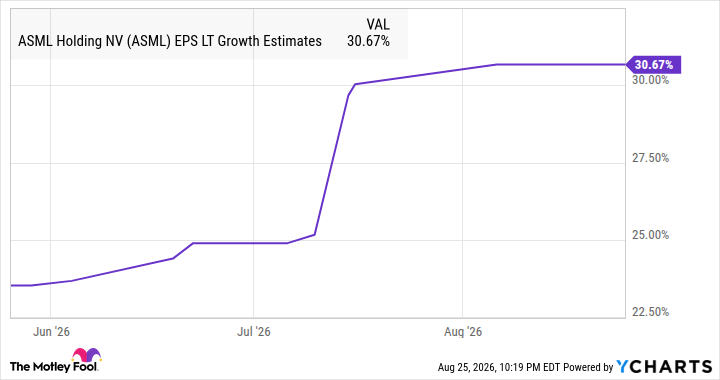
So, the strong memory capex environment that's powering ASML's growth this year will continue into 2027. Importantly, memory demand is anticipated to exceed supply until the end of the decade, indicating that the memory market will remain a key growth driver for ASML. This is one of the reasons why analysts have become more bullish about ASML's long-term earnings growth prospects following its quarterly report last month.
Data by YCharts
Why this Dutch giant could be a bigger winner than Micron and Sandisk
ASML is the only supplier of extreme ultraviolet (EUV) lithography machines, which are used for printing advanced microchips. Memory makers have been using EUV machines to reduce production costs and make more advanced memory chips with higher computation power and improved energy efficiency.
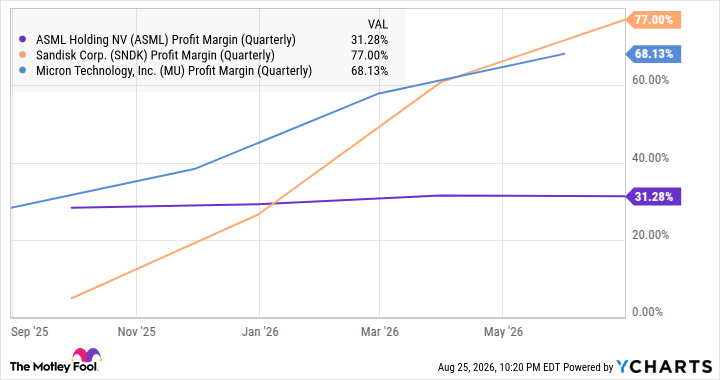
So, ASML can charge a premium for its EUV lithography machines given its monopolistic position in this market. Now, ASML's profit margin is significantly lower than that of Sandisk and Micron. ASML's pricing power can boost the company's margin profile, while Micron and Sandisk may find it difficult to achieve further gains due to their already-strong margin levels.
Data by YCharts
As such, I won't be surprised to see this semiconductor stock outperforming Micron and Sandisk due to the central role it plays in the memory market's expansion.


