Dividends used to contribute significantly to investors' annual returns. For much of the 20th century, dividend yields on the S&P 500 (^GSPC -1.11%) floated between 3% and 5%, save for a few macroeconomic shocks (which sent yields higher). Today, a stock paying a 3% dividend could be considered a high-yield dividend stock. In fact, the S&P 500's aggregate dividend yield over the last 12 months has fallen to 1.04%, the lowest value on record.
The last time dividend yields were this low, it didn't bode well for investors. The S&P 500 dividend yield reached a low of 1.11% in September 2000, just six months before the dot-com bubble burst. Here's what's pushing today's dividend yield lower, how low yields played out over the long run, and what it means for investors today.
Image source: Getty Images.
Do low dividend yields mean a crash is coming?
There are a few reasons why dividend yields have dropped significantly since the 1980s. First and foremost, fewer companies in the S&P 500 pay dividends. Instead, more companies are using excess cash to repurchase stock. In 1982, a Securities and Exchange Commission (SEC) rule change made it easier for companies to buy back their own stock, which gives management much more flexibility in capital returns.
The second factor is that Treasury yields have steadily declined (although they've recently recovered). Lower bond yields put less pressure on management to offer high dividend yields.
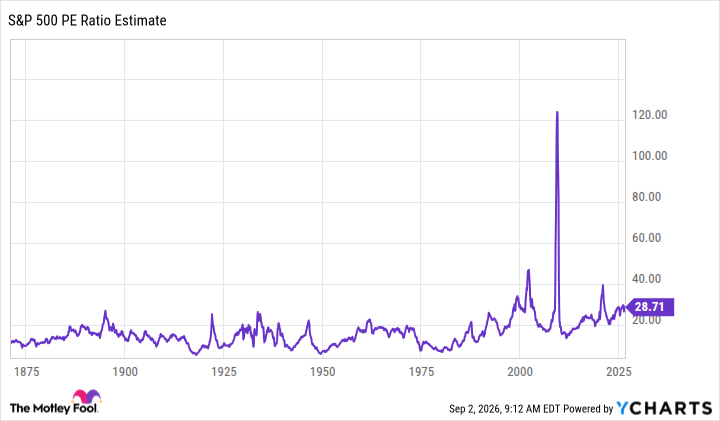
Lastly, stocks trade at a considerable premium compared to their historic average. With the S&P 500 trailing P/E ratio hovering around 29 (compared to levels well below 20 through the 1980s), paying out the same percentage of earnings as a dividend would still result in a lower yield due to higher stock prices.
Data by YCharts.
That last factor may be the most concerning for investors. After all, the last time valuations climbed to similar levels and pushed dividend yields lower was practically the peak of the dot-com bubble. That said, forward P/E ratios currently sit below peak dot-com levels, and the companies leading the stock market higher sit on a solid foundation of positive earnings and cash-flowing businesses.
Do companies have a good reason for keeping dividends low?
As mentioned, one of the big reasons dividends have shrunk over the last few decades is that share repurchases have become a much more practical way to return capital to shareholders. Even after recent legislation started taxing buybacks, they're still more tax-efficient for investors than dividends in most cases. The flexibility they provide for management to make capital investment decisions has also proved especially valuable in some cases.
The most recent example is that U.S. hyperscalers are pouring hundreds of billions of dollars into building out artificial intelligence data centers. They see the potential for very strong cash returns on their investments, even as they pour as much cash as possible into the business. There have rarely been opportunities like this in the past. With the opportunity to deploy cash at a high internal rate of return, many of the biggest businesses in the S&P 500 have kept capital returns very low over the last few quarters.
Again, investors may be getting flashbacks to the dot-com bubble. Fiber build-outs ate up tons of capital in the late 1990s ahead of the bubble popping. However, much of the fiber laid back in the 1990s was done so with the expectation that demand would continue to balloon. The so-called dark fiber went unused for years. By comparison, hyperscalers are seeing demand for their compute grow in line with their capital expenditures, with data center usage remaining extremely high.
S&P 500 Index
Key Data Points
Can history tell us what comes next?
When the dot-com bubble popped, earnings dropped, and stock prices collapsed. Many businesses were forced to slash their dividends. However, dividend cuts didn't match the drop in stock prices, resulting in higher dividend yields over time. Other factors continued to pressure dividend yields, including lower Treasury yields, but it was still common to see aggregate dividend yields top 2% in the 2010s even as bond yields moved lower.
It's unlikely that history will repeat itself here, but it could rhyme. The AI build-out will eventually slow down. Cash flows will recover. Stock prices could see a correction at some point, too, if actual results fail to meet expectations. Over time, capital returns as a percentage of stock prices will improve again, and that could include larger dividends for investors.
The key is to remain patient, focus on the fundamentals driving the market, and allow management to deploy capital in the most effective manner they can for shareholders. Another market crash isn't necessary for dividend yields to climb higher from here.