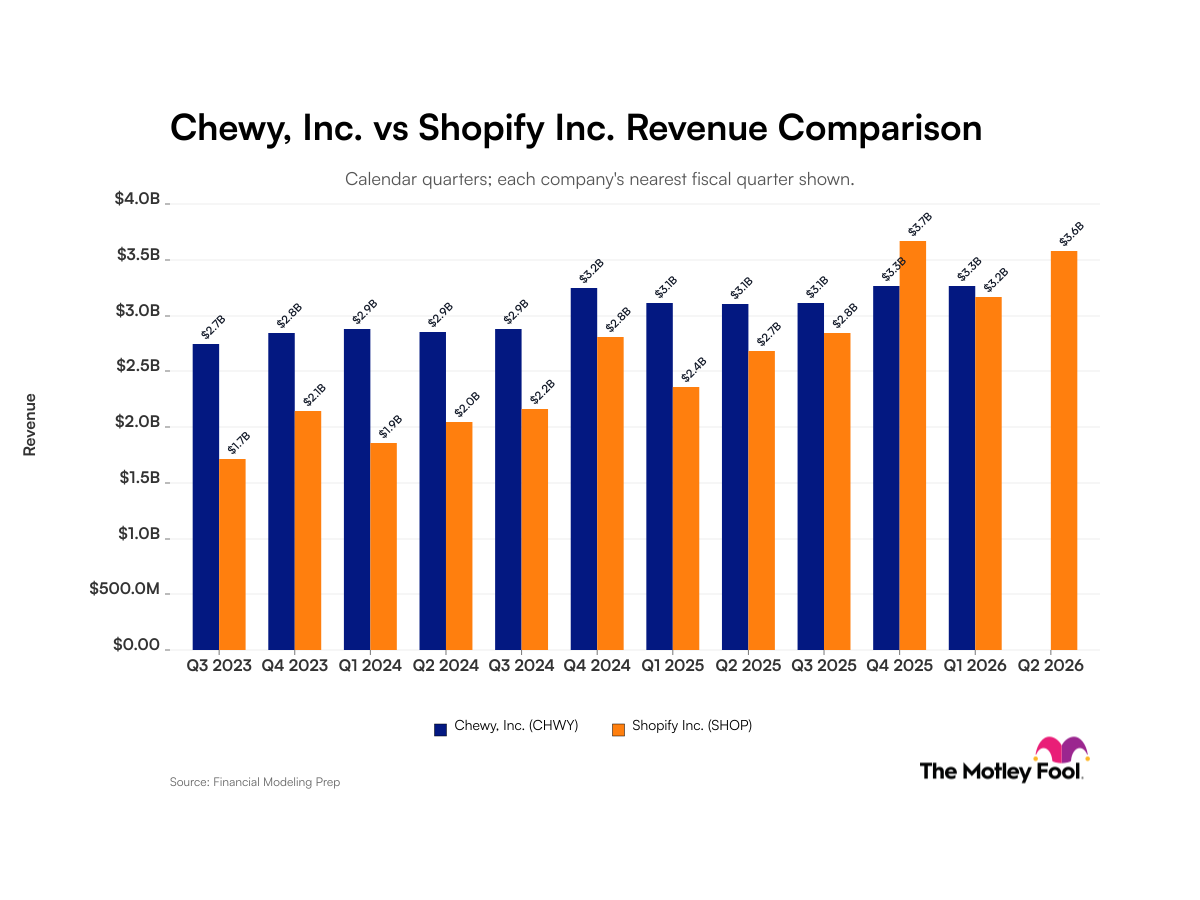
E-commerce platform Shopify (SHOP -0.54%) is doing something big companies rarely do: growing faster as it gets bigger. Gross merchandise volume (GMV), the dollar value of everything its merchants sell through the platform, grew 12% in 2022 and has accelerated every year since -- 20%, then 24%, then 29% in 2025. And 2026 is running faster still.
However, the stock hasn't followed the same line. It trades around $148 as of this writing, about 19% off its 52-week high of $182.19.
Where will Shopify stock be in five years? I think it hinges on a few numbers the company reports every quarter -- how fast volume grows, how much of it Shopify keeps, and how much of that turns into cash. It also hinges on how much of all that is already in the price.

Image source: Getty Images.
Faster every year
Shopify's second-quarter report, released in early August, extended the pattern. Revenue climbed 34% year over year to $3.6 billion, the second straight quarter of 34% growth, and GMV rose 32% to $115.6 billion.
For scale, Shopify estimates its merchants handled more than 14% of U.S. e-commerce in 2025.
"GMV growth accelerated on top of last year's already strong Q2 with solid results across all merchant sizes, channels, and geographies," said chief financial officer Jeff Hoffmeister in the second-quarter earnings release.
Of course, a five-year view also has to account for artificial intelligence (AI). If AI shopping tools help merchants sell more, volume per merchant can keep climbing. If they mostly make it easier for anyone to launch a competing storefront, they raise competition among Shopify's merchants instead.
The reported figures don't settle it yet.
Can Shopify keep more of each dollar?
Volume only matters to shareholders after Shopify takes its cut. The company's take rate, or revenue as a share of GMV, came to about 3.1% last quarter. That was a touch higher than a year earlier, as merchants adopted more of its services.
Merchant solutions revenue (payments and the other services merchants pay for as they sell) rose 37% year over year to $2.8 billion, while subscription revenue grew 22% to $802 million. Merchant solutions now make up about 78% of total revenue. Notably, those are lower-margin dollars. Gross margin there runs near 38%, versus about 80% on subscriptions. That mix is why gross profit rose 31% last quarter, trailing revenue's 34% growth -- a gap management expects again in the third quarter.
Meanwhile, cost discipline has more than made up for the cheaper revenue mix. Not only did operating income rise 68% year over year to $488 million, but free cash flow margin (free cash flow as a percent of revenue) also climbed to 18%, after 16% a year earlier and 15% in the prior quarter.
Investors are already paying for years of growth
The trouble is that none of it is a secret. At a market cap near $190 billion, Shopify trades at about 14 times its trailing-12-month sales, about 80 times its free cash flow over the same period, and about 60 times its expected adjusted 2027 earnings.
To justify those multiples of sales and cash flow, Shopify would need years of strong execution. If GMV compounds at 20% annually for five years (slower than today's pace), volume would reach about $1.1 trillion, from about $432 billion over the past year. A take rate near 3.1% turns that into revenue of around $33 billion. And if free cash flow margin climbs from 18% to 25%, Shopify would produce roughly $8 billion of cash in year five.
Today's market cap is still about 23 times that year-five cash flow. Five years of very good execution, in other words, gets a buyer to a valuation that is arguably just reasonable.

NASDAQ: SHOP
Key Data Points
A materially higher stock needs more than that. GMV growth could hold near 30% for the full five years, which would put revenue around $50 billion and free cash flow above $12 billion at that same 25% margin. At today's price, that outcome would work out to about 15 times year-five cash flow, cheap enough to leave room for the stock to climb.
Additionally, the take rate may keep inching higher as merchants adopt more services, raising revenue without another dollar of volume. Both are possible. But neither is the kind of assumption I'd want my returns to depend on.
Ultimately, I expect Shopify to be a much bigger business in five years. But I don't expect the stock to climb nearly as fast as the business grows, because so much of that growth is already reflected in the price.
I'm not buying the stock at today's price. If shares pull back meaningfully, or a few more quarters show the take rate and free cash flow margin climbing together, I'd take another look.