The GPU market is dominated by a duopoly featuring Nvidia (NVDA -0.59%) and Advanced Micro Devices (AMD +1.74%). Nvidia is shipping Blackwell at enormous scale and ramping up Vera Rubin as the next rack-scale platform. Meanwhile, AMD is selling MI300 systems and lining up its next-generation MI400 accelerators to keep its seat at the table.
Amazon, Alphabet, Microsoft, Oracle, Meta Platforms, Anthropic, and OpenAI are not picking one vendor to supply chips for the artificial intelligence (AI) build-outs. Instead, they are stuffing solutions from both Nvidia and AMD into the same stacks because supply is tight, different workloads require specific architectures, and nobody can afford to sit around and wait.
This is the backdrop of the AI infrastructure landscape. However, during Space Exploration Technologies' first earnings call as a public company, Elon Musk stepped into the chip arena and made his preference abundantly obvious.
Image source: The Motley Fool.
Musk is not hedging his bets
During SpaceX's second-quarter earnings call, Musk did not leave much room for interpretation. He stated:
[G]oing forward, we've decided to build exclusively on Nvidia because we think the Vera Rubin architecture is the best architecture. We think it's the best AI computer, and we greatly value our close cooperation and partnership on many levels with Nvidia. So we're exclusive to Nvidia.
This really isn't a shock to anyone who has watched Tesla over the years. Tesla trains some of its autonomy stack on Nvidia's hardware even while the company works on its own inference chips for robotaxi and Optimus. Musk has previously expressed public admiration for Nvidia CEO Jensen Huang, acknowledging that Tesla and SpaceX will continue ordering Nvidia chips at scale. The SpaceX call simply solidified a relationship that already existed.
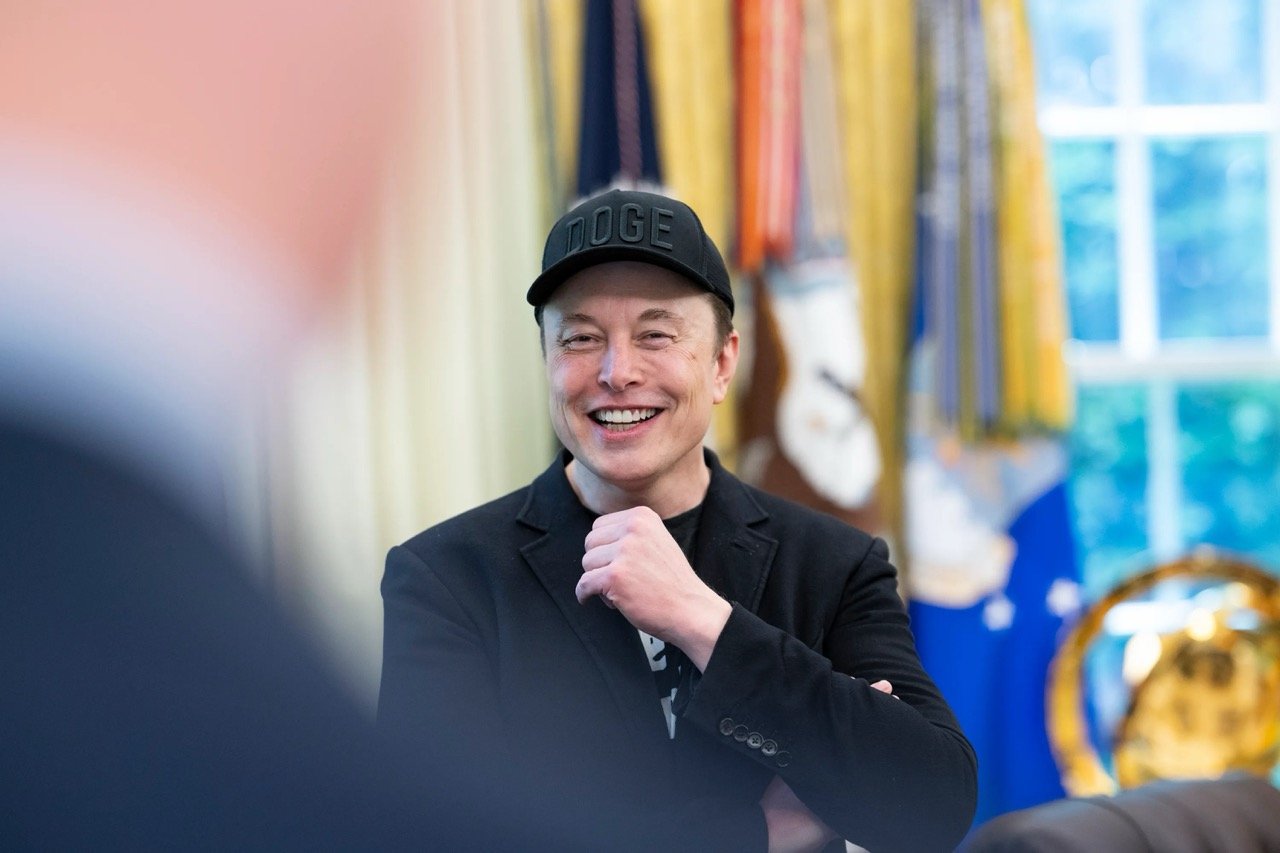
SpaceX and Tesla CEO Elon Musk. Image source: The White House.
What is SpaceX doing with Nvidia's chips?
AI chips are not used only for chatbots on Earth. SpaceX is using clusters of GPUs to design orbital data centers, integrate with Starlink operations and Starship mission planning, as well as simulate the same kind of work Tesla is doing with its autonomous vehicles. The near-term buzz is around Starmind, an optimized satellite payload built on Nvidia's Vera Rubin NVL72 system.
SpaceX has already turned its Nvidia procurements into a fast-growing AI infrastructure business. Filings detail how the company is leasing large clusters of Nvidia compute rather than sitting on the chips solely to train its home-grown generative model, Grok.
Anthropic entered into a cloud services agreement with SpaceX worth $1.25 billion a month through 2029. The deal provides Anthropic with access to compute capacity across SpaceX's supercomputers, Colossus and Colossus II, which feature roughly 325,000 Nvidia GPUs.
Meanwhile, Google Cloud committed $920 million a month for access to roughly 110,000 Nvidia GPUs, CPUs, memory, and related networking kits through the middle of 2029. Most recently, Reflection AI signed a multiyear deal worth up to $6.3 billion to access Nvidia GB300 chips at a reported $150 million per month.
NVDA Nvidia
NASDAQ · As of 4:00 PM ET 10/23/26

Why I think Nvidia is the better buy over AMD
For SpaceX and Tesla, Musk sided with the established leader in the chip industry. I think the numbers line up with that choice.
Nvidia boasts a market cap of roughly $5.3 trillion, while AMD hovers around $830 billion. During the second quarter, Nvidia's data center revenue reached $89 billion -- up 117% year over year. AMD, on the other hand, generated $6.7 billion in sales from its data center segment -- an increase of 107% year over year. While AMD is demonstrating strong growth, it's off a much smaller base relative to Nvidia. Meanwhile, Nvidia is growing faster and at a size AMD isn't even close to reaching.
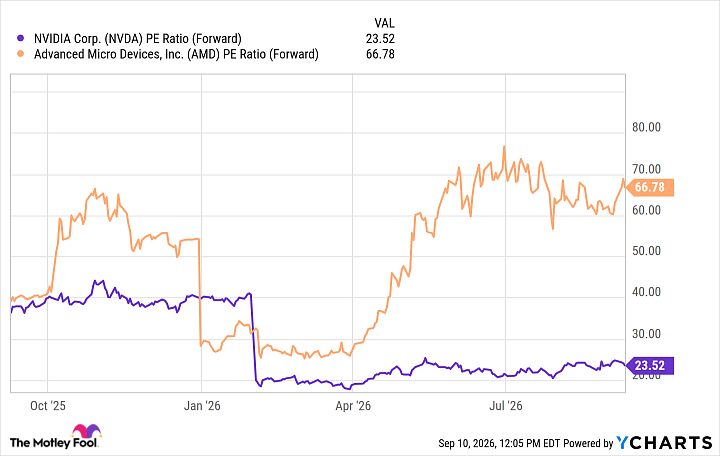
NVDA PE Ratio (Forward) data by YCharts
Valuation makes the comparison between the chip rivals even sharper. Nvidia trades at a forward price-to-earnings (P/E) ratio around 23. AMD trades at a much richer multiple at roughly 67 times forward earnings. In other words, investors are paying nearly triple for AMD's next dollar of earnings even though Nvidia clearly owns the software stack, the rack-scale systems, and the customer list that includes two empires run by the world's richest person, Elon Musk.
None of this means AMD will disappear. Hyperscalers will keep dual-sourcing and MI400 will continue getting design wins. But from my view, Musk does not appear to be experimenting with the No. 2 chip for his rockets, satellites, and AI factories. Instead, he is doubling down on the platform he's trusted for years. I think this is a good reason for an investor to do the same.