The Motley Fool Stock Advisor has rewarded subscribers who followed its monthly selections with a 950% return between Feb. 2002 and Sept. 14, 2026. As The Motley Fool states, "the strategy is built for patient investors willing to own a diversified portfolio of 50+ picks, not for short-term traders chasing quick gains." The size of the portfolio is no accident; diversification is a key part of the investment approach. You can easily put diversification to work for your portfolio regardless of your investment approach. Here's what you need to know.
What is diversification?
The folksy example of diversification is not putting all of your eggs into one basket. If you have just one basket and that basket falls, all of your eggs break. If you have multiple baskets and one falls, you still have plenty of eggs to eat. In the investment world, that example translates to buying multiple stocks. This way, no single company can destroy your portfolio if something goes wrong. The Motley Fool recommends 50 stocks to have a well-diversified portfolio.

Image source: Getty Images.
That said, you can't just buy 50 technology stocks. If the tech sector, which is known for being volatile, falls out of bed, so will most of your portfolio. So you also need to spread your portfolio across sectors, including things like utilities, consumer staples, energy, and real estate investment trusts, among other sectors. You want a broad mix of sectors within the 50 stocks you buy.
Proof beyond The Motley Fool
The Motley Fool Stock Advisor's results are what they are, but there is another, more prominent example of diversification's benefits: the S&P 500 index (^GSPC -0.52%). As the index's name suggests, the S&P 500 comprises roughly 500 stocks. Companies are selected by a committee to be broadly representative of the U.S. economy. They tend to be large and economically important businesses. And if you go back through history, just buying the S&P 500 has produced impressive results.
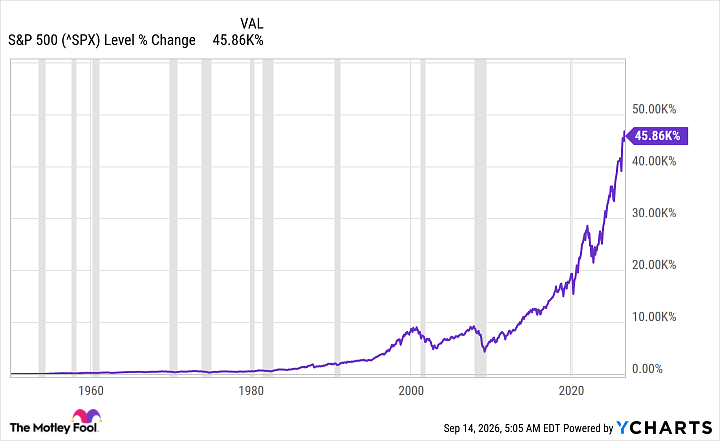
Since just the start of the millennium, the S&P 500 has rewarded investors with an over 400% price advance. The gains get more impressive the further back you go in time, as the chart below highlights. It is important to note that the returns below include multiple recessions and bear markets, some of which were incredibly deep. But sticking with the diversified S&P 500 index proved to be a long-term winning strategy.
Perhaps the best part of the S&P 500 index, however, is how easy it is to buy the index with exchange-traded funds (ETFs). The first ETF ever created, SPDR S&P 500 Trust (SPY -0.52%), tracked the index. It has an ultra-low expense ratio of 0.09%. If you're into Wall Street history, you might want to buy it. However, you can get an even lower-cost option with Vanguard S&P 500 ETF (VOO -0.53%), which has an expense ratio of just 0.03%.
VOO Vanguard S&P 500 ETF
NYSEMKT · As of 4:00 PM ET 10/23/26
Since the two ETFs do the exact same thing, most investors should probably go with the cheaper option. That said, buying either one of these S&P 500 ETFs will put the power of diversification on your side with a single investment. That allows you to focus on saving money and spending your free time with family and friends, instead of picking stocks.
Two ways to use diversification
The impressive returns provided by The Motley Fool Stock Advisor show that diversification can be a powerful tool for those who want to invest in individual stocks. The S&P 500 index's returns over time also highlight the power of diversification. But the S&P 500 also shows that you can buy a single ETF and still benefit from diversification, so you don't have to spend all your free time picking stocks.
Still, the big picture is that putting all of your eggs in one basket is a risk you probably shouldn't take. Whatever your investment approach, you'll likely be better off if your nest egg is spread across multiple baskets.