Between 2023 and 2025, Nvidia (NVDA +0.14%) was the market's most obvious artificial intelligence (AI) trade. During this period, the stock went parabolic, surging by 1,180% and turning the chipmaker into the world's most valuable company by market cap. On a split-adjusted basis, that was a climb from about $14 per share to $186 by the end of 2025.
Currently, Nvidia stock sits around $218, up another 17% year to date. This is what it looks like when a company owns a scarce product that's in heavy demand -- in this case, graphics processing units (GPUs).
Micron Technology's (MU -1.73%) rocket-like move came a bit later, but hit much harder. Memory chips were an afterthought during the initial GPU gold rush. But as training clusters got larger and inference workloads got hungrier, supplies of high bandwidth memory (HBM) started running short. Prices for HBM soared, and Micron stock responded epically -- rising 239% in 2025 and another 242% so far this year. This type of price action indicates the market has recognized that memory is no longer just another tech commodity -- its supply is one of the key bottlenecks dictating the pace at which data centers can be built.
Nvidia and Micron are not the same bet. While Nvidia sells engines, Micron is selling the tanks for the fuel these engines cannot operate without. This begs the question: At this point, which of these AI chip stocks would be the better one to buy and hold for the next five years?
Image source: The Motley Fool.
Nvidia is more than a GPU designer
AI development is no longer just about who can procure the most GPUs. Nvidia understands this shift, and has spent the last couple of years trying to own the whole AI factory -- from compute, networking, optics, and software to even some of the customers that rent capacity. This is what makes Nvidia's partner ecosystem so important.
Marvell Technology received a $2 billion investment from Nvidia and a seat inside NVLink Fusion. This integration allows Marvell's custom accelerators to plug directly into Nvidia's rack-scale stack, rather than competing with it. Meanwhile, Coherent and Lumentum each received $2 billion checks from Nvidia in addition to purchase commitments to scale their lasers and silicon photonics -- hardware that provides greater bandwidth and reduced latency, and keeps today's ever-larger server clusters from choking on the limitations of copper.
Nvidia also invested $1 billion in Nokia as part of a collaboration to develop AI-enabled radio access networks (RANs). The idea is to parlay the same accelerated compute stacks that go into hyperscale data centers and place them at the edge among telecom networks.
Lastly, Nvidia works closely with Nebius and CoreWeave, two of the largest neocloud providers. Those relationships achieve two things at once: They help customers finance their infrastructure build-outs while keeping more data centers running on Nvidia systems.
Of course, Nvidia does have competition. Advanced Micro Devices is scaling its GPU business, while custom ASICs (application-specific integrated circuits) being developed by the hyperscale cloud providers -- Microsoft Azure, Amazon Web Services, and Alphabet's Google Cloud -- represent a longer-term threat. Even so, many of these new rival chips still sit inside the very networks, racks, and software stacks Nvidia is trying to profit from through its savvy partnerships. Hyperscalers may design their own AI chips that can be substituted (in some cases) for Nvidia's GPUs, but Nvidia can still provide the CPUs, DPUs, switches, optics, and the software layer that go around those custom chips.

NASDAQ: NVDA
Key Data Points
Memory is the current bottleneck, but how long will it last?
Right now, memory might be the most critical component within AI chip stacks, because there's a global shortage, and it will be at least 2028 before new production coming online could make a dent in the strained supply-and-demand dynamic.
Nvidia has acknowledged this with its own wallet, as in its last reported quarter, it boosted its supplier commitments by $119 billion to a total of $279 billion through fiscal 2032, and management said that contracted spending was primarily related to securing memory.
That order book is a gift to Micron, SK Hynix, and Samsung, the three firms that dominate the advanced DRAM and HBM markets. When only three companies control a scarce input, prices and profits tend to go vertical.
I think Micron's boom will be narrower than Nvidia's because the most likely way that this up phase of the memory supercycle remains hot past 2030 would be if new applications -- autonomous vehicles, robotics, and agentic AI -- consume more memory than analysts are currently expecting. Even if those workloads explode, Nvidia will still benefit from incrementally greater GPU adoption in these markets, and it still benefits from a business that's exposed to the rest of the value chain.
Nvidia vs. Micron: Valuation is the tiebreaker
The matter of valuations is where the five-year outlook gets practical. Nvidia trades at a forward price-to-earnings (P/E) ratio of around 23, a sharp discount to the levels it changed hands at during prior chapters in the AI revolution. Micron looks much cheaper by comparison on a near-term forward earnings multiple because its profitability and earnings are exploding in tandem with HBM pricing.
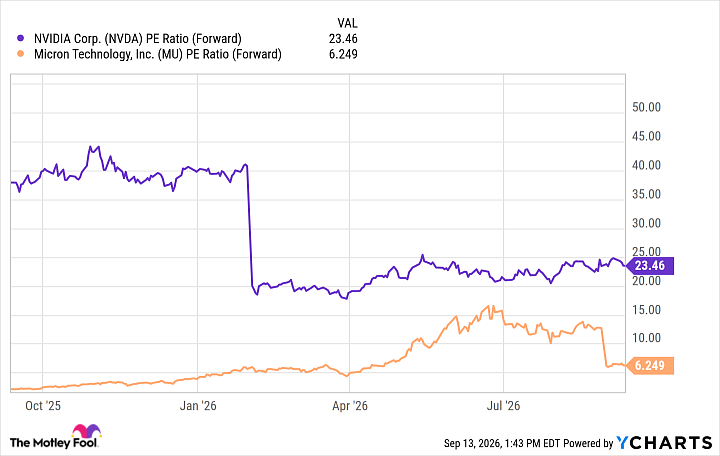
NVDA PE Ratio (Forward) data by YCharts.
An apparently cheap stock price can be a trap when assessing a historically cyclical business like Micron. If the memory shortage fades even a little bit, Micron's multiple could go from a period of expansion to snapping right back. Nvidia's earnings multiple, on the other hand, has more room to expand and hold if investors view the company as a durable, diversified architect of next-generation AI factories rather than as a single-product chip vendor.
While Micron appears to be the sharper trade amid the visible memory shortage, Nvidia is the better stock to buy and hold over the next five years because the company is no longer designing just one scarce component. Rather, Nvidia is positioned as a critical supplier across the entire AI supply chain.