AMD (AMD -5.96%) investors have been rewarded this year. The stock has risen nearly 200% so far, with a recent boost driven by reports that it plans to raise prices by 10% in Q4.
That's an incredible return in just one year, but there's one problem: I don't think AMD deserves it.
The stock's valuation has gotten out of control, and investors must be aware of that. AMD's high valuation may hamper future returns or prime it for a crash in the coming months.

Image source: Getty Images.
AMD is very expensive
No matter how you spin it, AMD's stock is not cheap. The first metric many investors look at is the price-to-earnings (P/E) ratio. This is an imperfect metric (as all are), but it's especially so for AMD because the past year includes several quarters where AMD's profit margin was much lower than it is today. As a result, several quarters are dragging down AMD's earnings per share metric compared with what it would be if AMD had maintained the same profit margin in Q2 as it did over the past 12 months.
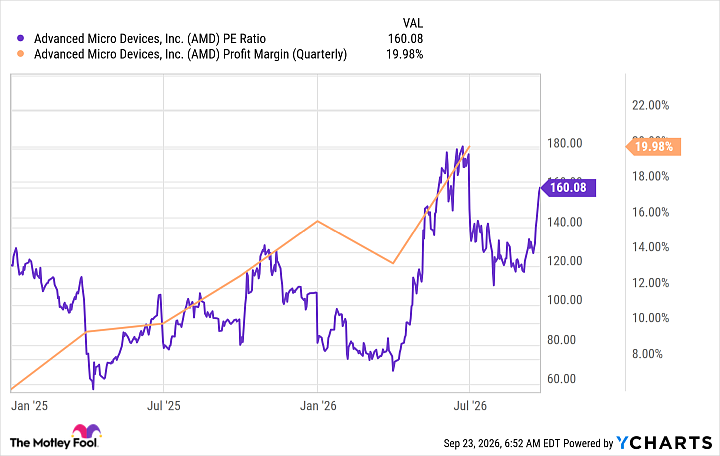
AMD PE Ratio data by YCharts
Instead, I'll use 2027's earnings estimate. This will have maximum profit margins baked into the stock price, based on the expectation that AMD's margins will continue to improve as various items, such as price hikes, are incorporated. AMD looks much more reasonable at this price point, but it's still very expensive.
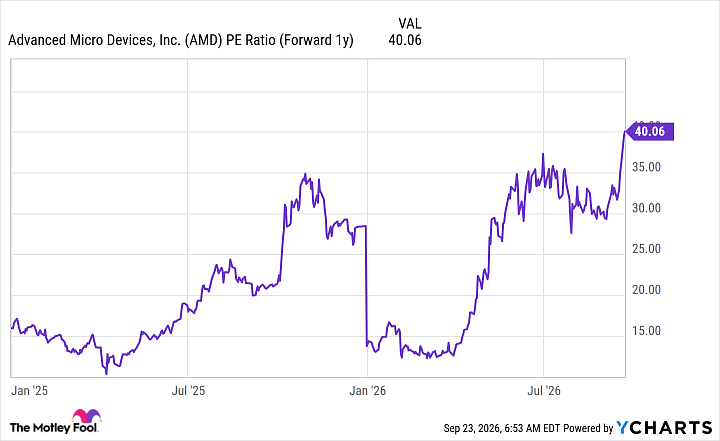
AMD PE Ratio (Forward 1y) data by YCharts
A forward P/E ratio of 40 is expensive, no matter how the story is twisted. Furthermore, it's far more expensive than some of its industry peers, like Nvidia (NVDA -1.43%) and Broadcom (AVGO -4.53%), which trade for 14.6 and 18.8 times next year's earnings estimates, respectively. These two are widely considered to be the top computing unit suppliers, so why does AMD get a massive premium?
That's the exact reason I think AMD investors need to be cautious: There's a ton of optimism priced into AMD's stock on the expectation that it will take market share, but that perception doesn't align with reality.
AMD Advanced Micro Devices
NASDAQ · As of 4:00 PM ET 10/16/26

In Q2, AMD's data center business increased 107% year over year, which is outstanding. However, Nvidia's data center business rose 117% year over year, and Broadcom's Q3 AI semiconductor revenue rose 221% year over year.
AMD is not the premier company in this space, nor is it the fastest-growing. However, it somehow deserves to be valued at more than double the multiples of the industry leaders?
I think that's a market error, and one of two things can happen. First, AMD's bubble could burst, sending shares plummeting. Second, AMD's returns may be very low for a long time as it grows into this sky-high valuation.
I'm not sure which will happen, but I'm fairly confident that AMD's returns will be a lot lower than Nvidia's or Broadcom's over the next few years. As a result, I think investors should ditch AMD's shares in favor of those two.