Choosing between Advanced Micro Devices (AMD -4.24%) and Arm (ARM -0.26%) requires understanding two distinct paths within the chip industry. You must decide whether to favor a chip designer or an architecture licensor for 2026.
Advanced Micro Devices operates as a direct provider of high-performance computing hardware, while Arm licenses the underlying architectural blueprints used by other designers. This comparison explores which business model and financial profile offers a more compelling opportunity for retail investors today.
The case for Advanced Micro Devices
AMD is a prominent player among semiconductor stocks, designing high-performance computing products for data centers, gaming, and personal computers. The company sells CPUs, GPUs, and AI accelerators to major hyperscale operators and hardware manufacturers. Key commercial agreements include Sony (SONY +1.72%) for gaming consoles, Microsoft (MSFT +1.08%) for Xbox and operating systems, and a strategic partnership with OpenAI. AMD relies on a limited number of customers for a substantial portion of its revenue, and such customer concentration adds a layer of risk to the business.
According to its latest annual report, filed for the fiscal year ended Dec. 27, 2025, revenue reached nearly $34.6 billion. This represents growth of roughly 34.3% compared with the prior year, indicating strong demand for its AI-focused hardware. Net income for the period was approximately $4.3 billion, reflecting a net margin of nearly 12.5% as the company successfully scales its high-end computing segments.
As of its December 2025 balance sheet, the debt-to-equity ratio was roughly 0.1, which measures total debt relative to shareholder equity. The current ratio, comparing current assets to current liabilities to assess short-term liquidity, was approximately 2.9. Free cash flow, calculated as cash flow from operations minus capital expenditures, was nearly $6.7 billion. Note that stock-based compensation accounted for roughly 21.2% of operating cash flow, inflating reported cash generation, since SBC is a non-cash expense added back in the cash flow statement.
The case for Arm
Arm operates a unique business model by developing the compute platform and architecture that other semiconductor companies license. Its technology is ubiquitous, deployed in more than 350 billion chips to date and powering over 99% of the world's smartphones. While the company does not disclose major customers in its SEC filings, its reach extends across cloud AI, edge computing, and autonomous machines. Arm earns revenue through licensing fees and royalties paid by partners that build chips using its fundamental designs.
In the fiscal year ended March 31, 2026, revenue came in at $4.9 billion, a 22.8% increase compared with the prior fiscal year. Net income was approximately $904 million, yielding a net margin of roughly 18.4%. This profitability highlights the efficiency of a licensing model, as the company avoids the high costs of physical chip manufacturing while benefiting from the growth of the overall tech industry.
As of its March 2026 balance sheet, Arm maintains a very conservative capital structure with a debt-to-equity ratio of approximately 0.1. Its current ratio was close to 6, indicating a high level of short-term liquidity. Free cash flow for the fiscal year ended March 31, 2026, was roughly $979 million. Note that stock-based compensation represented roughly 69% of operating cash flow.
AMD & ARM: Performance Comparison


Key Financial Metrics
Risk profile comparison
Advanced Micro Devices faces intense competition from Intel (INTC -4.37%) and Nvidia (NVDA -1.84%), which use aggressive pricing and proprietary software ecosystems to defend their market share. The company is also subject to regulatory and geopolitical risks, including restrictions on exporting advanced chips to China and tensions involving Taiwan. Furthermore, it depends heavily on third-party manufacturers like Taiwan Semiconductor Manufacturing (TSM -2.70%) for production. Any capacity constraints or manufacturing failures at these facilities could lead to supply shortages and harm operations.
Arm faces risks related to the saturation of the smartphone market and the potential shift of licensees toward alternative architectures. Competition from open-source alternatives and rivals like Qualcomm (QCOM +1.59%) could pressure royalty rates over the long term. Since Arm relies on other companies to design and sell the final chips, it has less direct control over the end-market success of its technology. Additionally, high stock-based compensation remains a factor for investors to monitor, as it can dilute existing shareholders if not managed effectively.
Valuation comparison
Advanced Micro Devices appears more affordable on both earnings and sales multiples despite its faster recent revenue growth compared to Arm.
| Metric | Advanced Micro Devices | Arm |
|---|---|---|
| Forward P/E | 75.3 | 110.1 |
| P/S ratio | 22.7 | 50.8 |
Valuation metrics include sourcing from Financial Modeling Prep (FMP) and may differ from other data providers.
The forward P/E measures the stock price against future earnings estimates, while the P/S ratio measures market value relative to sales over the past twelve months.
Which stock would I buy in 2026?
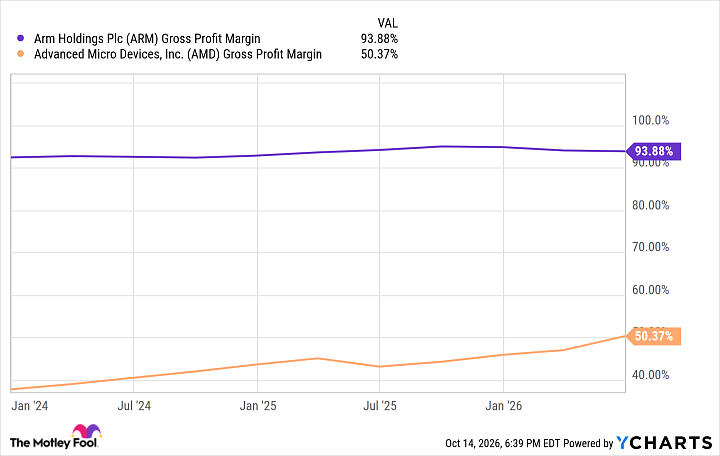
Arm shares look pretty expensive; no argument here. And the company's growth doesn't quite measure up to AMD's. But consider this chart:
ARM Gross Profit Margin data by YCharts
Because Arm makes all its money from licensing and royalties, it posts a consistently staggering gross margin. Plus, it's really hard to dismiss its overwhelming presence in smartphones.
That said, Arm's stock hasn't kept pace with AMD, underperforming the latter by more than 60 percentage points over the past five years.
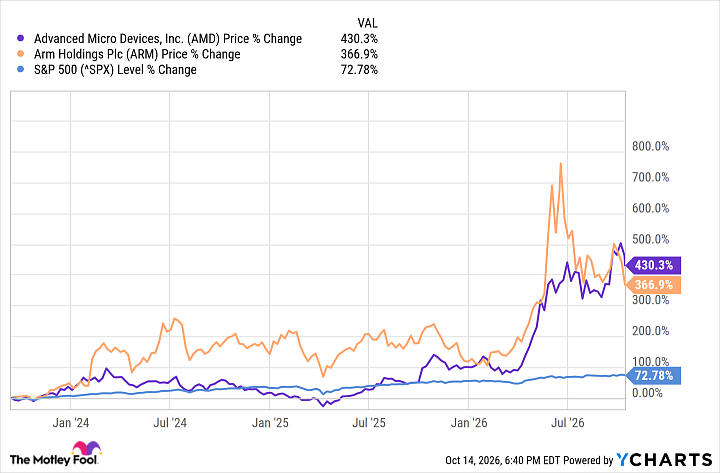
Arm's return is nothing to sneeze at, though. Both stocks have handily beat the S&P 500. But past performance is no guarantee of future results, of course, which is why I'm more inclined to think Arm is the better buy. Investors are paying a premium possibly for the same reason I find the stock so attractive: gross margins that would make pretty much any company weep.