For anyone seeking income from dividend payments, Walmart (WMT +0.78%) may not be the first stock that comes to mind, as its dividend yield is less than 1% as of this writing.
That said, despite the lower dividend yield, there are still advantages to owning Walmart shares for dividend investors. As you'll see shortly, it could help you avoid a risk associated with owning too many income-generating stocks.

Image source: The Motley Fool.
Combining income with stock price appreciation
As income-seeking investors well know, there are always trade-offs when investing in dividend stocks. A stock with a 6% dividend yield warrants further investigation into why the yield is so high, which may reveal unfavorable realities about the state of the company.
A lower-yielding stock may offer more sustainable payouts, but that can be because the business is mature, with revenue growth opportunities that are steady but restrained. With that type of stock, the sacrifice is often accepting a meaningful yield in exchange for limited stock price appreciation.
And owning too many income stocks with limited stock price appreciation leaves a portfolio vulnerable to underperformance relative to the broader markets. When it comes time to sell those stocks, the gains may be limited by inflation's eroding effects and may not provide the expected retirement nest egg due to rising living costs.
But Walmart strikes a middle ground by providing income opportunities while also offering stock price appreciation potential, without forcing a decision between one over the other. For example, over the last five years, as of this writing, the Walmart stock price has climbed 128%. In comparison, over the same period, the S&P 500 has climbed 77%. That type of outperformance, then, can help boost an overall portfolio's returns and avoid the risk of investing too heavily in dividend stocks.

NASDAQ: WMT
Key Data Points
A history of reliability
Walmart's price has stumbled a bit in 2026 as it grapples with more cautious consumers and rising operating expenses due to higher fuel costs. In addition, with a forward price-to-earnings ratio of 38, the market's expectations are high, which can set investors up for disappointment. That played out in the retailer's fiscal 2027 second-quarter earnings, with net income of $6.3 billion, a 9.3% decline from roughly $7 billion reported in the prior-year period.
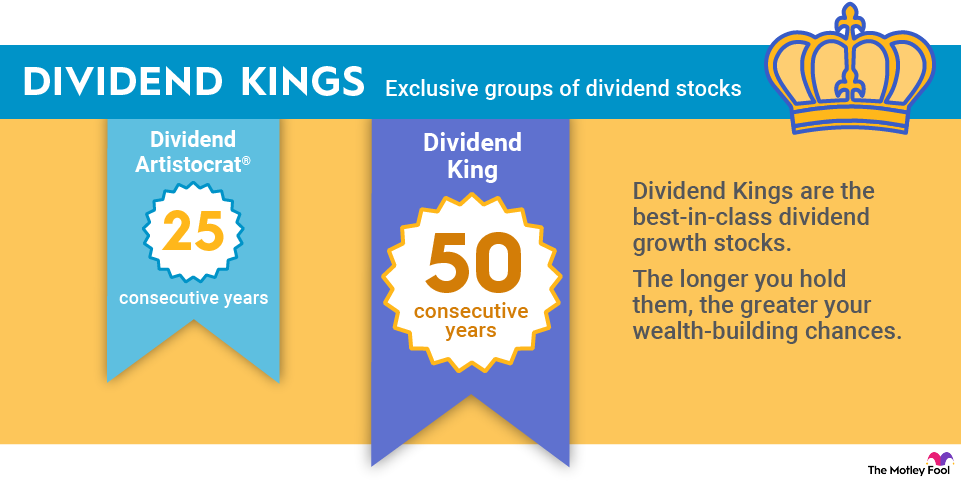
Still, given Walmart's history, it has demonstrated the ability to navigate a variety of challenges while rewarding shareholders. For decades, even amid war, stagflation, inflation, bear markets, technological disruptions, and numerous other challenges, Walmart has increased its dividend payout for 53 consecutive years, making it a Dividend King. It knows how to navigate headwinds, and as a provider of groceries, pharmacy items, and household essentials, it still sees people flock to it during challenging times because of its low prices and convenience.
Turning to stock price potential, despite the current challenges, there's a lot to like thanks to the company's adoption of technology. Walmart is seeing success with its artificial intelligence shopping agent, Sparky, and shoppers who use it spend 40% more than those who don't. It's also seeing more revenue from its online presence in general, with global e-commerce sales up 23% in the second quarter of its fiscal 2027.
With a history of continuous dividend payouts and the potential to outperform broader markets, Walmart is worth a second look for dividend investors.