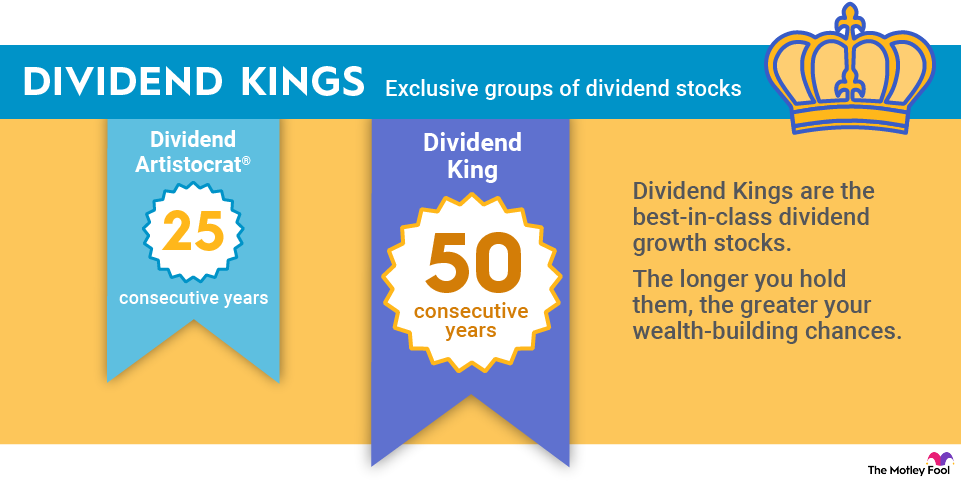
Medtronic (MDT +2.62%), one of the world's largest medical device makers, raised its dividend for the 49th consecutive year this June. If it raises its dividend again next year, it will cross the 50-year threshold required for becoming a Dividend King.
But over the past five years, Medtronic's stock has declined 31%. Even with reinvested dividends, it delivered a negative total return of 19%. Let's see why Medtronic's stock slumped, and why it might be worth buying as an income-generating turnaround play.

Image source: Getty Images.
What happened to Medtronic?
Medtronic was once considered a reliable blue chip stock. But in fiscal 2023 and fiscal 2024 (which ended in April 2024), its EPS declined as it struggled with supply chain constraints, inflation, forex headwinds, a lumpy recovery in elective procedures after the pandemic, and regulatory hurdles for its diabetes unit. It also faced tougher competition, quality-control issues, and the rise of GLP-1 drugs, which could reduce demand for certain medical procedures.
Medtronic spun off and restructured some of its lower-margin businesses to offset that pressure, but those near-term costs reduced its net income and EPS. In fiscal 2025 and fiscal 2026, its EPS grew again as its component costs normalized, its new diabetes products were approved, and it expanded its higher-growth cardiovascular and neuroscience businesses. It also completed the spin-off of its diabetes unit, MiniMed (MMED +3.61%), this March.

NYSE: MDT
Key Data Points
Why is Medtronic worth buying?
In fiscal 2026, Medtronic's revenue grew 8.4% (5.8% organically), marking its strongest top-line growth in a decade. That acceleration was mainly driven by its cardiovascular business, which grew 9.3% organically and accounted for over 38% of its enterprise revenue. All of Medtronic's other business segments also grew organically.
Medtronic expect its organic revenue to rise 7.25%-7.75% in fiscal 2027. From fiscal 2026 to fiscal 2029, analysts expect its reported revenue and EPS to grow at CAGRs of 5% and 15%, respectively. At $87 per share, it still looks like a bargain at 18 times this year's earnings.
Medtronic pays a forward dividend yield of 3.4%. It has plenty of room to raise that payout, which only consumed 70% of its EPS and 60% of its free cash flow (FCF) over the past 12 months. So when more investors notice that Medtronic's business is growing again and it's on track to become a Dividend King next year, it could finally command a higher valuation.