Strike Price
About the Author
Lyle Daly has no position in any of the stocks mentioned. The Motley Fool has positions in and recommends Apple and Netflix. The Motley Fool has a disclosure policy.
Invest better with The Motley Fool. Get stock recommendations, portfolio guidance, and more from The Motley Fool's premium services.

If you're interested in options trading, one of the first things to learn is the difference between call options and put options. You'll see these terms used frequently, so understanding them is a must.
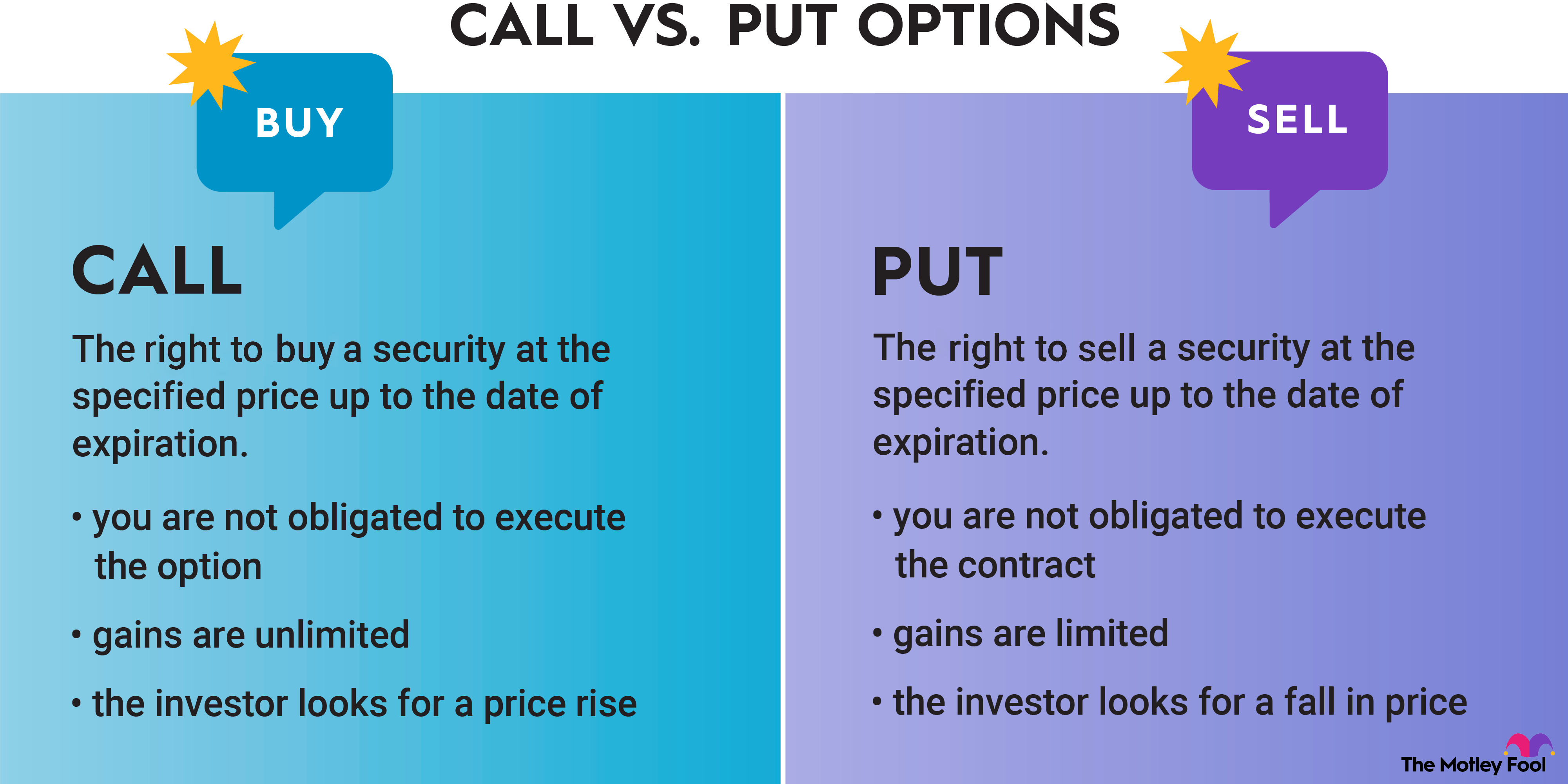
A call option is the right to buy a stock at a specific price by an expiration date, and a put option is the right to sell a stock at a specific price by an expiration date. That's the summary. Now, let's take a closer look at how call and put options work, as well as the risks involved with options trading.
A call option is a contract tied to a stock. You pay a fee, called a premium, for the contract. That gives you the right to buy 100 shares of the stock at a set price, known as the strike price, at any point until the contract's expiration date.
You're not obligated to execute the option. If the stock price increases enough, you can exercise it or sell the contract for a profit. If it doesn't, then you can let the contract expire and only lose the premium you paid. You could also sell before expiration for a lower price than what you paid.
The breakeven point on a call option is the sum of the strike price and the premium. When you have a call option, you can calculate your profit or loss at any point by subtracting the current price from the breakeven point.
Let's say you're bullish on a stock that's trading at $150 per share. You buy a call option with a strike price of $170 that expires in six months, and it costs a premium of $15 per share. Since options contracts cover 100 shares, the total cost would be $1,500.
The breakeven point would be $185 (the $170 strike price plus the $15 premium). If the share price increases to $195, your profit would be $10 per share, totaling $1,000.
A put option is a contract tied to a stock. You pay a premium for the contract, giving you the right to sell 100 shares of the stock at the strike price. You can execute the contract at any time until its expiration date.
If the price of the stock decreases enough, then you can sell your put option for a profit. You're not obligated to execute the contract, so if the asset's price doesn't drop enough, you can let it expire.
The breakeven point on a put option is the difference between the strike price and the premium. When you have a put option, you can calculate your profit or loss at any point by subtracting the breakeven point from the current price.
Imagine a stock trades at $500 per share, and you think it's overvalued. You buy a put option with a strike price of $450 and an expiration date 12 months away. The premium is $10 per share, for a total of $1,000 for the put option.
The breakeven point would be $440, the difference between the $450 strike price and the $10 premium. If the stock plummets to $400, then you're up $40 per share ($4,000 total) on your put option. If it doesn't drop below $450 at all, you'd either need to sell at a loss before the option expires or let it expire and eat the premium.

The risk of buying both call and put options is that they expire worthless because the stock doesn't reach the breakeven point. In that case, you lose the amount you paid for the premium.
It's also possible to sell call and put options, which means another party would pay you a premium for an options contract. The risk of selling options is that you're responsible for fulfilling the contract. That means you'd need to:
Buying and selling options carry different risks. There tends to be more risk of losing money when you buy options, but the most you can lose is what you paid for the contract. Selling options usually has a higher probability of profit, but losses can be much greater.
Options can be riskier than buying and selling stocks because there's a greater possibility of coming away with nothing. When investing in stocks, you only need to predict whether the stock goes up or down, and there's no time limit to get it right. For options trading, you need to predict three things correctly:
If you're wrong about any of those, then the options contract will be worthless. While there's the potential for greater returns with options, they're also harder to trade successfully.
Despite the challenges of trading call and put options, they offer an opportunity to amplify your returns. That can make them a valuable addition to a balanced portfolio. For investors interested in options, there are also more advanced strategies that go beyond buying or selling calls and puts.