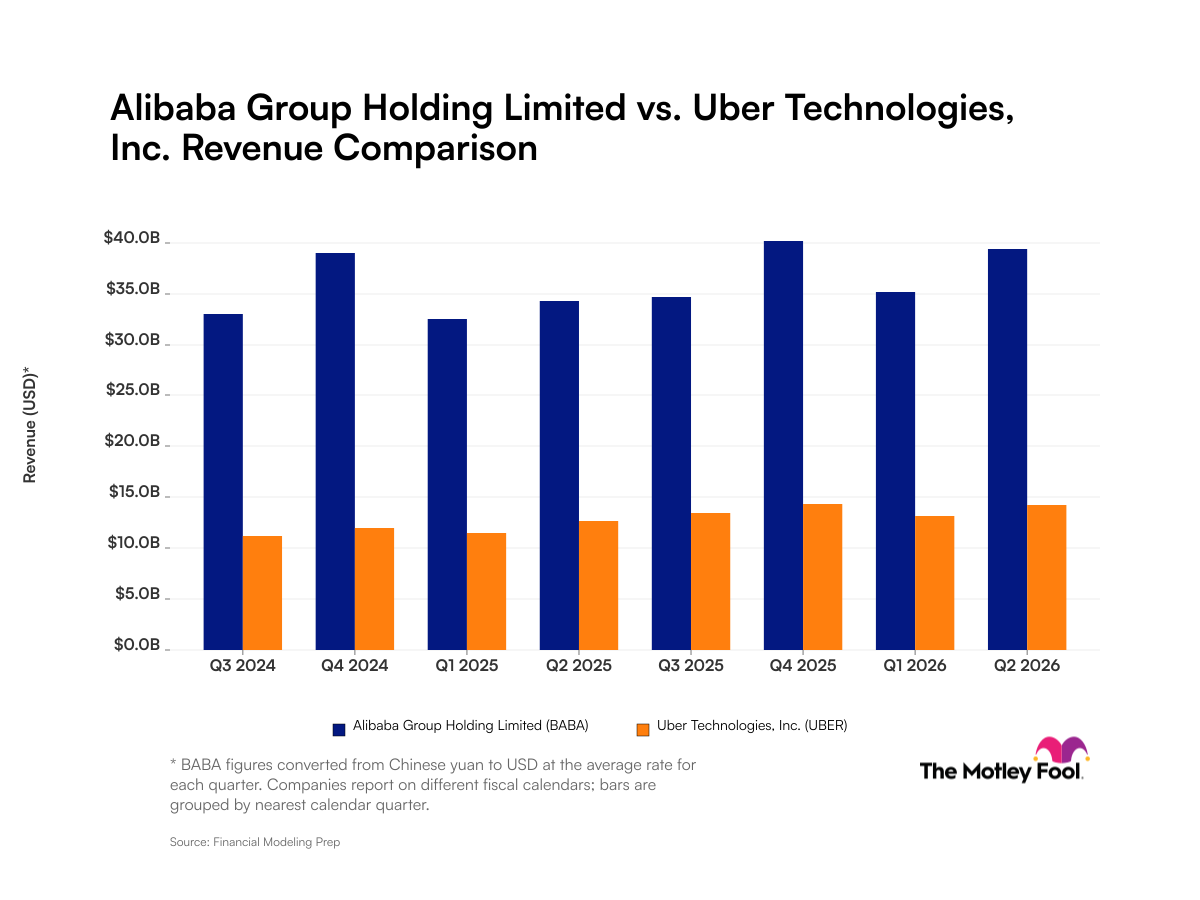
Alibaba Group (BABA +4.68%) and Uber Technologies (UBER +2.01%) are both attempting to define the next era of their respective industries. Which of these platform leaders is the better buy for your portfolio right now?
Alibaba is a cornerstone of Chinese commerce and cloud infrastructure, while Uber has transformed global mobility and logistics. Both companies have moved past their early growth phases and are now focused on long-term efficiency and shareholder value.
BABA & UBER: Performance Comparison
Key Financial Metrics


The case for Alibaba
Alibaba Group is a global technology leader focusing on consumption and artificial intelligence cloud services. As a leader among consumer discretionary stocks, the company operates a massive ecosystem that includes Chinese e-commerce marketplaces and international digital trade platforms. It serves millions of users and employs more than 131,000 full-time staff to maintain its dominant position. The company does not disclose major customers in its latest annual report, though it serves a vast array of merchants and brands.
In the fiscal year ended March 31, 2026, revenue reached $148.4 billion, representing a growth of roughly 2.7% compared with the prior fiscal year. The company reported net income of approximately $15.5 billion for this period. This resulted in a net margin of close to 10.1%, which is the percentage of revenue remaining after all expenses are paid.
As of its March 2026 balance sheet, the debt-to-equity ratio was roughly 0.2x, which compares total debt to shareholder equity. The current ratio, which measures the ability to pay short-term debts with short-term assets, was approximately 1.3x. Free cash flow, which is cash from operations minus capital expenditures, was negative $6.76 billion for the fiscal year ended March 31, 2026.
The case for Uber Technologies
Uber Technologies operates a massive technology platform connecting riders, diners, and shippers across over 70 countries and 15,000 cities. The business recently expanded through the acquisition of Delivery Hero (DLVHF +0.00%) and manages a network of over 200 million monthly users. Partnerships with Tesla (TSLA +2.20%) and Alphabet (GOOGL +0.86%) are central to its long-term vision for automated mobility and delivery services.
In the fiscal year ended Dec. 31, 2025, revenue reached close to $52.0 billion, which was an increase of approximately 18.3% year over year. Net income for the period was nearly $10.1 billion, yielding a net margin of approximately 19.3%. This metric shows the percentage of revenue kept as profit after accounting for all operational and financial costs.
Based on its December 2025 balance sheet, Uber carries a debt-to-equity ratio of approximately 0.4x. Its current ratio was roughly 1.1x, providing a basic margin for meeting immediate financial liabilities. Free cash flow, representing cash from operations minus capital expenditures, reached nearly $9.8 billion for the fiscal year ended Dec. 31, 2025.
Risk profile comparison
Alibaba faces significant competition in the Chinese e-commerce market from domestic rivals and global firms like Amazon (AMZN -0.05%). It must also navigate a complex regulatory environment that impacts its cloud and fintech operations. Additionally, shifts in consumer spending habits and macroeconomic conditions in its core markets can affect its overall revenue growth.
Uber faces ongoing legal risks regarding the classification of drivers as independent contractors. The company also deals with litigation related to safety issues and shareholder claims. Competition from Lyft (LYFT +1.75%) and logistics firms like XPO (XPO -1.74%) or RXO (RXO +22.54%) requires constant spending on incentives. Furthermore, the $14.8 billion acquisition of Delivery Hero and heavy investments in autonomous technology with partners like Alphabet carry significant integration and execution risks.
Valuation comparison
Alibaba is the value choice, offering a lower Forward P/E using future earnings estimates and a P/S ratio based on sales over the past twelve months.
| Metric | Alibaba | Uber Technologies |
|---|---|---|
| Forward P/E | 16.4x | 20.3x |
| P/S ratio | 1.6x | 2.5x |
Valuation metrics include sourcing from Financial Modeling Prep (FMP) and may differ from other data providers.
Which stock would I buy in 2026?
I'd go with Uber. The company is performing at one of the highest levels in its history, with revenue, bookings, and profitability all accelerating right now. Its platform spans ridesharing, food delivery, and freight across dozens of countries, all three growing simultaneously. Gross bookings have grown at a double-digit rate for several consecutive quarters, free cash flow is substantial, and early investments in autonomous vehicle partnerships give it a credible path into the next era of transportation.
Alibaba is a more interesting company than its beaten-down stock price suggests. The shares have fallen significantly this year despite improving business fundamentals: Cloud revenue is being driven by AI demand, the e-commerce business is holding up, and the valuation is lower than it has been in years. For investors comfortable with the geopolitical risk of owning a Chinese company listed in the U.S., there is a case to be made.
But that geopolitical risk is persistent and hard to plan around. Regulatory uncertainty between the U.S. and China adds a layer of unpredictability that Uber simply does not carry. For a patient investor, Uber's diversified platform and growing free cash flow make it the more comfortable long-term pick.