The semiconductor landscape is shifting as AI demands redefine hardware requirements. Choosing between Intel (INTC -5.88%) and Qualcomm (QCOM -3.29%) requires weighing a massive manufacturing turnaround against a mobile titan's expansion.
Intel is betting its future on becoming a world-class foundry for other chip designers, while Qualcomm is leveraging its 5G leadership to capture new markets in automotive and computing. Both companies are central to the technology narrative, but they offer vastly different financial profiles and risk levels for investors.
The case for Intel
Intel designs and manufactures processors, accelerators, and software, serving as a heavyweight among semiconductor stocks. It is aggressively expanding its foundry business to produce chips for other designers, recently deepening its partnership with Applied Materials (AMAT -4.35%). This strategy targets the growing need for specialized hardware in a world increasingly dominated by artificial intelligence.
In fiscal 2025, revenue reached nearly $52.9 billion, a slight decline of roughly 0.5% from the previous year. The company reported a net loss of approximately $267 million, which resulted in a net margin of negative 0.5%. This performance reflects the massive research and development costs associated with reclaiming its process technology leadership after several years of falling behind competitors.
As of its December 2025 balance sheet, Intel has a debt-to-equity ratio of 0.4, which measures total debt relative to shareholders' equity. Its current ratio, comparing short-term assets to liabilities, is a healthy 2, but free cash flow was negative at nearly $4.9 billion. Note that stock-based compensation accounted for roughly 25.1% of operating cash flow, inflating reported cash generation, since SBC is a non-cash expense added back in the cash flow statement.
The case for Qualcomm
Qualcomm develops essential wireless technologies, providing modems and processors for major smartphone brands like Samsung and Xiaomi (XIACF -0.58%). It also generates significant income by licensing its massive portfolio of 5G intellectual property to other manufacturers. A high concentration of sales comes from a few massive customers like Apple (AAPL +0.02%), and customer concentration like this adds a layer of risk to the business.
In fiscal 2025, revenue reached roughly $44.3 billion, representing growth of nearly 13.7% from the prior year. Qualcomm achieved net income of approximately $5.5 billion, resulting in a net margin of 12.5%. This net margin indicates the percentage of total revenue that remains as profit after all expenses are paid, showing the company's ability to turn sales into actual earnings.
As of its September 2025 balance sheet, Qualcomm has a debt-to-equity ratio of 0.8, suggesting it uses more debt relative to its equity than Intel. The current ratio is strong at roughly 2.8, indicating the business has ample liquid assets to cover short-term debts. Free cash flow for the period was robust at nearly $12.8 billion.
INTC & QCOM: Performance Comparison


Key Financial Metrics
Risk profile comparison
Intel faces intense competition from rivals focused on high-performance AI chipmaking. The cyclical nature of the industry often leads to volatile revenue and operational stability. It also requires significant capital expenditures to maintain leadership in process technology, and any supply chain dependencies could further disrupt its manufacturing goals.
Qualcomm is exposed to risks from customers developing their own internal chips, which could reduce demand for its products. A heavy geographic concentration in China makes it vulnerable to trade tensions and geopolitical shifts. Additionally, the company relies on third-party foundries for manufacturing and faces persistent legal challenges regarding its intellectual property licensing.
Valuation comparison
Qualcomm appears more affordably priced than Intel based on current valuation multiples. The forward P/E compares the stock price to future earnings estimates, while the P/S ratio uses sales over the past 12 months as the denominator to evaluate the stock price.
| Metric | Intel | Qualcomm |
|---|---|---|
| Forward P/E | 63.7 | 17.1 |
| P/S ratio | 9.2 | 4.1 |
Valuation metrics include sourcing from Financial Modeling Prep (FMP) and may differ from other data providers.
Which stock would I buy in 2026?
Intel is not especially attractive here. It's in the midst of a massive business overhaul, and that costs (lots of) time and money. It reported a massive net loss of over $18 billion in the previous fiscal year, and the company also suspended its dividend as it works to build out its foundries. Furthermore, its valuation compares unfavorably to Qualcomm's.
Qualcomm is not in the middle of reinventing itself. Its stock is also cheaper, and it pays a modest dividend yielding roughly 2%. The chip specialist isn't posting mega growth, but it's also not reporting losses. Ordinarily, I'd say the choice here is pretty obvious.
But (you knew there was a "but" coming, right?) Intel's stock has climbed twice as much as Qualcomm over the past five years, and it has slightly outperformed the S&P 500, to boot. Past performance is no indication of future results, of course, but pulling up that five-year chart gave me pause. Now consider this chart:
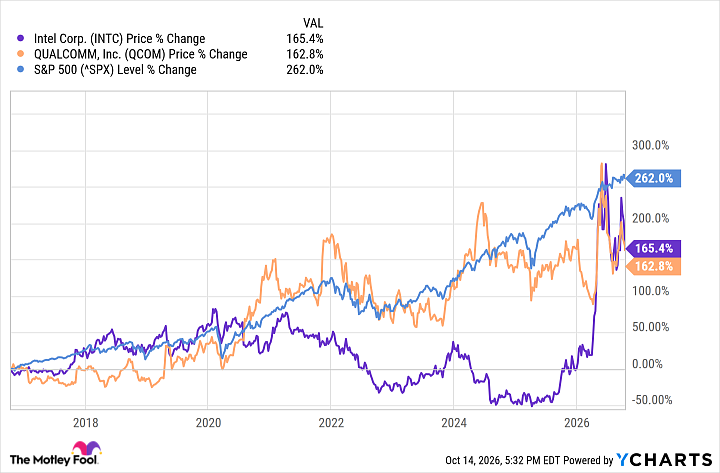
Over the past 10 years, neither company's shares have come even close to the S&P 500's return. The whole point of investing in individual stocks is to outperform the market, and yet neither Intel nor Qualcomm did.
Twist my arm, I'd buy shares of Qualcomm. But honestly, I'd rather buy Vanguard S&P 500 ETF (VOO -1.39%).