Amazon.com: Balancing Retail Scale and Cloud Expansion
Amazon.com (AMZN +3.97%) primarily generates revenue by operating a vast global e-commerce retail enterprise alongside providing comprehensive cloud computing, digital advertising, and subscription services.
It faced regulatory scrutiny from the National Labor Relations Board and launched a private freight network, while it reported a net income margin of 17% for the quarter ended March 31, 2026.
Shopify: Sustaining E-Commerce Growth
Shopify (SHOP -0.93%) primarily generates its revenue by providing an extensive suite of software, financial tools, and operational services that equip independent merchants to run digital and physical storefronts globally.
It settled a copyright lawsuit with a competitor and experienced a temporary administrative outage. It reported a net income margin of -18% for the quarter ended March 31, 2026.
Why Revenue Matters for Retail Investors
Revenue serves as a crucial baseline indicator for investors to assess a company's fundamental ability to generate continuous customer demand and scale its ongoing operations over time.
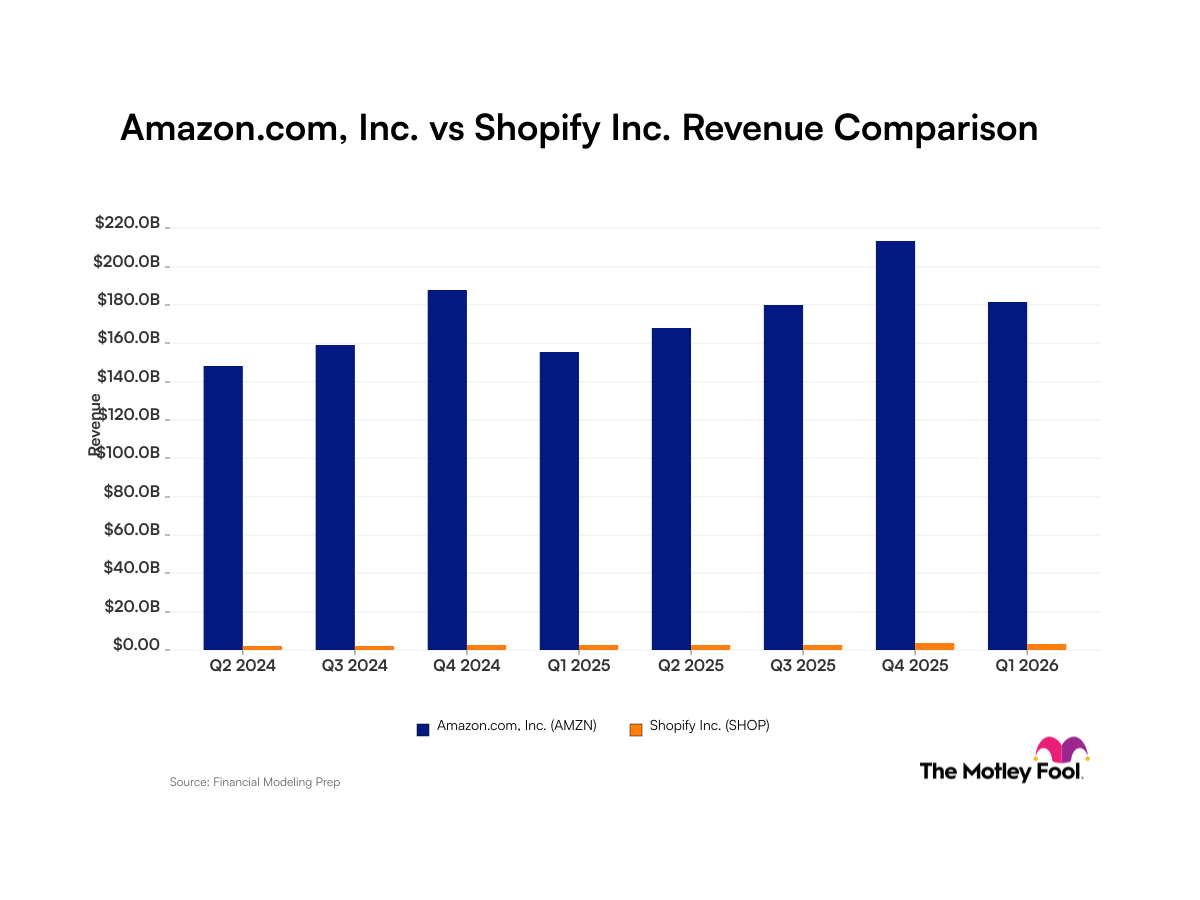
Quarterly Revenue for Amazon.com and Shopify
| Quarter (Period End) | Amazon.com Revenue | Shopify Revenue |
|---|---|---|
| Q2 2024 (June 2024) | $148.0 billion | $2.0 billion |
| Q3 2024 (Sept. 2024) | $158.9 billion | $2.2 billion |
| Q4 2024 (Dec. 2024) | $187.8 billion | $2.8 billion |
| Q1 2025 (March 2025) | $155.7 billion | $2.4 billion |
| Q2 2025 (June 2025) | $167.7 billion | $2.7 billion |
| Q3 2025 (Sept. 2025) | $180.2 billion | $2.8 billion |
| Q4 2025 (Dec. 2025) | $213.4 billion | $3.7 billion |
| Q1 2026 (March 2026) | $181.5 billion | $3.2 billion |
Data source: Company filings. Data as of July 7, 2026.
Foolish Take
In typical fashion for companies in the retail sector, Amazon and Shopify see their largest sales in the fourth quarter thanks to the holiday shopping season. Both are experiencing year-over-year revenue growth, which is a sign that their businesses continue to expand. Shopify boasts the higher growth rate with first-quarter sales soaring 34% year over year compared to Amazon’s 17%.
Still, Amazon’s total sales far exceed Shopify’s, and looks likely to remain that way due to where each is going with their growth strategies. Shopify focuses on being a technology provider to smaller enterprises interested in selling online. With the rise of artificial intelligence, it is adding functionality that can further galvanize merchant sales on its platform.
Amazon has extended beyond its e-commerce roots to become a provider of artificial intelligence for other businesses. Rather than Shopify’s approach of baking in a set of AI features into its solutions, Amazon has constructed a proprietary AI model that differentiates it from competitors. The move has been costly, as the company builds up its AI infrastructure. It turned to offering $25 billion in bonds recently to fund its AI expansion.
Even so, Amazon’s stock remains a much better value at a price-to-sales ratio of four compared to Shopify’s 13. In fact, Shopify’s high valuation looks like a factor in the stock’s fall to a 52-week low of $94 in May.