Image source: The Motley Fool.
DATE
Thursday, May 28, 2026 at 5 p.m. ET
CALL PARTICIPANTS
- Chief Executive Officer — Daniel Solomon Dines
- Chief Operating and Financial Officer — Ashim Gupta
- Vice President, Investor Relations — Allise Furlani
Need a quote from a Motley Fool analyst? Email [email protected]
TAKEAWAYS
- Annualized Recurring Revenue (ARR) -- $1.901 billion, up 11%, driven by $49 million net new ARR and FX tailwind of $9 million.
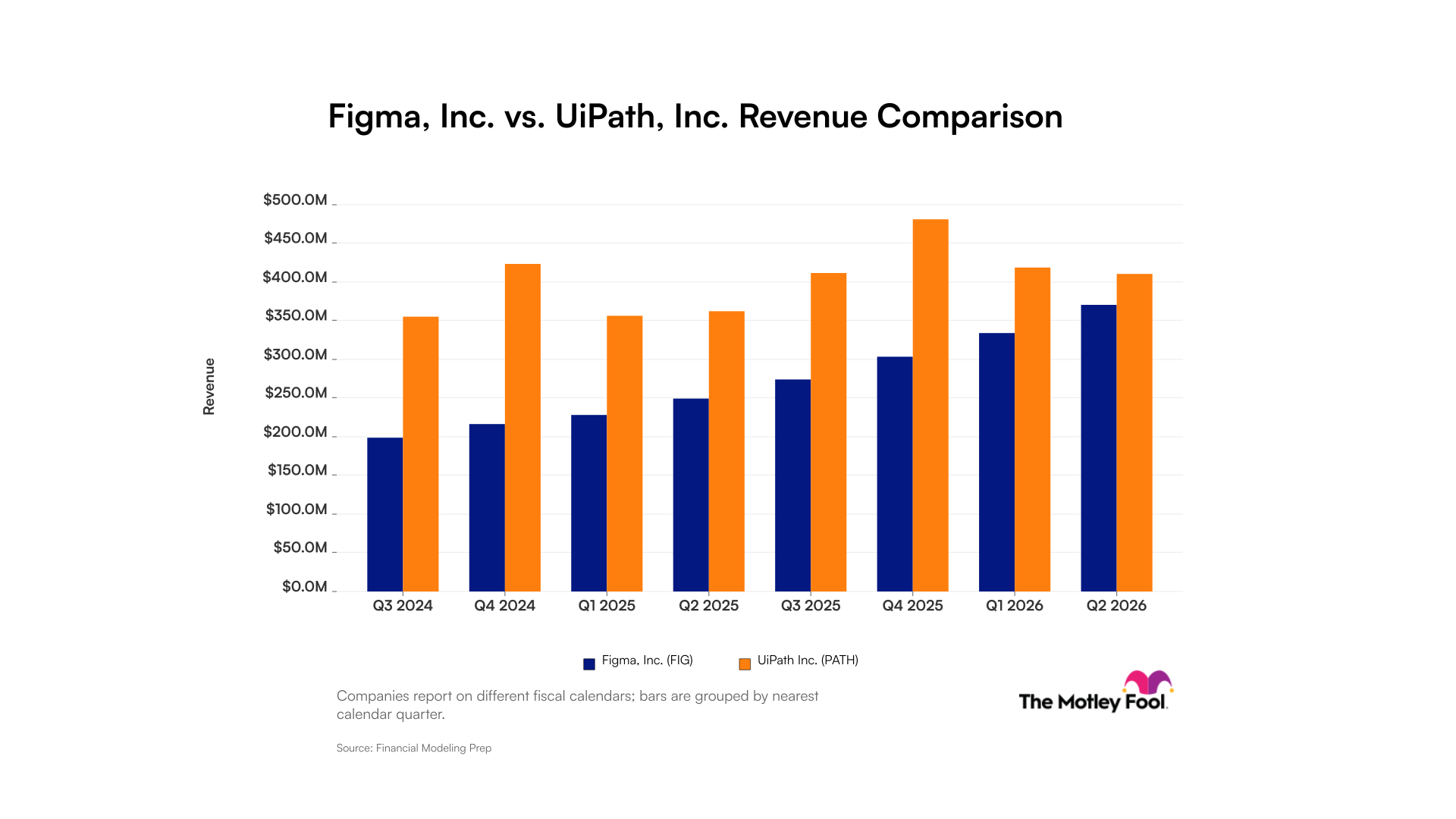
- Revenue -- $418 million, up 17%, with a $7 million positive FX impact; 15% growth normalized for FX.
- Non-GAAP Operating Income -- $92 million, yielding a 22% margin, increasing over 250 basis points year over year.
- GAAP Operating Income -- Positive $28 million, marking the company's first profitable quarter on a GAAP basis, versus a prior-year operating loss of $16 million.
- Non-GAAP Adjusted Free Cash Flow -- $130 million, reflecting operational efficiency improvements.
- Gross Margin -- 83% overall; software gross margin at 90%.
- Dollar-Based Gross Retention Rate -- 97%; net retention rate at 109%, or 108% normalized for FX and M&A.
- Customer Growth -- Total approximately 10,600; customers with ARR above $100,000 up 11% to 2,620; those above $1 million up 18% to 374; customers over $30,000 in ARR grew 7%.
- Share Repurchases -- 20 million shares repurchased at an average price of $11.47; an additional 2 million shares bought at $9.63 through May 27, 2026.
- Cash and Equivalents -- $1.4 billion on balance sheet with no debt.
- AI Integration in Deals -- AI featured in 16 of the top 20 deals; expansion deals with AI were six times larger than those without.
- Process Orchestration Adoption -- Increasing enterprise focus, with specific expansions tied to Maestro and new Maestro Case capabilities.
- Test Cloud Momentum -- Notable adoption in regulated and enterprise clients, with discrete examples translating to multi-million dollar customer savings.
- Vertical Solutions Momentum -- Large new logo wins and significant expansions in healthcare, financial services, and the office of the CFO, including a Latin American healthcare provider expecting $12 million in cumulative benefits.
- Guidance Raised -- Second-quarter revenue guided to $395–$400 million and ARR to $1.929–$1.934 billion; for the full fiscal year, revenue is guided to $1.776–$1.781 billion and ARR to $2.058–$2.063 billion; non-GAAP operating income forecast at $430 million for the year.
- Public Sector -- Stable relationships and active opportunities noted across agencies, with funding carefully monitored and a “measured and prudent” guidance approach maintained.
- Pricing Model -- Subscription and server-based pricing dominate over per-seat or consumption models; outcome-based and process-based pricing evolving for top-tier clients.
- Deterministic and Agentic Automation -- Strategic emphasis on integrating both, with “coding agents” enabling reduced implementation and maintenance time; company positions deterministic and agentic capabilities as complementary and non-cannibalizing.
- Partner Ecosystem Expansion -- Deeper integration with Deloitte and Accenture, resulting in embedded UiPath solutions and client expansions across multiple verticals.
SUMMARY
Enterprise adoption of UiPath (PATH +1.36%)'s agentic AI and process orchestration accelerated, with customer priorities shifting toward end-to-end automation that leverages both deterministic and AI-driven workflows. Management highlighted that Maestro and newly introduced Maestro Case are driving broader transformation, particularly in complex, multi-stage enterprise environments. UiPath’s AI modules generated significant deal sizes and are now pivotal to enterprise expansions, especially in regulated, document-intensive, and vertical-specific use cases such as healthcare and financial services. Strategic partners contributed to expanded deployments, while vertical solutions saw traction from new logo wins and measurable operational savings. Share repurchases continued to be executed amid disciplined expense management, and liquidity remained strong, supporting both near-term investments and longer-term profitability targets.
- The company emphasized its platform’s flexibility for integrating external and proprietary AI models, promoting a model-agnostic strategy to accommodate diverse enterprise requirements.
- CEO Daniel Solomon Dines stated, “AI creates automation. Sometimes maybe even on the flight. You will run those automations it is very cheap to run, very deterministic, reliable, auditable, and only when these scripts break you can invoke again AI to fix the scripts.”
- Testing and validation automation is embedded across the full software delivery lifecycle, with Test Cloud referenced as a core differentiator.
- Customer cohort analysis showed attrition remained concentrated in smaller clients while enterprise penetration expanded, aligning with UiPath’s growth strategy to deepen relationships with complex, high-value customers.
- Pricing strategies are evolving, with discussions of outcome-based and use-case-driven models becoming material in negotiations with large enterprise clients.
INDUSTRY GLOSSARY
- Agentic Automation: Automation processes leveraging AI-powered “agents” capable of reasoning and acting autonomously across workflows, beyond traditional rule-based automation.
- Deterministic Automation: Automation tasks defined by predictable, rules-based scripts that guarantee the same outcome when repeated, critical for regulated enterprise use cases.
- Maestro: UiPath’s platform module for process orchestration, enabling management of workflows involving humans, automations, systems, and AI agents in complex business scenarios.
- Maestro Case: A UiPath feature extending Maestro beyond structured process orchestration to unstructured, multi-stage enterprise work.
- Test Cloud: UiPath’s cloud-based automated testing solution, designed to continuously validate both deterministic and agentic workflows at scale.
- IXP: UiPath’s Intelligent Document Processing solution for automating high-volume, unstructured document workflows.
- Forward Deployed Engineering (FTE): UiPath teams dedicated to hands-on customer workflow design and deployment, bridging innovation and implementation.
Full Conference Call Transcript
Operator: Good day, everyone. My name is Megan, and I will be your conference operator today. At this time, I would like to welcome you to the UiPath first quarter 27 earnings conference call. All lines have been placed on mute to prevent any background noise. After the speakers' remarks, there will be a question and answer session. If you would like to ask a question during this time and if you have joined via the webinar, please use the raise hand icon, which can be found on the bottom of your webinar application. If you have dialed in by phone, please press 5 to raise your hand.
Please note that all participants will be limited to 1 question and 1 follow-up.
Allise Furlani: At this time, I would like to turn the call over to Allise Furlani, vice President of Investor Relations. Good afternoon, and thank you for joining us today to review UiPath's first quarter fiscal 27 financial results which we announced in our earnings press release issued after the close of the market today. On the call with me are Daniel Solomon Dines, founder and chief executive officer, and Ashim Gupta, chief operating and financial officer. To deliver our prepared comments and answer questions. Our earnings press release and financial supplemental materials are posted on the UiPath Investor Relations website. These materials include GAAP to non GAAP reconciliations. We will be discussing non GAAP metrics on today's call.
This afternoon's call includes forward looking statements regarding our financial guidance for the second quarter and full year fiscal 2027, and our ability to drive and accelerate future growth and operational efficiency, and grow our platform, product offerings and market opportunity. Actual results may differ materially from those expressed in the forward looking statements due to many and therefore investors should not place undue reliance on these statements. For a discussion of the material risks and uncertainties that could affect our actual results, please refer to our annual report on Form 10 ks for year ended January 31, 2026, our subsequent reports filed with the SEC. Forward-looking statements made on this call reflect our views as of today.
We undertake no obligation to update them. I would like to highlight that this webcast is being accompanied by slides. We will post the slides and a copy of our prepared remarks to our Investor Relations website immediately following the conclusion of this call. In addition, please note that all comparisons are year over year unless otherwise indicated.
Daniel Solomon Dines: Now I would like to hand the call over to Daniel. Thank you, Allise. Good afternoon, everyone. Thanks for joining us. We delivered a strong start to fiscal 27. Once again exceeding our guidance across all key financial metrics. Before I dive into the results, I want to take a moment to reflect on our progress over the last year. In May of last year, we launched our AgenTeam™ and Business orchestration products in general availability. 1 year in, adoption has moved from early experimentation to production deployment. We are seeing this play out across 3 areas in particular. Install base expansion, process orchestration adoption, and vertical AI workflows.
A great example is 1 of the largest healthcare distribution companies in the US. 1 end-to-end workflow combining UiPath agents and better deterministic automations is expected to drive multimillion dollar annual savings. Which led to a 7-figure expansion in the quarter. 1 of the world's largest construction companies adopted our purchase to pay vertical solution and told us they chose UiPath. Not as a software vendor, but as a strategic co development partner for their enterprise AI transformation. And the Fortune 500 energy company placed UiPath at the center of a $70 million cost reduction initiative made possible by our ability to bring deterministic, agentic, and process orchestration together as a single class platform.
Turning to the quarter, First quarter ARR reached $1.901 billion, up 12% year over year. Driven by $49 million of net new ARR and revenue of $418 million, up 17% year over year. We grew first quarter non GAAP operating income to $92 million, a 22% margin. Driven by improved operational efficiency and disciplined execution across the business. And we delivered first quarter GAAP profitability for the first time in company history. This quarter's performance is built on the strength of our enterprise automation installed base, Thousands of customers with deep platform adoption proven ROI, and a track record of expanding with us over time. And it reflects continued momentum with our AI products.
In the quarter, 16 of the top 20 deals included AI, and expansion deals that included AI were 6x larger than those that did not. The drivers behind these results are the same core differentiators we outlined last quarter. Our platform that brings together deterministic and agentic automation, with enterprise grade process orchestration. Our installed base flywheel, our governance foundation, and our ability to combine a horizontal automation platform with deep vertical solutions. I saw that momentum firsthand across our global events including in India. At our annual Fusion event and DevCon developer conference. Across customers, developers, and partners, The message was consistent. Enterprises increasingly need the platform that can govern and orchestrate humans agents, workflows, automations, and systems.
An area where UiPath has a structural advantage. At DEFCON, we launched UiPath for coding agents enabling developers to connect their coding agent of choice to create, test, deploy, and manage automations across the full life cycle on the UiPath platform with enterprise grade governance and reliability built in. This matters because nearly every customer conversation surfaces the same constraint. An automation backlog that outpaces their capacity to build and maintain. Implementation is often the hardest part particularly in complex enterprise environments. Where upstream system changes can drive maintenance costs over time.
By combining coding agents with the governance orchestration, and self healing capabilities built into our platform, we can dramatically reduce that operational burden and compress deployment time from quarters to weeks. We expect this to accelerate time to value for our customers drive deeper adoption and strengthen long term retention across our customer base. Our internal teams and customers are also seeing great results with coding agents. Including 1 of the world's largest consumer electronics companies, which reduced a 4-week project build to 3 hours. And 1 of the world's largest chip manufacturers reduced a 2-month project build to a few days.
What stood out most this quarter is how clearly customer priorities have evolved with the focus consistently centered on process orchestration. As 1 customer, put it during DevinCon, Models are easy. Orchestration is not. That directly reflects what we hear across our customer base. Customers are no longer asking us simply to deploy more agents. Or generate more code. They are asking us to transform how entire businesses operate through end to end workflows that span departments, connect systems, and deliver measurable operational outcome. And delivering that kind of transformation requires more than individual AI agent. It requires a platform that can orchestrate agents automations, API, system, and people together within secure governed enterprise workflows.
A great example is 1 of the world's largest telecommunications company. With nearly 2,000 processes already automated and over $30 million in annual cost savings They are now expanding their deterministic base further and moving into agentic workflows building a pipeline of more than 200 additional deterministic automations and over 20 agentic use cases. That same process orchestration capability also drove a competitive displacement with the Fortune Global 500 electronics manufacturer where we were the only platform that could take them from task based automation to enterprise wide business process orchestration. Building on a strong deterministic foundation, they are now expanding across manufacturing and supply chain workflows using Maestro to coordinate automations, agent systems, and human decision-making globally.
Maestro already excels at workflows like invoice approvals and deployment pipelines. Where the process itself is clearly defined. But increasingly, enterprise work is nonlinear and it is dynamic, exception driven, and centered around business processes that move across teams and systems. This is why at DEFCON we launched Maestro Case into public preview extending Maestro beyond traditional process orchestration into the orchestration of unstructured enterprise work. The breadth is what makes UiPath the most complete process orchestration and automation platform in the market. And it is already driving broader customer adoption including Sonic Automotive, an early adopter of our agentic products, They initially deployed UiPath to automate vehicle stocking and sales lead follow-up.
They are now standardizing their agentic automation strategy on the UiPath platform under a broader c suite initiative and expanding into workflow such as month-end close and employee onboarding. The key driver of the expansion was Maestro Case's ability to orchestrate complex multistage workflows across agents, automations, and people. Beyond process orchestration, documents remain 1 of the biggest sources of friction in enterprise work. And customers are increasingly turning to UiPath IXP, to automate document intensive workflows at enterprise scale. In May, we were named a leader in the Forrester Wave, document mining and analytics platforms, Q2 26. We are seeing that momentum translate directly into largest enterprise deployment and competitive wins.
A great example is the leading medical technology company that is standardizing on UiPath Cloud IXP to automate high volume unstructured documents like invoices and purchase orders. The customer is already realizing approximately $5 million in annual savings and expects that to grow to $10 million as they scale. Demand for industry specific, governed workflows continues to grow as enterprises increasingly adopt purpose built AI solution tailored to their business. What differentiates UiPath is our ability combine those deep domain specific solutions with the same process orchestration, automations, and governance platform. This quarter, we expanded our portfolio across financial services retail, and manufacturing. And the office of the CFO.
We are already seeing momentum in health care in a 7-figure new logo win. A leading Latin American healthcare provider selected our vertical solutions to support revenue cycle management. Medical records summarization, and claim denial management, and expect $12 million in cumulative benefits. Customers are also realizing operational benefits from these vertical solutions. A leading healthcare technology company reduced clinical summary review times by 90% using our medical records summarization solution. We are seeing similar momentum in financial services A regional bank is now automating 61% of sanctions hit reviews with our transaction screening alert review solution processing roughly 14 thousand alerts per month. AI is accelerating software creation. but it is also accelerating the need to validate it.
As code volume grows, so does the testing burden. Independent research firms have consistently recognized UiPath as a leader in this space. And we believe that validation reflects the real and growing structural advantage. Test Cloud is at the center of that. Helping customers move testing from a downstream bottleneck to a continuous intelligent function. Embedded across the delivery life cycle. 1 example this quarter is a leading U. S. Utility provider that adopted UiPath Test Cloud for agentic testing to streamline customer platform support launch. The solution is expected to significantly reduce manual testing while generating nearly $3 million in savings. During the quarter, we continued to deepen our partnerships across both go to market and technical integrations.
This included our expanded collaborations with Deloitte. Embedding UiPath Test Cloud into their Ascend™ delivery platform. Bringing agentic testing capabilities to Deloitte's global client base. We are seeing similar momentum with Accenture. A life sciences customer we highlighted last quarter worked with Accenture to deploy a global agentic sales entry solution and has now scaled this across 70 countries. Building on that success, they signed a 7-figure expansion and are now partnering with us to design an office of the CIO Intake Solution built on our process orchestration platform. On the technical side, we continue to broaden our reach across key enterprise ecosystems. With Microsoft, integrated UiPath with their security test suite to help automate threat detection and response.
With Salesforce, we launched a new agent exchange offering that extend Maestro process orchestration across Salesforce and back office systems. With Google Cloud, we brought our IXP solution to their marketplace. And with Databricks, we connected their Data Intelligence Platform directly with UiPath process orchestration. To help enterprises move from data insights to automated action we then govern workflows. In summary, this quarter reflected disciplined execution across the business, continued AI adoption, and growing momentum across our platform. No other vendor can bring together deterministic automation, agentic AI, document intelligence, and business process orchestration on a single platform.
And that completeness is what customers are standardizing on We believe we are uniquely positioned for this next phase of enterprise AI adoption. And our strong start to fiscal 27 reinforces both the durability of our business and the scale of the opportunity ahead. Before I turn it over to Ashim, I want to take a moment to acknowledge the loss of our dear friend and board member, S. Somasegar. Soma was a longtime investor in UiPath. And rejoined our board just 8 months ago. His impact on UiPath was immediate and profound. He was a mentor, trusted adviser, and someone I deeply admire both professionally and personally.
I will miss him greatly and I know our entire board and leadership team share that feeling. Our hearts are with his family. With that, I will turn the call over to Ashim.
Ashim Gupta: Thank you, Daniel, and good afternoon, everyone. Before turning to the financials, I would like to provide a quick operational update. We continued to make meaningful progress across the key priorities we outlined last year. Our partner ecosystem is becoming more deeply integrated with both our go to market motion and customer adoption efforts. Helping us scale larger enterprise deployments across the globe. As Daniel mentioned, partners like Deloitte and Accenture are increasingly instrumental not just in selling, but in helping customers operationalize and scale AI driven work. And we are seeing that play out across financial services, health care, and other key verticals. At the same time, our internal focus on customer adoption remains a central operating priority.
We continue to invest in our services organization and industry expertise, to help customers accelerate deployment and expand platform usage. A key part of that effort is our forward deployed engineering, which we launched 6 months ago. FTEs are proving to be an effective bridge between product innovation and customer deployment. Shaping vertical workflows directly in customer environments and accelerating time to value. In addition to adoption, go to market teams are executing with discipline, and customer centric AI is now part of virtually every strategic customer conversation. And those discussions are increasingly expanding into platform orchestration, and vertical solutions. The deal data Daniel mentioned reflects that.
AI was included in 16 of our top 20 deals, and expansion deals that include AI were 6x larger than those that did not. Finally, on operational efficiency, AI is changing how we run the business internally. We are seeing increased operating leverage across the organization. While continuing to invest deliberately in R&D vertical solutions and customer facing functions. Turning to the quarter. Unless otherwise indicated, I will be discussing results on a non GAAP basis, and all growth rates are year over year. I also want to note that since we price and sell in local currency, fluctuations in FX rates impact results.
Since the time of our last earnings call through the end of the first quarter, rates remained largely stable and resulted in an incremental tailwind to our first quarter ARR and revenue results of less than $1 million First quarter revenue grew to $418 million, an increase of 17%. Normalizing for the year over year FX tailwind of $7 million, revenue grew 15%. ARR totaled $1.901 billion, an increase of 11% This included a $9 million year-over-year FX tailwind. Net new ARR was $49 million Normalized for foreign exchange and the impact of M&A, net new ARR improved on a year over year basis.
Our dollar based gross retention rates remain best in class at 97%, and our dollar based net retention rate was 109%. Underscoring the durability of our customer base as they embrace our agentic automation solutions. Adjusting for FX, dollar based net retention rate was 108%, demonstrating stabilization across our business. We ended the quarter with approximately 10.6 thousand customers. Attrition continues to be concentrated amongst our smallest customers, While customers generating more than $30 thousand in ARR, grew 7% year-over-year. That dynamic is also reflected in our cohort performance. Customers with $100 thousand or more in ARR increased 11% to 2.62 thousand and customers with $1 million or more in ARR. increased 18% to 374.
Our customer strategy has continued to focus on deepening our presence within the world's most complex enterprises, where we see the greatest opportunity for long term expansion. Consistent with that strategy, we continue to add new enterprise customers with significant long term expansion potential. Including new logos like Candela Medical, Tire Rack, and ShopRite Holdings, a global semiconductor company. Who is replacing a legacy RPA vendor with UiPath as their strategic automation platform. Our cross system integration and end to end process orchestration capabilities give them a scalable foundation that they need to migrate their existing automation program beyond task based automation into broader agentic workflows. Remaining performance obligations increased to $1.413 billion, up 15%.
Normalizing for the FX headwind, which was approximately $9 million, RPO grew 16%. Current RPO increased to $988 million, up 17%. Turning to expenses. We delivered first quarter overall gross margin of 83% and software gross margin was 90%. First quarter operating expenses were $256 million For the first time in company history, we delivered a GAAP profitable first quarter with GAAP operating income of $28 million, up from the prior year GAAP operating loss of $16 million GAAP operating income included $53 million of stock based compensation expense. First quarter non GAAP operating income was $92 million, representing a 22% margin. Up over 250 basis points year over year. And driven by our continued focus on operational efficiency.
First quarter non GAAP adjusted free cash flow was $130 million We ended the quarter with a healthy balance sheet of $1.4 billion in cash, cash equivalents and marketable securities and no debt. During the first quarter, we repurchased 20 million shares at an average price of $11.47. Since April 30, under our 10b5-1 plan, we have repurchased an additional 2 million shares at an average price of $9.63 through May 27, 2026. Now turning to guidance. We are pleased with the team's execution and what continues to be a variable macroeconomic environment. We continue to maintain a prudent outlook and guide to what we see in front of us.
Since we provided guidance on our last call, the Euro has remained largely stable while other currencies such as INR and Romanian Lei have experienced volatility. As a result, for the second quarter and full year, we expect a nominal incremental FX headwind to ARR and revenue. Despite the incremental FX headwind, we are raising guidance for the progress we have made on our operating priorities. Turning to the specifics of our guide.
For the second fiscal quarter 27, we expect revenue in the range of $395 million to $400 million ARR in the range of $1.929 billion to $1.934 billion Non GAAP operating income of approximately $75 million, and we expect second quarter basic share count to be approximately 518 million shares. For the fiscal full year 27, we expect revenue in the range of $1.776 billion to $1.781 billion ARR in the range of $2.058 billion to $2.063 billion non GAAP operating income of approximately $430 million And finally, we continue to expect fiscal year 27 non GAAP adjusted free cash flow of approximately $425 million, and non GAAP gross margin of approximately 84%.
Thank you for joining us today, and we look forward to speaking to as many of you during the quarter. With that, I will now turn the call over to the operator. Operator, please poll for questions.
Operator: We will now move to our question and answer session. If you have joined via the webinar, please use the raise hand icon, which can be found at the bottom of your webinar application. If you have dialed in by phone, please press 5 to raise your hand. When you are called upon, please unmute your line and ask your question. Please note that participants will be limited to 1 question and 1 follow-up. We will now pause briefly to assemble the queue. Our first question will come from Brian Bergen with TD Cowen. Your line is open. Please ask your question.
Analyst (Brian Bergen): Hey, guys. Good afternoon. Thank you. Ashim, maybe just to start on the overall demand environment. Any interesting changes in the underlying demand trends and pipeline conversion? Anything as it relates to deal timing, sales cycles, things like that, just as this conflict has been extended?
Ashim Gupta: No. And I we actually feel like the environment has stayed relatively stable versus what we saw in the first quarter. Terry, when we guided to the first quarter earlier this year. Bryan, I think we actually feel very positive about the momentum in the business. The health of our pipeline, and the conversion rates and the predictability. The customer conversations are going really well. A lot of the pilots are beginning to now start to convert, convert, which we feel really positive about. So overall, we are actually very positive overall on our pipeline. The environment remains variable, as it has been. It feels like a new normal is the way we kind of think about it.
Analyst (Brian Bergen): Okay. And then on our AI products, ARR levels, Any sizing you can update us there. And how the pricing conversation across those solutions is evolving.
Ashim Gupta: Yeah. We will disclose the product ARR periodically here. We feel really good about the momentum. I think we pointed to it in terms of 16 of the top 20 deals for the quarter, involved AI. I think Agentic and our AI products in general just have really good strong momentum and our vertical solutions are also starting to really gain traction, both from customer interest and pipeline, particularly in health care and financial services. And then lastly, I think Test, which is our agentic testing solutions, has really good traction as well. We look forward to updating the numbers here in the coming periods.
But right now, we feel really good momentum, and I think the deal traction kind of speaks to the overall trajectory for the AI.
Operator: Your next question will come from Scott Berg with Needham. Your line is open. Please go ahead.
Analyst (Scott Berg): Hi, everyone. Nice quarter. Thanks for taking my questions. Daniel, you spoke extensively about orchestration, and it is a key topic that comes up in our work on the space consistently over the last probably year or 2. When you think about Maestro and the deals that you have out there, is there any reason why Maestro is not a part of basically every deal that has AI, or is there some, you know, combination that would suggest that is not going to be a part of every deal going forward?
Daniel Solomon Dines: I do not think Maestro can be part of every deal. The way we are looking at our business is we have entire platform that can address the whole spectrum of task and process orchestration. Maestro is a solution that comes into play when customers are doing process orchestration and automation and end to end process orchestration and automation. But we have customers out there that are happy to start with the task automation product. And task automation can also be deterministic and cognitive. I would say that RPA and API plays into deterministic task automation while we have agents that can be applied to task level.
Maestro comes into play when you need more complex orchestration of work that involves humans, task automations, enterprise workflows, systems, and agents. So it is it is naturally more for our, more involved customers. Maestro helps us lending bigger deals, makes our installed base stickier with customers, but I cannot say it can be deployed in every single deal.
Analyst (Scott Berg): Got it. Helpful. And then Ashim, a follow-up to the last question that was asked. I think what we are all trying to understand is the impact of obviously, some of your AI modules on the business and the bookings and what the general trajectory is. I understand that you do not want to necessarily report that AI metric every quarter, but if I ask a the question a slightly different way is if I think about those 16 deals in the top 20 that had an AI component of them, How significant are those transactions coming from some of the AI functionality.
I think what I am trying to understand is it still traditional RPA heavy in those transactions or if we are seeing a bigger impact from some of the AI functionality?
Ashim Gupta: We are seeing a bigger impact. I think for the way I look at it, I kind of would divide it into 3 areas. Our top customers and our top deals the majority of our transactions have a significant AI, if not a majority AI component. Scott, that is driving it. They are not piecemeal where it is kinda like 1 or 2 SKUs that get moved in or small quantities. They are materially what we are selling. to our customers. I think there is a mid tier of customers where you see actually a continued demand in traditional RPA and deterministic automation.
And those are companies that you know, are not yet either embracing Agentic and AI in a major way, and they are actually pulling forward more deterministic automations as they weigh both the cost and the trust and governance that agentic versus deterministic automations give you. And then really some of the drag that we talked about is really from the low end of the market. Smaller customers and personal productivity. that is kind of the way I would divide up the quarter. So we are actually really pleased with the pull that we are getting on the Agentic side, and it is contribution to our growth.
Operator: Your next question will come from Sanjit Singh with Morgan Stanley. Your line is open. Please go ahead. Sanjit Singh with Morgan Stanley. Please go ahead.
Analyst (Sanjit Singh): Yep. This is Rishi Jaluria on for Sanjit Singh. Thanks for taking the question. Would love to hear a little more on the beat and to kind of dig into given Q1 revenue upside with strong, but then the beat was largely driven by license revenue. And then ARR was relatively in line. So can you kind of help us understand the quality of that revenue beat? Is there anything unusual in license timing or customer behavior that we should be aware of? And then how should we think about the relationship between license performance and ARR trajectory for the rest of the year?
Ashim Gupta: Yeah. I mean, I would say 2 things. 1 is we feel really good about the quality of that revenue, both in terms of the products as well as the deal quality and structures. I would say our quarters have been very clean. And we feel very good about the overall deal quality and construction. Remember, revenue is a quarterly performance metric when you are looking at the growth rates. And we are on ASC 606. Versus ARR, which is a 12-month metric. So if I break down the question, you know, you look at revenue growth at 17%, when you look at a trailing 12-month period, the revenue growth rate is 15%.
So actually which makes me feel very good about 15% growth on a trailing 12-month basis. And it is relatively in line with the ARR growth at 12%. In terms of ARR beat versus revenue beat, it is really just the mix of deals with 606 timing. And, you know, the license revenue being a factor in that. Is a sign of actually really good quality revenue overall.
Analyst (Sanjit Singh): Thank you. And then as a follow-up, anything you can share in terms of the mix between consumption based revenue? And per seat?
Ashim Gupta: We do not-- consumption based revenue is a very small part of what we do. We still have the subscription really dominates our pricing model. And per seat pricing as well, you know, that is not the majority of what we do. We are really selling executions as well as kind of our typical server based pricing that we have for unintended robots in particular. I just really emphasize again personal productivity is, you know, a very small part of our portfolio. Simple task based automation. So what we sell is the larger complex use cases now, and that really mixes higher towards both server-based and subscription based pricing.
Operator: Your next question will come from Matthew Hedberg with RBC. Your line is open. Please ask your question.
Analyst: Hey, guys. This is Mike Richards on for Matt Hedberg from RBC. Thank you so much for taking the question. Could you talk a little bit about the broader competitive environment for orchestration and any changes or trends you are seeing? And there have also been a lot of developments around frontier model capabilities. Could you talk through how you see these developments impacting broader competitive landscape and the company specifically? Thanks.
Daniel Solomon Dines: Yeah. Sure. I would like to start by saying that we have a really unique platform in the market. and it is based on 3 major pillars. We have a very modern process orchestration technology that is built on a very innovative workflow engine capabilities. We have a proven track record of 10 years of deploying at scale of automations in a secure and governed environment with some of the largest companies in the world. And we have a unique ability to connect to both modern API based systems and legacy systems. These 3 pillars make our platform quite unique in the market.
And in terms of the new developments that we are seeing, I think we all recognize the huge impact of the coding agents on the entire ecosystem. And I want to point you to an interesting phenomenon that it is something that we spot with our customers and within our own UI path. Operations. it is becoming increasingly easier to build deterministic automations. and using coding agents to build deterministic automations and deploy them at scale. it is becoming much easier to address the long tail of opportunities of work. And it was not economically feasible before coding agents to get to this level of automations. And building automations is really creating the substrate for deploying agentic AI later on.
I would point to why coding agents are so successful nowadays. Because they really combine models, the strengths of the models, with the strength of deterministic automations. Code Cloud, it is so good because there is this deterministic harness around it. So clot generates code but then it uses a compiler, which is a deterministic piece of technology to compile the code then it is using testing, which are another deterministic piece of code to validate the code that is generated. So I think it is becoming more clear to everyone that the combination of deterministic automations and models are what makes you know, the real deployments in production.
I would say that in this regard, we do have tremendous advantage. Our platform is already enabled for coding agents, and we showed that our DevCon in India we show that we can reduce significantly the implementation times. Think for a second. weeks to hours. That really means a lot when you go and deploy automations to the long tail of possible work.
Analyst: Guys. Appreciate the color there. And as a quick follow-up, you have talked a lot about sort of profitability. And last quarter, you also updated your long term non GAAP operating margin target to 30%. And keeping in mind the fact that growth remains a priority for the company, what are some of the keys to margin expansion in fiscal year 27? And is there any seasonality you would point out on that? Thanks.
Ashim Gupta: Look. I think on from a cost seasonality, nothing. For obviously, there are later parts of the year. We have sales compensation, you know, which is just normal SaaS seasonality from an expense standpoint. Otherwise, I think we are pretty you know, there is no real seasonality to mention. From my standpoint, I think, you know, we are looking as growth is our first priority. So we are investing in FTEs. We are investing in tests. We are investing in vertical solutions. We are investing in coding agents as evidenced by the speed of the launch by which we are moving through things. And so from our standpoint, you know, that investment is our first priority.
At the same time, we updated our long term models because we are able to find increasing levels of efficiency both through continued discipline and scrutiny and then also from implementing both our platform as well as broader AI tools within the company. And so, you know, we are I would say we are an invest-first mindset and a waste nothing mindset. And that combination, I think, gives us the ability to both grow and drive the strategic initiatives while expanding operating margins.
Operator: Your next question will come from Jake Roberge with William Blair. Your line is open. Please go ahead.
Analyst: Hi, Daniel and Ashim. Thanks for taking my questions. My first question, I thought the AI summit you put on earlier this year was very helpful in envisioning how customers can evolve from your traditional RPA workflows towards more agentic-enabled workflows and specifically how they can choose their own autonomy level and then kind of use a feedback loop to evolve the level of automation in that process over time. So I know it is early on, but for your existing customers, where are they in that autonomy evolution right now?
Are a lot of them content with the value they are getting from current RPA work and leveraging AI within newer workflows or are they really racing towards these agentic solutions to the ROI they are getting from the platform, both existing and new workflows alike?
Daniel Solomon Dines: Yeah. I would like to point out that despite the technology being very new, it is hailed by our with a lot of enthusiasm. Even when we were in, like, closed review, We got a lot of requirements from the customers. Some of the customers even went to find online some of the skills that we publish and use them with the coding agents. And also, I would like to point out to the fact that basically, coding agents address 2 of the biggest hurdles in deployment of automations. Number 1 was always the implementation leading time. to when an enterprise would get value from automation.
So that is been already proven internally by our own forward deployed engineers and externally by a few advanced customers that can be shrunk in many cases from weeks to hours. Which is very which is very significant. The second way that coding agents unlocks a bottleneck of automation is in maintenance. 1 of the apparent flaws of automations was always the fact that they are fragile and they break. If there is an upstream modification in an enterprise system that the automations are not aware of, they might break and that will require human intervention and many days reviewing and understanding. Now we offer both a healing agent and the diagnosed agent.
So the healing agent can do a lot of the work during run time, during execution. And in many cases, the healing agent can fix the execution in itself and the processes run unaffected. When there is an exception, we help tremendously developers with these diagnosed agents to gather all the contexts. Around an automation and they can publish a fix in much faster. Than before. So, yes, I would conclude that for us, this is a really big unlock. And we see the potential for a huge acceleration of customer adoption. as a follow-up. Thanks, Daniel, for the thoughts there. And to kinda continue on, it sounds like AI agents are, you know, largely extending, not replacing deterministic automation.
Within your platform. But as we think about that, I wanted to ask is there any sort of dynamic where you are seeing customers leverage Agencik AI to somewhat cannibalize some of the traditional bot monetization, or is it largely building incremental automation and therefore incremental monetization on top of those workflows. Yeah. I would like to say that perhaps this is 1 of the biggest confusion that AI brings into the table. The idea that the nondeterministic probabilistic technology can replace deterministic automations. This is not true. it is not true from the capability perspective, and it is not true from an economical standpoint. And let me elaborate a bit on both.
A probabilistic technology is not architecturally meant to follow a dozen of steps and sometimes hundreds of steps. In the same order, in the same sequence. Every step will have a probability. When you multiply these probabilities, you will end up with something that is not reliable end of the day. And there are many regulated industries that cannot tolerate anything that is not 100% reliable. They will prefer an automation fail as an exception. Rather than produce an unexpected result. What that mean? that is a bit that cannot be replaced by nondeterministic agents. Again, this is the architecture that is proven over and over again by all the AI agents that are out there.
The most sophisticated agents like GitHub Copilot or OpenAI Codex, are built on the foundation of deterministic tools. That they call. So it is a harness around the model and deterministic tools. This is this is exactly how they work. This is exactly what we are proposing to our customers. Guys, reuse your investment in your existing deterministic automation and surround it with process orchestration, which is also deterministic that can orchestrate models, agents, in the context of determinism. that is really the only way to deploy effectively into an enterprise context. And now to the second point about the economical aspect.
Even if in certain cases an agent can replicate some steps that are deterministic, Why would you do something that is costly and is gonna consume tokens? At every step in the process, rather than generate a script that works, and it costs nothing in order to run. So to my previous answer, this is the best combination between AI and deterministic. AI creates automation. Sometimes maybe even on the flight. You will run those automations it is very cheap to run, very deterministic, reliable, auditable, and only when these scripts break you can invoke again AI to fix the scripts. But that is basically the right model to run Agentic AI and automation into enterprise context.
Operator: Your next question will come from Raimo Lenschow with Barclays. Your line is open. Please go ahead.
Analyst (Raimo Lenschow): Perfect. Thank you. Thanks for squeezing me in. And, Daniel, could we stay on that subject because that is obviously where a lot of the investor questions are coming around? So how does the world work then going forward? If you do the deterministic part and you have all the experience and whatnot, so you should do that. who is then doing the probabilistic part? What are you seeing there in terms of where customers are thinking and how they think about you in that context? And then I had 1 follow-up for Ashim.
Daniel Solomon Dines: Well, I think the answer varies. We are model agnostic. In terms of how we see the world. So we provide deterministic orchestration and we can infuse that deterministic orchestration at any step with agentic AI. That Agentic AI uses behind the scenes, you know, frontier lab models, can use open weights models, We have a bring your own model policy. So we will accommodate every spectrum of requirements from our customers. But again, I think it is important to note that even on the frontier lab models, the offering is a combination between deterministic and the model itself, is purely cognitive. We extend in a way that model into the enterprise work itself.
And when you go and I think very important distinction to understand the enterprise work is to think of who initiates an agent-ware process automation. it is a big difference if it is initiated by a person and the agent work on a person desktop, versus an automation is triggered by an event or by an enterprise workflow, where you will need to have different degree of audit and reliability. And, again, this is where we really shine. We have these 10 years of experience in running a large scale unattended automations that work on event triggers. Yeah. And we are involving Agentic AI and models into this work that can run unattended.
Analyst (Raimo Lenschow): Yeah. Okay. makes sense. that is very clear. Thank you, Daniel. And then, Ashim, the 1 other question I get from investors a lot at the moment is your you are doing really well on the revenue side. ARR is very steady. But at some point, they kind of need to start lining up. So revenue at the moment keeps growing faster than ARR. How do we need to think about that dynamic? Because in theory, you would think that they should line up, I would think.
Ashim Gupta: Yeah. I think, Raimo, the first piece is I again, like, when you look at it on a trailing 12-month basis, the revenue growth rate is 15%. Versus the ARR growth rate of you know, 12% that you see. The second piece is within the revenue growth rate, there is obviously the revenue growth rate, and then there is services, etcetera, you can see we actually had good services revenue as FTEs, etcetera, are in demand from our customers. So that is, you know, that is a second piece that is there.
Over time, this has moved in different directions. there is been times where with 06/2006, revenue has trailed as you know, certain duration and mix has moved the growth rate and where it succeeded. But when you look at it on an overall average over a longer period of time, it is together. I do not really see any major disconnect at this moment, that is, you know, that is driven by a business specific area really just a mix of 606. Impacts on the on the business.
And, again, I would emphasize to look at it on a trailing 12-month basis, versus, you know, looking at it where it is just in a particular quarter because ARR is obviously an annual metric.
Operator: Your next question will come from Michael Turrin with Wells Fargo. Your line is open. Please go ahead.
Analyst (Michael Turrin): Hey. Great. Thanks very much. Appreciate you taking the questions. I will just ask the 2 up upfront. And you can take them in whatever sequence you like. I guess the first is just in terms of public sector As we roll into midyear, maybe just remind us of your thinking about public sector this year, any updates in terms of progress or deal progression from that vertical specifically? And then maybe, Ashim, just on the net retention rate, just what you are seeing currently and the uptick there and how to think about the trend line obviously, without guidance, but just thinking through the drivers there. Very much.
Ashim Gupta: Let me answer the I can answer both questions. I will start with the net dollar retention rate. I am actually super excited with the net dollar retention rate and the progress we have made on it. As you can see, it is a 2-point increase quarter over quarter. that is 1 of the first times we have had an increase as we have stabilized net new ARR and beginning to point the trajectory up towards that reacceleration mark. 1, when you normalize for foreign exchange and the impact of M&A, that is, you know, 1 point. But it is still a reacceleration of net dollar retention rate that you know, we are we are actually very encouraged by.
And as I said, as we start to stabilize net new ARR, next step is reacceleration. So we are we are moving into that territory, and I think that is really great progress by the teams and speaks to the strategy and the operational execution that you see. In terms of public sector, I actually was at the public sector Fusion event that we had. The energy was very strong. I think public sector in terms of disruption of budgets, etcetera, we feel like there is good stability. Obviously, as funding moves with different defense initiatives and wars, etcetera, that are there. We stay on top of it.
But within many agencies, we actually have a very good presence strong relationships, with really good use cases, whether that is audit compliance within you know, within the government, which we have a very strong set of solutions and partners that we are working with. Or other transactional areas we actually feel like our relationships are very good. In terms of what is in front of us. You know, as we talk about that, we continue to guide what is in front of us there, which is we are pretty measured and prudent. We know what projects are generally funded. And, you know, we are we are looking to execute against that.
Operator: Your next question will come from Brad Sills with UBS. Your line is open. Please go ahead.
Analyst: Awesome. Thanks for taking my question. First up for Daniel, just on the UiPath for coding agents, you mentioned this will be targeted at the full software development life cycle. But I guess are there, like, 1 or 2 areas where you see the biggest pain points where you can add the most value? And then you also mentioned its good strength and retention. Maybe just how you imagine monetizing or bundling these agents into the broader suite.
Daniel Solomon Dines: So we plan to bring agents across the entire development life cycle. We are starting with an agent that helps with planning for an auto-build. So you can have a business analyst that can, with the help of the agent, interview different subject matter experts. Gather all the information, create a process documentation document, and then we will have, like, a solution architect agent that will take this design document and convert it into code. We will have different agents for different types of code. We have an agent that can create enterprise user interface. We have an agent that will create RPA, another agent that can create API work, an agent that will create process orchestration based on Maestro.
These can be deployed and tested again, it is fully agentic. Once they are in production, we have agents that monitor the entire execution and can fix proactively the errors that are coming. And once there is an exception, we have also agents that help our developers to diagnose faster the exception and fix them faster. So the entire life cycle, there is no single point in the life cycle that is not touched by agents. In fact, we believe that the entire offering surface of our platform is basically agentic first. Humans, we think are mostly going to do validation. They will inject goals to the agents, and they will do the validation and supervision of the work.
But most of the work itself is going to be created by agents.
Analyst: Got it. Got it. Maybe just 1 follow-up for Ashim. Last quarter, we talked about, you know, core RPA still growing and becoming increasingly strategic to the AI product offerings. Can you just talk through how you think about how pricing should evolve for the, you know, RPA, deterministic automation side of the business, given that it is becoming increasingly strategic to customer AI initiatives to kind of capture that incremental value?
Ashim Gupta: Yeah. Look. I think that there is a lot of discussions around outcome based pricing that are real and active more than they ever have been before. So I think that is 1 tier of pricing. To our top, you know, to our top customers. That I think is it is a real evolution. We see real line of sight, and we see people especially with their fears of you know, about getting ROI with AI, really looking for that. The second piece I would say I think is where we are looking. We also see, like, use case or process based pricing.
Where people are looking for restricted use cases so they can solve problems and have the ability to use different parts of the platform that enable them to do so. Those are 2 evolutions that are there. In terms of where we are with the deterministic side and overall.
Operator: This now concludes the Q&A session. I would like to turn the call back over to management for closing remarks.
Daniel Solomon Dines: Thank you so much for the questions. And as usual, we would like to speak directly with many of you over the next few days. Thank you so much.