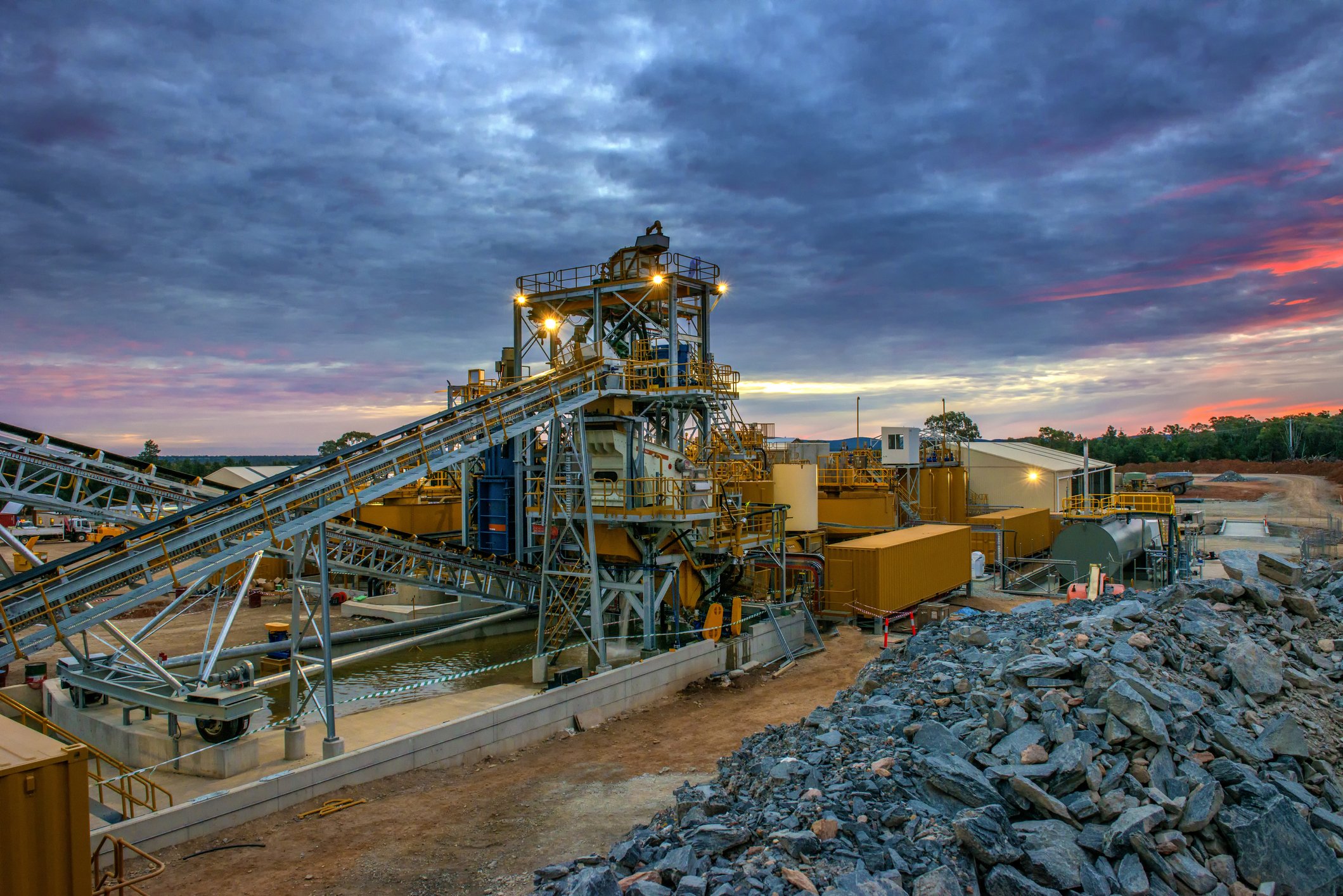
Image source: The Motley Fool.
DATE
Monday, Aug. 10, 2026, at 11 a.m. ET
CALL PARTICIPANTS
- Vice President, Investor Relations - Emily Chang
- President and Chief Executive Officer - Mark F. Hill
- Senior Executive Vice President and Chief Financial Officer - Hongyu Cai
TAKEAWAYS
- Gold Production -- 796,000 ounces, representing 3% growth over guidance and an 11% increase compared to the previous quarter.
- Adjusted EPS -- 82¢, matching the Bloomberg consensus for the period.
- Net Earnings -- $1.2 billion, a 50% increase compared to the prior year.
- Attributable Adjusted EBITDA -- $2.425 billion, growing 51% year over year with a margin of 59%.
- Newmont Agreement Value -- Approximately $4 billion, a package resolving historical disputes and integrating the Mike and Fiberline properties into the joint venture.
- Mike and Fiberline Resources -- 6.4 million ounces, vended into the Nevada Gold Mines joint venture as part of the Newmont agreement.
- Year-to-Date Free Cash Flow -- $1.4 billion, more than double the amount reported in the prior corresponding period.
- Quarterly Free Cash Flow -- Declined 33% year over year, impacted by a one-time $400 million payment related to Loulo-Gounkoto.
- Share Repurchases -- $1.2 billion, executed under the $3 billion authorization announced in the previous quarter.
- Total Capital Returns -- $3 billion in dividends and buybacks returned to shareholders since October 2025.
- Total Attributable CapEx Guidance -- Reduced to a range of $3.8 billion to $4.2 billion for 2026, primarily due to lower spending at Reko Diq.
- Reko Diq Attributable CapEx -- $450 million to $500 million, lowered for 2026 from the previously estimated range of $600 million to $700 million.
- Safety Frequency Rate -- 0.77, an improvement from 0.92 in the previous quarter.
- Safety Technology Investment -- Over $90 million, allocated for automation, AI analytics, and reporting software.
- Copper Production -- 56,000 tons, with management expecting production to increase in the second half of the year.
- NGM and PV EBITDA Contribution -- 53% of total attributable adjusted EBITDA, achieved at an operating margin of 61%.
- Fourmile Drilling -- 20 active rigs, with a Pre-Feasibility Study on track for completion by the end of 2028.
- Lumwana Copper Expansion -- On track to deliver first copper production by the end of the first quarter of 2028.
- Pueblo Viejo Resettlement -- 90% of resettlement packages have been accepted, supporting the continued advancement of expansion projects.
- Nevada Roaster Estimate -- Approximately $2.5 billion, as management considers increasing processing capacity to optimize the Nevada Gold Mines infrastructure.
Need a quote from a Motley Fool analyst? Email [email protected]
RISKS
- Hill stated, "disappointingly, we still had 6 LTRs. So there is still a lot of work to do. it is completely unacceptable," regarding safety performance despite overall frequency improvements.
- Hill stated, "We have had Veladero down for I think it is 2 weeks now, but we had a weather event where we had to evacuate everyone," identifying operational disruptions in Chile and the United States.
- Hill noted, "Pueblo Viejo has been down for the opposite reason because Wylie Creek Dam dried up, and we had to shut the whole plant down," attributing the closure to weather-related factors.
SUMMARY
Management reported that Barrick Mining Corporation (B +1.32%) has finalized an agreement with Newmont to optimize the Nevada Gold Mines joint venture, valuing the transaction package at approximately $4 billion. This agreement resolves long-standing disputes and incorporates the Mike and Fiberline properties into the joint venture. The company reported that gold production exceeded guidance for the second quarter, facilitating the return of $1.5 billion to shareholders through dividends and share repurchases. Management stated it remains on track to complete the initial public offering of its North American gold assets by the end of 2026, with current CEO Mark Hill selected to lead the new entity.
- CEO Hill noted that Nevada Gold Mines is "dealing with 25 year old infrastructure" and emphasized the need to increase processing capacity to avoid trucking ore across the state.
- Management indicated that the Newmont agreement "reduces the friction costs of the planned IPO," which is expected to unlock shareholder value beyond immediate cash proceeds.
- Regarding the search for a new parent company CEO, Hill described the recruitment as an "advanced process" involving both internal and external candidates.
- The company deferred the start of plant construction at the Reko Diq project, leading to a reduction in 2026 attributable capital expenditure guidance.
- Management confirmed that the North American IPO will involve a 10% minority stake, intended to highlight the value of a dedicated management team.
- Hill reported that copper margins are now comparable to the gold business, with expansion projects at Lumwana expected to double copper production by 2028.
- The company stated that the Newmont deal allows for the optimization of resource allocation between high-grade assets like Fourmile and existing infrastructure at Cortez.
INDUSTRY GLOSSARY
- NGM: Nevada Gold Mines, a joint venture between Barrick and Newmont.
- Mike and Fiberline: Gold properties in Nevada recently integrated into the Nevada Gold Mines joint venture.
- LTRs: Lost Time Records, referring to safety incidents resulting in an employee's inability to work.
- PFS: Pre-Feasibility Study, a technical and economic study used to determine the viability of a mining project.
- Reko Diq: A large-scale copper and gold project located in the Balochistan province of Pakistan.
- Lumwana Super Pit: A major copper expansion project in Zambia aimed at doubling existing production.
- PEA: Preliminary Economic Assessment, an early-stage study used to gauge the potential of a mineral resource.
Full Conference Call Transcript
Operator: Welcome to Barrick's second quarter 2026 Results Presentation. At this time, all participants are in a listen-only mode. As a reminder, this event is being recorded and a replay will be available on Veric's website later today. I will now turn the call over to Emily Chang, vice president of investor relations. Please go ahead.
Cleveland Dodge Rueckert: Thank you, and good morning, everyone. Hope you have had an opportunity to review the press releases issued before the markets opened this morning. The presentation deck we will review is also available to download on our website. Website. Presenting our results today are Mark F. Hill, Barrick's President and CEO and Hongyu Cai, Senior EVP and CFO. Other members of Barrick's management team will be available after our prepared remarks for Q&A. Before we begin, please note that there will be forward looking statements. This slide includes a summary of the significant and factors that could affect Barrick's future performance and our ability to deliver on those forward-looking statements. This material is also available on our website.
With that, I will turn it over to Mark.
Mark F. Hill: Okay. Thanks, Emily, and good morning, everyone. So for those who do not know Emily, is our new vice president, investor relations and joins us from US Steel. So before we share our full quarterly results, I want to begin with the agreement with Newmont we announced today. And, actually, I want to go off script straight away to make the lawyers nervous here. So I want to clarify a few misconceptions here. So firstly, the total value of that package approximately $4 billion. So, obviously, it includes the proportion of Fourmile, but it also includes contribution of Newmont's properties, Mike and Fiberline, which I think around 6.4 million ounces as well.
It is also the cost of resolving historical disputes and litigation between the joint venture partners. And it also reduces the friction costs of the planned IPO, which will unlock even greater value for the shareholders beyond the cash proceeds from the transaction. And as we have said, they will be largely returned. To the shareholders. So moving on, we have reached this agreement after 4 months of negotiations. So it now enables us to focus on delivering value through safely and consistently producing ounces. And our interest now are completely aligned as joint venture partner is critical.
And I did not want to actually thank our counterparts at Newmont Natasha and her team, and, of course, everyone on the Barrick team. For the enormous amount of effort and work that is gone into this over the last 4 months, the greatest risk of it. Now, before I get into the results, there is also a couple of other things I would like to follow, which I think are the key strengths that have come out of Barrick over the last 9 months. So first, our leadership team. So over the last 10 months, we have improved the operational performance across the entire business. And that is the thing thanks to the strength of our operating insight team.
Right? So it is our GMs and everyone right down through to the mining front. So we have also strengthened our relationship with Newmont, as we just said, positioning us well to grow and develop NGM further. Which is also critical. Second, with the IPO, we are building the only major American pure gold company with high quality, long life asset, That is exactly what he bests including some of the world's fastest growing source of capital are looking for.
And third, outside of North America, the rest of the world polio, has a significant growth profile, also has a distinctive advantage in our ability to work with our Chinese partners, as you know, our joint mine ownership and co investment And this enables us greater efficiency, and supply chain strength, which has helped us control our. And partnership that improved outcome and reduce our risk. So with this context, let me turn to our results for quarter. As I said, we have had our third quarter in a row with excellent operating and financial result. We delivered on all 4 of our priorities for the year. The same priorities outlined at the start of the year.
We continue to improve our safety performance get to that a bit later, but there is obviously still more work to be done there. We delivered our gold production above guidance, and met our cost guidance. We advanced our growth projects, Fourmile, Lumwana, and the PB expansion, which remain on time and on budget. Not often you hear that in the mining industry. We continue to review record deck and commence development on the July as previously disclosed. And our delivery on production and meeting our cost guidance also allowed us to deliver strong financial results which Hongyu will discuss a bit later.
And finally, we achieved major milestones in the preparation of the IPO of our North American gold exit. Which are on track which is on track to be completed by the end of the Now let me move to safety, which is still our number 1 priority. And our goal is that everyone obviously goes home safe and healthy every day. So we saw a reduction quarter on quarter in our frequency rate between that from 0.92 to 0.7 But disappointingly, we still had 6 LTRs. So there is still a lot of work to do. it is completely unacceptable, and we need to focus on our safety until we get to our target. Zero harm.
All of our leaders, the way up to the executive committee, including myself, spending more time in the field and at the mine site They are doing more critical control verification and fixing more risks. On the spot. On top of that, we have also invested over 90 million this year in technology to improve safety. This include OptiR automation of mining equipment, right down to vehicle dash cams, safety reporting software, and AI analytics. And we are also working hard to engineer out as many safety hazards as possible. So turning to our Q2 highlights, actually, before I start on Q2 highlights, when I look, you know, I would like to clarify about earnings were 82¢.
Adjusted earnings were 82¢ per share. It is in line with the Bloomberg consensus? I know there is some media out there this morning. that we missed? But I am not sure what the source of that is. Barrick produced 976 thousand ounces of gold in the quarter, which was 3% above guidance and 11% over Q1. The main drivers of that were we progressed the ramp up of Loulo-Gounkoto ahead of schedule. PV ramped up faster than expected after the maintenance shutdown in Q1. And we mined record tonnes underground at Cortez and continued the ramp up at Goldrush.
On the copper side, we produced 56 thousand tons, We managed costs well, our gold costs, as I said, were within guidance. Our earnings nearly doubled year over year, and we more than doubled quarterly shareholder return to $1.5 billion And the strong performance for Q2 is up across all of our regions, though North America continued to anchor our world class portfolio MGM and PV both registered year over year revenue growth Together, they accounted for 53% of our total attributable adjusted EBITDA at a margin of 61%. Our other regions also delivered strong gold production with meaningful attributable EBITDA at margin of 59%. Copper continued to perform well and delivered comparable margins to our gold business.
Moving on to growth, as I said, our growth projects advanced on February during the quarter. So Fourmile, we ramped up to ramped up the drilling to 20 active rigs. We plan to complete the PFS by the end of 28. At Lumwana, we made good progress on the mill expansion, which will double the copper production. Expect the project's 2026 capex to come in at the lower end of guidance and the project remains on budget we are on track to produce our first copper from the expansion by the end of Q1. In 2028. The PV expansion also advanced on schedule We have made progress on permitting and construction across the tailings facility, haul roads, water treatment plant.
And we are also very pleased to report that we now have 90% of resettlement packages being accepted. We continue to review Reko Diq as previously disclosed. We have decided we will not start building the plant this year. So we have reduced our expected 2026 attributable CapEx. It was $600 million to $700 million and is now $450 million to $500 million. So the lower spend on the mine and Reko Diq has reduced group guidance for 2026 total attributable CapEx. To $3.8 billion to $4.2 billion. So back to the IPO of our North American assets. So as I said, this entity will be a high quality pure gold play company, which assets are located exclusively in London.
Risk jurisdiction. And what I am pleased to share is that the board has selected me to lead the new company as a CEO on launch. We have completed all operating and separation agreement between Barrick and the new company, and we remain on track to complete the IPO by the end of the year. And we expect the vast majority of net proceeds raised to be returned to shareholders. I know several people have asked me in the past. So I will now turn it over to Hongyu Cai, our CFO, who will review our financial performance.
Hongyu Cai: Thank you, Mark, and good morning, everyone. Q2 marked the third consecutive quarter of strong production, cost performance, and financial result. Net earnings were $1.2 billion, a 50% increase year over year. Adjusted net earnings was $1.36 billion, which equates to adjusted EPS of 82¢ in line with Bloomberg consensus. Attributable adjusted EBITDA of $2.425 billion, was up 51% year over year. With a 59% margin. On a cash flow basis, the second quarter is typically our lowest each year for free cash flow. Due to the timing of our annual tax and interest payments. This quarter, we also incurred a 1-time $400 million payment related to Loulo-Gounkoto.
Combined, this led to a 33% decline in year over year attributable free cash flow. Excluding this, attributable free cash flow for the quarter would have been over 60% higher year over year. Year to date, attributable free cash flow has been $1.4 billion, more than double the same period last year. Turning to the operations. Gold production increased 11% quarter over quarter and exceeded guidance. We continue to operate within our cost guidance reflecting an acute focus on operational efficiencies to offset fuel price pressures. We closed Q2 with a healthy $1.2 billion of net cash on the balance sheet. Giving us flexibility to continue investing in our highest return opportunities and returning capital to shareholders.
Turning to our capital allocation framework. We have 3 priorities. First, managing the balance sheet with discipline. Second, investing in our assets to drive earnings accretive growth. And third, returning capital to shareholders. Our framework is designed to be sustainable through the cycle. On the balance sheet, we ended the quarter with meaningful access to liquidity to liquidity, an undrawn $3 billion revolving credit facility and no meaningful debt due until 2033. Turning to our portfolio, Lumwana and Fourmile, are 2 clear examples where we are strategically deploying capital into organic opportunities that we believe will generate superior returns. More broadly, we intend to identify similar earnings accretive opportunities to strengthen our growth profile.
While remaining disciplined in how and when we deploy capital. This is not about growth for the sake of it. It is about creating value over time with a suite of assets that has extraordinary growth potential. And finally, we are executing against our capital return policy Our dividend policy provides for a quarterly base dividend of 17.5¢ per share. With an additional performance top up at year end to target a total payout of 50% of attributable free cash flow. We also completed $1.2 billion of share repurchases this quarter.
Of the $3 billion authorization, that was announced last quarter, In the 3 quarters, since new leadership began in October 2025, Barrick has returned $3 billion in dividends and buybacks to shareholders, more than double the prior corresponding period. We expect a careful execution of our allocation strategy to drive further shareholder returns. In summary, our capital allocation framework is disciplined. Flexible, and designed to work throughout the cycle. It supports reinvestment in the business advances growth, protects the balance sheet, and creates a clear pathway for returning excess cash to shareholders. With that, I will turn the call back over to Mark.
Mark F. Hill: Okay. Thank you, Hongyu. So just on guidance, so our 2026 production and cost guidance remain unchanged. So for the third quarter, we expect gold production to be higher than Q2, consistent with the plan. And we expect even higher production in the fourth quarter. Copper production should also increase in the second half of the year relative to the first half. So since, and I will say it again, since 10/20/2025, we have consistently delivered against our strategic priorities, set a new standard of operational performance. And, again, I would like to congratulate our GM and our people on the site.
We continue to focus on controlling costs, capital intensity, and productivity, and based on what we see today, we remain confident in our ability to deliver on a full year commitment for 2023. So just a couple of things to conclude. So, obviously, again, I am gonna finish with the most important thing, which is safety. And as I said, even though we have seen significant improvements, everyone is still focused on making sure every employee goes home safe every day. We have improved our operational consistency, which is, as I said, and we have delivered on our guidance again. And as I said before, we have delivered on all our projects. They are on time and on budget.
And I will Again, I am not sure how many times we do that in the morning. And we have advanced our North American IPO as well., So we are basically on track to execute against all the 4 priorities that we set at the start of the year. And so, again, I wanna say, and, of course, we are transformed this relationship with Newmont which allows us to get full value and expand MGM. So with that, I will hand it back to the moderator for Q&A.
Operator: Thank you. For the Q&A session, we will use the raise hand feature in Zoom. If you would like to ask a question, click on the raise hand button. At the bottom of your screen. Once prompted, please unmute yourself and go ahead. We will now pause for a moment to assemble the queue. Our first question comes from Josh Wolfson with RBC. Your line is open. Please unmute and go ahead.
Josh Wolfson: Thank you very much, operator. And thank you, Mark, for those, introductory comments. and some of the numbers that were provided. Wonder if you can maybe break down more information behind of the different components that would have been attributed to the agreement components. So I guess you know, what would have been Mike and Fiberline within that 1.95 billion? And then perhaps what the adjustments would have been to the you know, the prior disputes. Thank you.
Mark F. Hill: Okay. So the Josh, just to be clear, I am not gonna break it down. So on the prior disputes, I mean, I cannot give a number on that. We would have had to go through a process to actually get to that number, so we just got to where we are. And then on the structural changes, I mean, we now that we have this agreement done, actually gonna go away and optimize this structure for the IPO. So as you can imagine, that is a bit of a work-in-process thing.
So but the overall value that we had on the table, we had at the end of this discussion of about $4 billion of highlight And just 1 other thing, Josh. I The thing I wanna highlight is since I started this job, you know, NGN has a lot of opportunity. I mean, you know the assets well, and I am sure you agree with that. there is been no increase in processing capacity there for years.
I mean, we are dealing with 25 year old infrastructure and then we have something like Fourmile, that comes in, which is a you know, world class asset, and the answer is that we are just going to feed that through the current infrastructure and delay the other routes, which anywhere else in the world if you found that number of answers, you would be wanting to bring that in early. So you know, my discussions with Natasha and Newmont right from word go was how do we get this together so we can optimize MGM? And by optimize, I want to look at increasing processing capacity I want to stop trucking ore all over the state.
And the only way I can do that is if we combine all these assets now and work together to see if we can justify a roster or an autoclave and what we need to build in. What infrastructure we need at Cortez, you know, to process Fourmile and Goldrush to get our cost structure in place, and increase our overall ounces. So where we have landed now, at least we are in a position now to add to add a lot of value very quickly. Without getting into these disputes. About allocation of resources. And, obviously, Josh, there will be a lot of synergies as well because we are just gonna use the same team.
We are going to combine them all together. All the same equipment. And we can advance this a lot faster. And that was obviously my ultimate goal.
Josh Wolfson: Thank you for that detail. Just a follow-up question. You know, with this resolution now completed, is the company considering a different structure in the IPO versus the 10% to 15% minority that was historically reviewed? And could you go larger? And you know, if the company went larger or under what circumstances would there be a shareholder vote?
Mark F. Hill: Josh, it will still stay at 10%. I do not see any of that just the way the company is structured. Anyway, correct me. Yeah. As you know, I said that sorry.
George Joannou: it is George speaking. Yeah. Just exactly. And I think it is just a matter of looking at the structures that we started looking at the beginning and comparing it to the current structure because as Mark said, it is friction costs within the You know, to look at where it is domiciled, etcetera. So all these things that we need to go back and look at now that we have the new agreement with Newmont. And, again, as Mark said, that is where the value comes as well. We have this flexibility and option at Great.
Mark F. Hill: Thank you very much. Thanks, Josh.
Operator: Our next question comes from Tanya Jakusconek. Line is open. Please unmute and go ahead.
Tanya Jakusconek: Good morning. Can you hear me?
Mark F. Hill: I can hear you, Tanya. How are you?
Tanya Jakusconek: How are you?
Mark F. Hill: Houston, we have made contact.
Tanya Jakusconek: This is awesome. Congratulations on your new role. I have a few questions if I could. The first 1 is just coming back to Josh's question. Should we be thinking, Mark, that it was $4 billion of the new loan assets plus dispute plus the 2 billion that is a top up for a total of $6 billion. Is that how I should be thinking about the price paid?
Mark F. Hill: Tanya, it is $4 billion total package. Oh, okay. Alright. Thank you for that.
Tanya Jakusconek: And should I be thinking about the cash that Newmont is just paying for this? Is this going to be part of the cash coming into the IPO, Or would this $2 billion be cash that is going to be potentially used for share buyback and or the top up dividend at the end of 24. 2026. Sorry.
Mark F. Hill: Okay. Sorry. You are very hard to hear. But, Tanya, I think if I got the question right. So the cash we get back would be the majority would be returned to shareholderss. Correct?
Tanya Jakusconek: Okay. And then my final question, Mark, just for some of the processes for this IPO You mentioned that you have done your separation agreement. I think everything has been filed. With the SEC, the technical report. What are we still waiting for? Is it just approval from the SEC? Filing the 3.5 year financials? Completing the new board maybe just the process of what we need to go for this to go live. Thank you.
Mark F. Hill: Actually, Tanya, let me hand it over to George, who is more up to date.
George Joannou: So I would say we are actually very close. But like I said, you know, now that we have this agreement with Newmont and their consent, 1 of the things we wanna do is go back and look at how, you know, previous structures and compare that to what we have today. So we just wanna go and do that and make sure we do our diligence and understand the impact of that because we think there are big savings there. So that is where we are at the moment.
Mark F. Hill: Thank you. Thanks, James.
Operator: Our next question comes from Lawson Winder with BofA Securities. Your line is open. Please unmute and go ahead.
Lawson Winder: Thank you very much, operator and hi, Mark. Good morning to you and the team. Very nice operational quarter. Congratulations on that. Just a couple of questions. So to follow-up on Fourmile, I noted that the PFS is still on track for completion in 2028. However, with it now vended into MGM, is there any scope to speed up development and potentially have the asset in production earlier than what the initial PEA had indicated or around sort of early 20 thirties. And then yeah. So that is the first question.
Mark F. Hill: Okay. So thanks, Lawson. Look. Obviously, my intention is to accelerate this as fast as possible. Now that I have sort of got through this process, I think that allows us to accelerate it for sure. Now we are still going to be limited by how many timelines and things like that. Where I think we can really advance it will be on the processing side as well. Right? Because I am going to advance that I have already talked to Natasha about it. We are gonna advance that all in parallel while we are driving those declines and doing this drilling.
So it may not come on earlier, but hopefully, when it comes on, we will be able to ramp it up a lot quicker and to actually a higher production. Target. That would be my target.
Lawson Winder: Okay. Very helpful. Thank you, Mark. And then maybe I could jump to the IPO. So after the initial minority interest is spun out, I mean, at this point, have you changed your thinking on what could come after? So I think you had indicated previously that you would just be an initial minority interest IPO, and that would be it. Is there any thought to eventually IPO ing a 100% of BNA at this point?
Mark F. Hill: No. So, Lawson, not at this point. I think, you know, we are still on track to do the 10% and just show the value and highlight the value of a dedicated management team. And just, by the way, if you look, we have already pretty much split the management team and hopefully, you have noticed the change in you know, production and safety and things like that with just having that dedicated focus. So anyway, to answer your question, no. there is no updated thinking. We are going to go past 10%.
Lawson Winder: Okay, very helpful. And then, in terms of the process, will there be a marketing process that will kick off in the relatively near future?
Mark F. Hill: It will be, but I do not know what the date is, George.
George Joannou: Do you know? Well, I again, we just have to go back and look at that. But, also, absolutely, there will be a marketing process. Okay.
Mark F. Hill: Thank you very much for taking the questions. Thanks, Lawson.
Operator: Our next question comes from Anita Soni with CIBC. Your line is open, Lisa Mead. And go ahead.
Anita Soni: Hi. Good morning. And, Mark, congratulations on your new role and on improving operations at MGM. My first question was with respect to the capital that you were talking about I think you just talked about sort of declining infrastructure, and I am just wondering what the capital would look like for a new roaster or a facility of that sort? And then what can we also expect in terms of MGM capital? Going forward?
Mark F. Hill: Okay. that is a good question, Anita. So on the roaster, I wanna reoptimize the whole process flow. I mean, you have been there several times, so you have seen what it is like. So the roaster, I am we have actually got hash looking at it permanently now. I would have said it is $2.5 billion. I do not really know, but it would be around that number. But that will offset a lot of things as you know. We track stuff all over the countryside as well, and it would reduce some other infrastructure requirements.
And then as far as other capital, and Chris will help me out. there is there is nothing else what else is material that is coming up in NGEN? it is really it is-- so, obviously, I will put on formal as we guided the market.
George Joannou: Yep. And the conceptual PA is in the range of $1.5 million to $700 million that we are spending over the next few years. On 4 miles. And apart from that, that is really the items that we have got. Our capital portfolio. We are planning this year to pull some capital forward for the expenditure that we have on replacing our truck fleet at Turquoise Ridge. And, actually, if the project process is also done autonomous hauling, If we have if we are confident following the success of those projects. But we still also expect total capital in line with what we thought previously at least for North America. So those are the key points.
Mark F. Hill: Thanks, Chris.
Operator: Does that answer your question, Anita?
Anita Soni: Yeah.
Mark F. Hill: that is a good answer.
Anita Soni: I think I also wanted to ask about the 4 mile PEA. I understand you are moving forward with the PFS with a different type of structure, I guess, in terms of what you are looking for infrastructure. But would this PEA like, should that not have been filed 45 days after you announced? The PEA? And I would venture to say that is probably part of the reason why you are seeing your share price move because we do not really have a barometer right now. Outside of a slide deck that will give you, like, you know, bare essentials in terms of how to model this.
And so you are seeing wide degrees of variance in terms of what people are modeling for Fourmile. So would you be able to file the PEA that was put out last year so at least we have something to go with while this PFS comes out.
Mark F. Hill: Actually, I Anita, fair question. Do you reckon that is why our share price is down 7%? Well, I mean, it is if everyone's debating whether or not there is you know, what the $2 billion is and it is and people are backing out something lower, which is something that you said. On the call, then it is because they are not certain of what the 4 mile value is. Okay. I have not got a good answer to that. I mean, we filed the-- when we issued the PEA, it was conceptual in nature. You know, we still have to file a technical report. Okay.
But then, Anita, you are saying you have not got enough information, basically, what you are saying?
Anita Soni: Yeah. So, I mean, yeah, it is there is a lot there were a lot of things that are unknown in terms of mining methodology, unit cost, Right? There was a you know, we did not know about this NPI. Right? That was 1 major thing that was embedded in there, but nobody knew about it. So anyway, I will leave it there. I also just wanted to ask in terms of Fiberline-- hang on.
Mark F. Hill: Let me just Sure. But we will take that away, right, and see how we can do a better job. And I understand what you are asking. So I will work something out and come back to you. Okay.
Anita Soni: And I wanted to try 1 last time on the Fiberline and Mike. Can you give us some round numbers in terms of what that would add to the equation? I am assuming and by the math, I would assume that your so Newmont is paying in for Fourmile. But they are also exchanging and you guys are reciprocally paying for their 38.5% of Fourmile and Mike. Hence, so and so it is a net, it is like, I guess, it is 61.5% that they are vending in of those specific assets. To get to the to get to a collective $4 billion. Is that the right way to look at it?
Mark F. Hill: Yeah. So the right way is just we are paying for 61.5% of Mike and Fiberline. And those others and that other settlement amount, which we are certainly not gonna get into. Look. Anita, we agreed we are just gonna go out with a number, and that was quite a bit. So the I apologize, but I cannot give you that breakdown.
Anita Soni: Okay. Alright. I guess with the IPO coming up, people are trying to understand what that significant component of Fourmile, is. So any additional information would be helpful. Thank you. I will leave it there.
Mark F. Hill: Thanks, Anita. Appreciate it.
Operator: Our next question comes from Daniel Major with UBS. Your line is open. Please unmute and go ahead.
Daniel Major: Hi. Team, and thanks for the questions. Sorry. Just to clarification on the $4 billion just to be clear. Is that the combined transaction value of 61.5% of Fiber Line and Mike and 38.5% of Fourmile? Or is it just the 4 mile component Can you just sorry if that is already been stated.
Mark F. Hill: Sorry. So when you net everything together and anyone jump in here if I get this wrong. Right? So to get to the $4 billion number, it is the value of Fourmile, the 38%, then you have to net off the value of 61.5% of Fiberline and Mike. There is some money in there for to settle some legacy disputes for want of another word. Right? As well. And then if you wanna understand the full value, there is obviously some benefit to Barrick by getting that consent. And reducing the friction cost on the IPO. Okay. Probably made it very complicated, Daniel, but No.
Daniel Major: No. that is okay. Just being clear. Okay. that is fine. And then, I mean, you have alluded to some of this already, but if I look at the high level parameters of the 2025 PEA 600 thousand to 750 thousand ounces, 1.5 to $1.7 billion of capex and $650 to $700 all in sustaining cost. You suggested there is $2.5 billion more capex maybe on downstream processing and maybe some upside to the production. Would it still be fair to assume that the all in sustaining cost would be comparable to the $650 to $700?
Mark F. Hill: Yeah. I would say it is comparable.
George Joannou: And, hopefully, if we depending where we locate that roster, you could actually see. Did you wanna say something? There is 1 point that we would raise, and sorry, it is Chris Joannou speaking. The basic ranges that we put out as part of the conceptual PA were naturally based at the consensus gold prices at the time, which from memory was around about $2.5 thousand of just in excess. So if you do apply today's long term annual consensus prices of $3.6 thousand an ounce, is about a $100 sensitivity for every thousand dollars if the gold price moves.
So the right way would be to look at it is to say, we ranged if we put our previously plus $100 to take into account the fact that the gold price has moved. By a thousand dollars since.
Mark F. Hill: Okay. Daniel, just to go back, though, just to the engineering side of it. Obviously, the idea is that we increase the overall production. Capacity in Nevada. Or reduce trucking So, yes, I would be there will be more capital but it will increase the production profile and lower the cost. That would be the target.
Daniel Major: Okay. And, sorry, the line was not totally clear. So yeah. So at $3.6 thousand you add $100 to the $650 to $700. Was that was that what you alluded to? Just to be clear?
George Joannou: that is correct. Yes.
Daniel Major: And that incorporates the Teck NPI?
George Joannou: sensitivity, and everything else is including the debt.
Daniel Major: Okay. Okay. that is good. And then, sorry, just final question on this. In terms of the if we are looking at the valuation of the stand alone project, or relative to what is implied in the $4 billion and the various elements. Is there any can you provide some more detail on whether Newmont benefited from any assumptions around their 38.5% share of the infrastructure in that calculation that was imputed in the value of today's transaction?
Mark F. Hill: I am not sure I understand that question. Daniel.
Daniel Major: What do you mean? There is a net okay. So there is a net off against displacing other material from the process plants, how is that adjustment made? Yes.
Mark F. Hill: That is taken into account. that is taken into account by the 2 technical teams. By the way, the 2 technical teams, 1 from Newmont and 1 from Barrick sat down with the model for Fourmile and all of the data and went right back and all of that into account when we came up with the PEA. Okay. Thank you.
Daniel Major: And maybe just 1 more if I could. Obviously, I guess, yeah, Mark, you are going to be leading the IPO vehicle. Can you give us any indication of how advanced you are in recruiting for the senior management positions in the parent company?
Mark F. Hill: Look. So we are advancing that discussion. Right? And next board meeting. And we will be updating you I would say, shortly. Is the right term. We will update the market shortly. it is an advanced process. Daniel. Okay. Thanks so much for the questions.
Operator: Thanks, Daniel. Our next question comes from Bennett Moore with JPMorgan. Your line is open. Please unmute and go ahead.
Bennett Moore: Good morning, Mark and Hongyu. Congrats on the strong quarter. Thank you for taking my question. I want to pivot to a slightly different topic here. I am wondering if you can discuss some more detailed ramp-up plans for Loulo-Gounkoto specifically in regard to the push into open pit ore, what sort of CapEx may be required to support this and your risk appetite to do so.
Mark F. Hill: Okay. Thanks, Bennett. I am gonna hand it over to Chris
George Joannou: So I think the best way to explain Loulo-Gounkoto at the moment is, as we have said, we ramped it up quite successfully. So what it has become is it is become self sustaining. And so, therefore, any capital and growth at the moment that we are funding is self-sustaining. And so our expected growth for next year would start coming from the deeper pushbacks. And the open pits in probably Q3 or middle of this the second quarter. So that is I think, most I can say at the moment. We are still looking at you know, optimizing those plans, but, certainly, we would be starting to move into the open pits in the first half of next year.
Mark F. Hill: Thanks, Seth.
Bennett Moore: Alright. Thanks for that context. And then maybe on the production cadence overall, I know you gave some commentary, Mark, on the back half for both gold and copper, but you know, MGM and PV tracking towards the high end, LG tracking ahead. So what level of conservatism you feel is kind of baked in at this stage?
Mark F. Hill: Well, I do not think it is conservatism, but, Bennett, look. We are gonna hit our guidance, as I said. Just, I suppose, to put something else on the table. We have had Veladero down for I think it is 2 weeks now, but we had a weather event where we had to evacuate everyone. I am sure you probably saw it on social media and things like that out of Chile and United States. So that has hit us, and Pueblo Viejo has been down for the opposite reason because Wylie Creek Dam dried up, and we had to shut the whole plant down.
So while I am still confidently hitting guidance and you are right, NGM is in a good place and so is PV. Have had some other issues throughout the portfolio, and nothing both of them are actually, you know, mother nature events. They are not actually operational problems. But so I still think, you know, the guidance is fine, but it is certainly not conservative.
Bennett Moore: Understood. And then real quick, just wondering how turnover trended at MGM during the quarter, if you are still in the mid teens range.
Mark F. Hill: who is got that number? It was 14%. Someone else brought this up. Does anyone know what the answer I will have to get back to you on that, Bennett. it is a good question, and it is something we are actually focused on. it is you know, making care and especially MGM, the employer of choice. Right? Not that long ago that everyone wanted a job with Barrick. And so we are working on that, and as I said, the culture at MGM despite what it might have been in some articles, has in my opinion, turned around completely. Right?
And you can tell that just by the performance that I said in their production performance, their safety performance, just when you go there of the workforce. Is certainly better than it was, but I will get you the actual number. If you can note that down and we will come back to you. Understood. Thank you. Best of luck. Thanks, Bennett.
Operator: Our next question comes from Matthew Murphy with BMO Capital Markets. Your line is open. Please unmute and go ahead.
Mark F. Hill: Matthew, I cannot hear you if you are talking. Matthew, can you hear us?
Operator: Okay. Our next question comes from Bob Brackett with Bernstein Research. Your line is open. Please unmute. And go ahead.
Analyst: Good morning. A broader question, then maybe I will follow-up with the MGM. The broader question would be if I think about the ex North America business, is there anything you are contemplating in terms of portfolio management on that asset base? And is that gonna be slowed down by the IPO process?
Mark F. Hill: Sorry, Bob. Just explain that to me a bit more. What do you mean by that? So think of all of the assets you have. there is a lot of natural partners or natural owners of some of your assets that sit outside of North America. Does the North America IPO process sort of take all of your attention, and therefore we should not expect a lot of portfolio management for the non North American businesses as we proceed, say, into the year end or early 27? Look. Actually so, Bob, the rest of the world portfolio is actually 1 of our biggest growth engines.
We talk about MGM a lot, but actually, what I just at our recent board meeting, actually, we had a whole session on growth for the rest of the world because of the potential you have seen what is going on at Lomana, and even around Kibali and what we can do there. So the plan-- the current plan is to really grow the rest of the world, and that is what the focus will be. And, Chris, if you want to add Yeah.
George Joannou: I think you have covered it, Mark. I think the most important thing on the rest of the world is that firstly, we are looking how we could best optimize that portfolio. And in terms of what Mark suggested around the partnerships that we are able to leverage, And, also, we have a real embedded growth profile, especially brownfield growth around most of our operations. So we have already embedded infrastructure and of course, that is probably the lowest cost answers you are gonna add into your production profile. And then as you said, we have we have got the Lumwana expansion on the cards.
There, Bob, there is I am not sure how familiar you are with those assets, but there is a lot of potential around those products.
Mark F. Hill: Which we are trying to crystallize and put into a proper plan. Very clear. A quick follow-up. On the agreement with Newmont. Are there any contingent payments involved at all, say, for hitting exploration upside, or can we consider it pretty much done? in light of future exploration success? No. it is done. Okay. Very clear. Thank you. Thanks.
Operator: Our next question comes from Steven Green with TD Cowen. Your line is open. Please unmute and go ahead.
Steven Green: Yeah. Thanks, Mark, for taking my question. I just wanted to follow-up a little bit on how you intend to optimize MGM and potentially accelerate Fourmile. I think Lawson and Anita asked most of my questions, but maybe you could just talk a little bit about permitting requirements and what will be required there.
Mark F. Hill: Okay. Thanks, Steven. So, look, on the permitting, obviously, we wanna get a permit for the full decline who they cannot drive it to our first. And after that, when I look at this which again is why it was critical that we got this joint venture sorted out. I have to get some I have to understand what we can do as far as process before I can even start the permitting. So I am trying to accelerate that For that very reason, it is probably not a bad time to get permits in Nevada as well. So I cannot give you a clear answer on the timing on the permits and that sort of thing.
But now that we have got this agreement in place, we are gonna sit down and completely optimize Nevada and that overflow. And I know Newmont is supportive also of what is the word, increasing processing capacity. And, Steven, we always get into the same discussion Like, just going to have to flesh out, which is autoclave versus roaster. And where it should be positioned. And I just have not got a clear answer on that, but that is what we will be accelerating starting tomorrow.
Steven Green: Okay. Thanks. And just to follow-up again on Fiberline and Mike. I believe you said there were roughly 6.4 million ounces in those properties. Is that correct?
Mark F. Hill: Are those inferred ounces? Actually, do not know what the breakdown of the 6.4 is. I was just going through the presentation before this. I will get back to you on that, Steven.
Steven Green: Okay. Thanks. And where roughly are those and kind of how far advanced are they?
Mark F. Hill: So Fiber Line is close to the infrastructure at Turquoise Ridge. I think that is a reasonable status. it is just it is an open pit, so it would be a matter of a satellite deposit. And, Mike, at this stage, I have not put a lot of value towards that. Mainly for now. Okay. Great. Thank you very much. Thanks, Steven.
Operator: Our next question comes from Martin Pradier with Veritas Investment Research. Your line is open. Please unmute and go ahead.
Martin Pradier: Hi. Thank you for taking my question. I wonder if you have given any thought about floating 10% of the x North America as well.
Mark F. Hill: I think I understand it. Floating 10% of like, you basically, now you are going to have, like, almost 2 companies. Like, the North America and everything else. Right? the rest of the world, would you, down the line float 10% of the non North America. The same way you are doing now. The IPO for the North American assets. Okay. No. Martin, I gotta be honest. We have not had that discussion. it is never come up so it is certainly not on the table at the moment.
Martin Pradier: And the second question I have is, in other expenses, there was this $200 million for Loulo-Gounkoto because you are applying, if I understood correctly, that 2023 law retroactively. Was that part of the original agreement? And if it was, why it was not included in the previous quarter?
Mark F. Hill: Or is this and I would like-- this is a bit of a fluid situation as you probably imagine. But let me hand it over to Hongyu to explain that.
Hongyu Cai: Oh, hi. Thank you for the question. The nature of the spending is additional royalties penalties, and associated interest. Based on the retrospective application of the 2023 mining code specifically for the year of 2024 and 2025. So previously, we had already settled related to 2023 and earlier years? But this is specifically for the 2024 and 2025. In terms of the amount paid, we paid cash of $400 million. In April. And, also, we had a further payment demand of $48 million. That was received in July. I hope that answers your question.
Martin Pradier: No. I am I am just curious why it was not included in the previous quarters. Like, it was part of the original agreement. It would not have been provisioned or something?
George Joannou: Yeah. Maybe you can add to that. I think maybe to simplify it. The original agreement only covered up to 2023. We continue applying our conventions. Through that period where we were negotiating in dispute. We still applied our original conventions. And so this was effectively the as per the agreement, it only applied the retrospective application to 2023, and therefore, we had to do a reconciliation the government for 2024 and 2025. And this was that payment, effectively.
Martin Pradier: Okay. that is very clear. Thank you.
Mark F. Hill: Thanks, Martin.
Operator: Our last question comes from Lawson Winder from BofA Securities. Your line is open. Please unmute and go ahead.
Lawson Winder: Yep. Thank you very much, operator. Thank you for taking the follow-up. I will try to make this really quick. So 1, you noted the revisions to the NGM joint venture agreement. Can you give us a little bit more color on the extent to which this would give Newmont additional say in various aspects of the operations and the release of technical reports and whatnot. Whatever detail you are able to disclose, I think, would be very helpful.
Mark F. Hill: Well, I think there is a couple of things. Firstly, just as a general thing, it is not actually in the venture agreement, but the way we have approached this is completely different. So you know, we will have access to whatever information and the site and we have already done that. With Francois and now with David, their technical lead, to come. And then they come and give any feedback they can and any suggestions, which you know, is always helpful. As far as actual rights go, the main 1 is around they do have a right to and, Joe, correct me if I get the language wrong.
But when we appoint the general manager of MGM, we have to get their consent to who that is. Which I do not have an issue with that at all. I and I think that is fair enough. And then the other part was, which we agree, which I also think would be quite helpful now that we have got we have reset this relationship. And, actually, we wanna advance this as quickly as possible. It is the way we would like to embed in our executive team at MGM a Newmont employee. Which I think will help.
It will go a long way just to with the transfer of information and things like that, and they will feel more comfortable with what is going on. So at a high level, that is what we agree. There was some other things around excluded property committees and other things like that, but, really, that is been taken care of by the fact that Fourmile and Fiberline and those things into the joint venture. So it is probably less relevant. Okay. that is very helpful.
Lawson Winder: And if I could ask a follow-up on the question about the CEO search for Barrick mining parent. Can you share with us if there is a preference between an internal or external candidate?
Mark F. Hill: Well, my preference is always internal, but, at this stage, we have not got to that conclusion yet who it is. So there are internal and external candidates. that is all I really can say. My preference is obviously internal. Okay. Great. Thanks very much, Mark. Thanks a lot, Lawson.
Operator: I will now turn the call over to Emily Chang.
Cleveland Dodge Rueckert: Yeah. Sure. Okay. Thank you. I just have an emailed question that I would like to read out. So given some feedback from shareholders, are you considering a spinout of North America to existing shareholders rather than an IPO structure? The shares of Nevada and PV are distributed to current shareholders rather than diluting existing holders.
Mark F. Hill: Okay. Who asked the question? Daniel. So. Like, no, so a lot of people ask that question, so the short answer is no. Anything else? Emily?
Cleveland Dodge Rueckert: that is it. Thank you. I will turn it back to the moderator.
Operator: Thank you. Thank you. That concludes our event for today. You may now disconnect.