You've no doubt worked hard to take care of your family. But what would their financial situation be if something happened to you? That's a situation that no one likes to think about, but it's an important one to consider.
Ideally, you will either have saved enough to provide for your family or have adequate life insurance policies in effect that would take care of them. Even if that's the case, though, it raises another question: What should your family do with the money after you're gone to ensure they're financially secure?
There are many potential answers to this question. We could get into a lengthy discussion of asset allocation and look at ways to diversify investments. Instead, let's look at what Warren Buffett has to say on the matter. Buffett is one of the most successful investors in history. He's laid out an investing plan for his family to be followed when he's gone. Here's what Buffett's plan is -- and why it's a good one for your family, too.
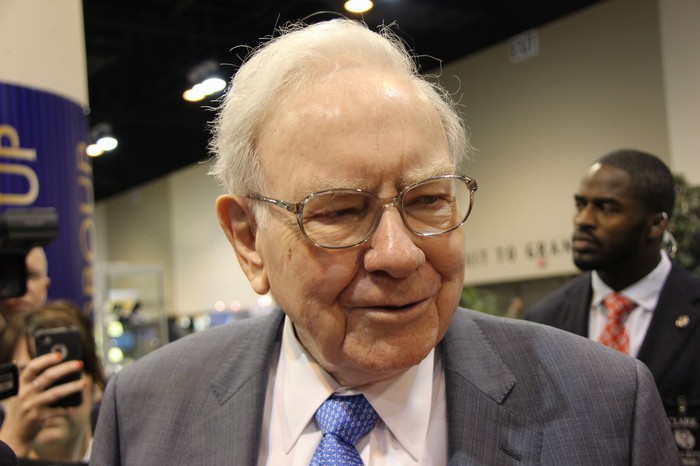
Image source: The Motley Fool.
The 90/10 plan
Buffett's plan is about as simple as it gets. In his 2013 letter to Berkshire Hathaway (NYSE: BRK-A) (NYSE: BRK-B) shareholders, he wrote that the instructions in his will state that the trustee is to invest 90% in a low-cost S&P 500 index fund, with the remaining 10% to be invested in short-term government bonds. (Note: all of Buffett's Berkshire shares will be distributed to charities.)
The Oracle of Omaha suggested that the trustee invest the larger amount into a Vanguard index fund. He didn't specify, however, whether he preferred the Vanguard 500 Index Fund, a mutual fund that tracks the S&P 500 index, or the Vanguard S&P 500 ETF (VOO +0.54%), an exchange-traded fund that also tracks the S&P 500 index.
Why does Buffett like this simple investing plan for his family after he's gone? He wrote to Berkshire shareholders, "I believe the trust's long-term results from this policy will be superior to those attained by most investors -- whether pension funds, institutions, or individuals -- who employ high-fee managers."
Based on history, Buffett's take is spot on. Earlier this year, S&P Dow Jones Indices released an annual report that compared the average performance of actively managed funds versus the S&P 500 index. For the ninth consecutive year, the majority of fund managers failed to top the S&P 500. Keep in mind that this was during a runaway bull market that should have relatively easy for funds to pick great stocks.
Interestingly, over 85% of large-cap funds have underperformed compared to the S&P 500 over the last 10 years. Nearly 92% of these funds have trailed the S&P 500 over the last 15 years.
One big reason behind this dismal track record for actively managed funds is their high fees. Buffett likes the low-cost approach with index funds. The Vanguard 500 Index Fund has an annual expense ratio of 0.14%, while the Vanguard S&P 500 ETF annual expense ratio is a super-low 0.03%.
The 10% that Buffett recommends investing in short-term government bonds, by the way, serves as a hedge to the stock index fund investment. When the S&P 500 goes down, short-term government bonds tend to rise in value.
What about the risks of investing in index funds?
There are some critics of the approach advocated by Buffett. Michael Burry, an investor who was one of the heroes in Michael Lewis' book The Big Short and the movie based on the book, told Bloomberg last week that passive investing in index funds is creating a bubble.
Burry stated, "Like most bubbles, the longer it goes on, the worse the crash will be." He added that "the dirty secret of passive index funds -- whether open-end, closed-end, or ETF -- is the distribution of daily dollar value traded among the securities within the indexes they mimic." In other words, Burry thinks that the influx of cash into index funds is distorting prices of stocks like what happened with sub-prime mortgages over a decade ago.
Such warnings from a man who predicted the sub-prime mortgage bubble that led to the market meltdown in 2008 and 2009 could raise concerns for some investors. Is Burry right and Buffett wrong? I don't think so.
For one thing, despite their huge rise in popularity, only a small percentage of stocks are owned by index funds (whether mutual funds or ETFs). Sure, the stock market could very well decline, but it won't be because of a bubble in index funds.
More importantly, though, Buffett is and always has been a long-term investor. His premise is that, over the long run, money invested in an S&P 500 index fund is a bet on America. And, in Buffett's own words (written, by the way, during the worst part of stock market plunge during the Great Recession), the American economic system "has unleashed human potential as no other system has, and it will continue to do so."
A good strategy
My view is that Buffett's investing plan for his family is a good strategy for most families. Low-cost index funds provide great returns if you buy and hold them for the long term. They also have the advantages of being tax-efficient and really easy to understand.
Having said that, I think there is an even better approach for some families. I like Buffett's 90/10 strategy. But for those who are willing to do the work required, investing some money in individual stocks can be an even better strategy.
It's important to note that Buffett himself doesn't follow the investing plan that he has laid out for his family. Why not? He's willing to spend the time required to research individual stocks and invest in the ones that he thinks have great long-term potential. This strategy has enabled Buffett to beat the market over the course of his long career.
You might be thinking that not everyone can be like a Warren Buffett. Some might point out that Buffett's Berkshire Hathaway has underperformed the S&P 500 in total return over the last five years and the last 10 years. That's all true.
However, the market can be beaten with the right approach. Individuals who have followed the recommendations of The Motley Fool founders Tom and David Gardner, both of whom are big Buffett fans, have nearly quadrupled the return of the S&P 500 over the last 17 years.
For those who want to keep it sweet and simple, though, Warren Buffett's investing plan for his family should be one to consider for your own family.