Mortgage REITs, or mREITs, provide real estate financing by originating or purchasing mortgages, mortgage-backed securities (MBS), and other real estate-backed loans. They are an essential part of the residential mortgage market, helping to finance about 1 million homes in the United States each year. They also support the commercial real estate sector by providing loans to develop, acquire, reposition, and own income-producing properties.
Here's a closer look at the overall mortgage REIT market and the sector's unique risks. Plus, we'll discuss a couple of interesting mREITs you might want to consider.
3 top mortgage REITs for 2026
There are several dozen mREITs, and many have underperformed the S&P 500 over the past few years due to fluctuating interest rates. However, a few mREITs stand out as compelling candidates in this volatile sector and could be worth a look for patient investors who want high income streams.
| Name and ticker | Market cap | Dividend yield |
|---|---|---|
| Starwood Property Trust (NYSE:STWD) | $6.6 billion | 10.86% |
| AGNC Investment Corp. (NASDAQ:AGNC) | $11.8 billion | 13.75% |
| Annaly Capital Management (NYSE:NLY) | $15.9 billion | 12.65% |
Here's a closer look at these leading mortgage REITs.
1. Starwood Property Trust

NYSE: STWD
Key Data Points

NASDAQ: AGNC
Key Data Points
AGNC Investment (AGNC -0.10%) is an mREIT focused on investing in Agency MBS, pools of residential mortgages protected against credit losses by government agencies (Fannie Mae, Freddie Mac, and Ginnie Mae). The REIT invests only in MBS, which it leverages primarily through repurchase agreements. It also uses a dynamic risk management strategy to protect the value of its portfolio from interest rate and other risks. As of early 2026, AGNC Investment's portfolio totaled $94.8 billion in assets and had a 7.3x leverage ratio.
The REIT's simple strategy has enabled it to pay a stable monthly dividend since resetting the payout in early 2020. That dividend stability has made it stand out in a sector where many rivals cut their dividends as interest rates rose. While AGNC has cut its payout several times in the past (including in 2020), it has generated a 559% total return since its IPO in 2008, outperforming its mREIT peers during that time frame.
3. Annaly Capital Management

NYSE: NLY
Key Data Points
Annaly Capital Management (NLY +0.18%) is the largest residential mortgage REIT with a total portfolio of $105 billion as of mid-2026. It has three investment strategies:
- Agency: It invests in agency MBS and Agency CMBS (Commercial MBS).
- Residential credit: Annaly invests in non-agency residential mortgage assets (e.g., jumbo loans).
- Mortgage servicing rights (MSRs): The REIT invests in MSRs, which obligate it to service residential loans in exchange for a fixed servicing fee.
The REIT uses leverage (an economic leverage ratio of 5.6 times in early 2026) to invest in additional mortgage assets. This strategy boosts its returns (11% to 15% returns across its three platforms in 2026).
The mREIT has generated a total return of 1,180% since its IPO in 1997, primarily driven by dividend income. While Annaly has cut its dividend several times over the years due to interest rate volatility, it raised its quarterly dividend from $0.65 to $0.70 per share in early 2025, reflecting its improved earnings profile.
How to buy mortgage REITs
Here's a step-by-step guide on how to invest in mortgage REITs:
- Open your brokerage app: Log in to your brokerage account where you handle your investments.
- Search for the REIT: Enter the ticker or company name into the search bar to bring up the stock's trading page.
- Decide how many shares to buy: Consider your investment goals and how much of your portfolio you want to allocate to this stock.
- Select order type: Choose between a market order to buy at the current price or a limit order to specify the maximum price you're willing to pay.
- Submit your order: Confirm the details and submit your buy order.
- Review your purchase: Check your portfolio to ensure your order was filled as expected and adjust your investment strategy accordingly.
Benefits and risks of investing in mortgage REITs
Benefits:
- High dividend yields: Mortgage REITs typically offer very high dividend yields, providing investors with the potential to earn lucrative passive income.
- Lower risk real estate exposure: Mortgages and real estate-backed loans tend to be less risky real estate investments.
- Diversification: Investing in REITs can help diversify your portfolio. Mortgage REITs provide exposure to both the real estate and fixed-income asset classes.
Risks:
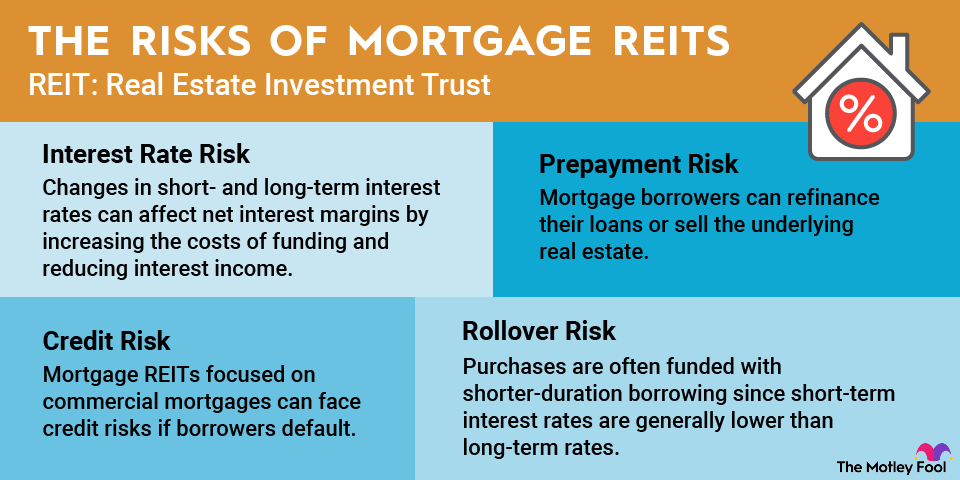
- Interest rate risk: While changes in interest rates affect REITs overall, they have an even greater effect on mREITs because short- and long-term rate changes can affect net interest margins by increasing funding costs and reducing interest income. Interest rate changes can also affect the value of an mREIT's mortgage assets, affecting its net asset value and share price.
- Prepayment risk: Mortgage borrowers can refinance their loans or sell the underlying real estate. When that happens, it forces the mREIT to reinvest the repaid loan proceeds at the prevailing interest rate, which might be lower than the rate on the existing mortgage.
- Credit risk: Mortgage REITs focused on commercial mortgages can face credit risks if borrowers default. Mortgage REITs that focus on residential loans backed by government agencies don't have to worry about this nearly as much.
- Rollover risk: Residential mortgage REITs tend to own long-term mortgages and mortgage-backed securities. However, they often fund these purchases with shorter-duration borrowing since short-term interest rates are generally lower than long-term rates. This funding strategy creates rollover risk. The mREIT must obtain funding at attractive rates to roll over loans as they mature.

Should you invest in mortgage REITs
Mortgage REITs can generate a significant net interest margin when there's a wide spread between short-term interest rates (where they borrow) and long-term interest rates (where they lend). Unfortunately, the spread doesn't usually stay wide for long, which is why mREITs tend to be very volatile.
Because of that risk, mREITs aren't always the best option for investors seeking a sustainable income stream, since their high-yielding dividends are at a high risk of future reductions. However, a few mREITs are worth considering for more risk-tolerant income investors since their differentiated business models help insulate them from the sector's overall volatility.
Related investing topics
FAQ
FAQ on Mortgage REITs
About the Author
Matt DiLallo has positions in Brookfield Asset Management and Starwood Property Trust. The Motley Fool has positions in and recommends Brookfield Asset Management and Starwood Property Trust. The Motley Fool has a disclosure policy.