Zoom Video Communications (ZM +2.37%) posted its fourth-quarter earnings report on Feb. 28. The video conferencing software company's revenue rose 21% year-over-year to $1.07 billion, beating analysts' estimates by $30 million. Its adjusted net income grew 8% to $394 million, or $1.29 per share, which also exceeded analysts' expectations by $0.22.
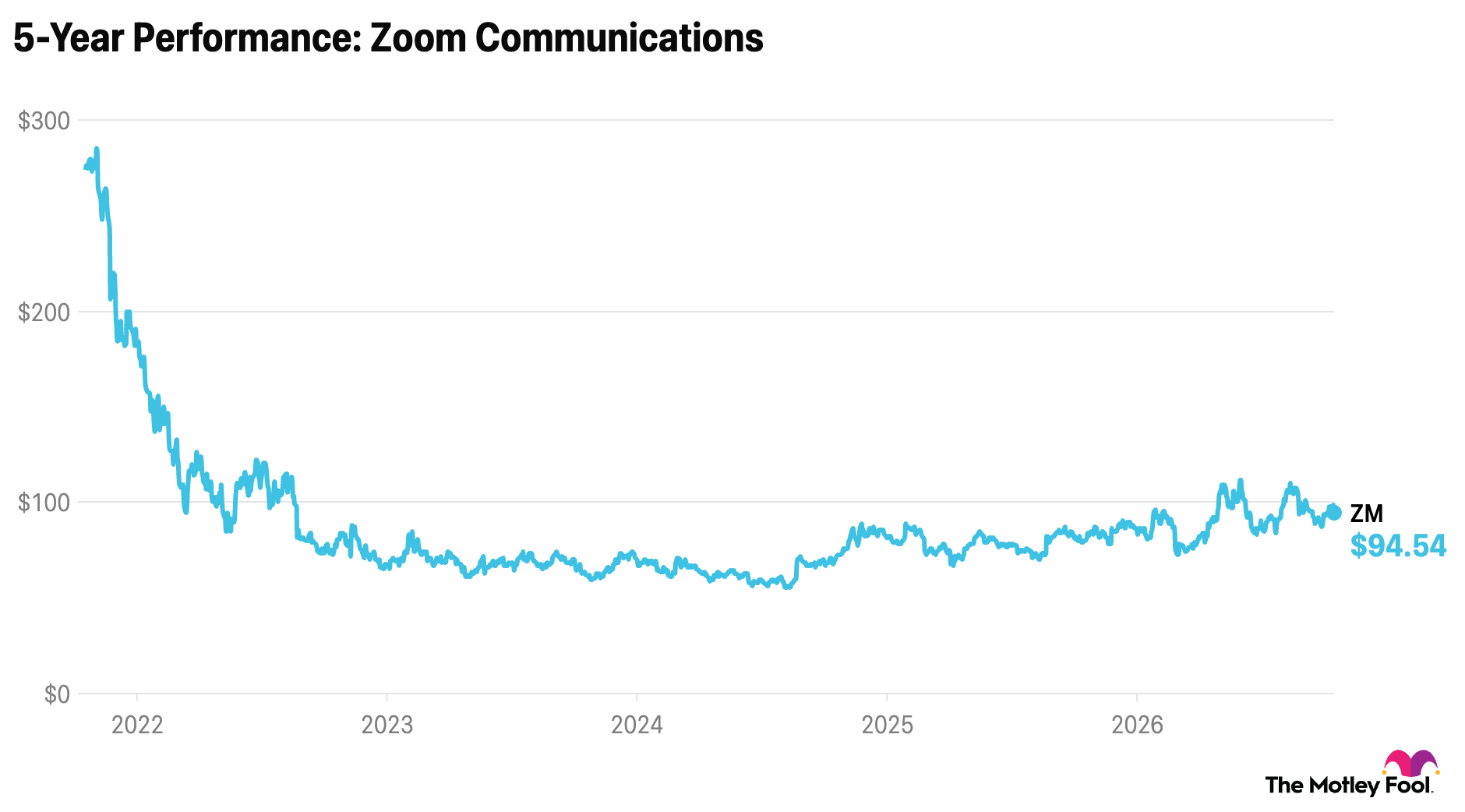
Those headline numbers looked decent, but analysts had also set the bar fairly low to account for Zoom's decelerating growth in a post-lockdown world. As a result, Zoom's stock dipped after the report and remains nearly 80% below its all-time high of $568.34 per share, which it hit in Oct. 2020.

Image source: Getty Images.
Some investors might be tempted to buy Zoom at these levels because its brand is still synonymous with video calls in many markets, it's firmly profitable by generally accepted accounting principles (GAAP), and it looks reasonably valued at eight times this year's sales. However, four red flags suggest it's still too early to turn bullish on this pandemic-era growth stock.
1. Its slowdown isn't over yet
For the full year, Zoom's revenue rose 55% to $4.1 billion. Its adjusted (non-GAAP) net income, which excludes its stock-based compensation expenses and other one-time charges, increased 56% to $1.55 billion.
However, Zoom's growth also decelerated throughout all four quarters of 2021 against tough year-over-year comparisons to the pandemic, which temporarily caused more people to work, attend classes, and socialize remotely. Those tailwinds waned as the lockdown measures were relaxed:
|
Growth (YOY) |
FY 2020 |
FY 2021 |
FY 2022 |
|---|---|---|---|
|
Revenue |
88% |
326% |
55% |
|
Non-GAAP Net Income |
513% |
883% |
56% |
Data source: Zoom. YOY = Year-over-year.
Zoom expects its revenue to grow just 10%-11% in fiscal 2023 as that slowdown continues. It also expects its non-GAAP earnings per share to decline 31%-32% as it ramps up its spending.
2. Peaking operating margins
Zoom's non-GAAP operating margin expanded from 14.2% in fiscal 2020 to 37.1% in fiscal 2021, then rose again to 40.4% in fiscal 2022. But in fiscal 2023, Zoom expects its non-GAAP operating margin to drop to about 32%. Analysts also expect its operating margin to stay nearly flat in 2024.
During the conference call, Zoom's CFO Kelly Steckelberg attributed that pressure to its "ongoing investment in R&D," and said the company would continue to "invest and innovate for the future." However, that spending will likely squeeze its near-term profits as its revenue growth decelerates.
3. Microsoft's growth in the video conferencing market
Zoom needs to aggressively widen its moat against Microsoft (MSFT +1.54%), which has pivoted away from Skype and transformed its collaboration platform Teams into a fierce competitor in the video conferencing market.
In its latest quarter, Microsoft revealed that Teams had 270 million monthly active users (MAUs), and that 90% of the Fortune 500 companies had used Teams Phone, its answer to Zoom's audio-only Zoom Phone. Zoom doesn't disclose its total number of MAUs, but it served about 300 million daily active participants during the onset of the pandemic in April 2020.
Microsoft is bundling Teams into its other productivity software, and it can easily afford to undercut Zoom's prices. Zoom placed a bid for the cloud contact center provider Five9 (FIVN +0.35%) last year to fend off Microsoft, but that deal was ultimately abandoned.
Therefore, Zoom will likely need to make more acquisitions to increase the stickiness of its ecosystem -- but that inorganic approach could squeeze its margins, throttle its cash flow growth, and dilute its own shares.
4. A pointless buyback
Buybacks are generally good for slow-growth, blue-chip companies that generate plenty of cash but have run out of ways to expand their core business. But they don't make sense for high-growth companies, since that cash would be better deployed on R&D, marketing, or fresh investments.
That's why Zoom's recent authorization of a new $1 billion buyback plan, which will last to Feb. 2024, is frustrating. That capital, which represents about three-quarters of Zoom's projected free cash flow in fiscal 2023, would arguably be better spent on new products or acquisitions.
ZM Zoom Video Communications
NASDAQ · As of 4:00 PM ET 10/26/26

Zoom's stock might look reasonably valued relative to its sales, but it isn't a bargain relative to its earnings yet. At $120, Zoom's stock still trades at 34 times the midpoint of its non-GAAP earnings estimate for fiscal 2023. That's a high multiple for a company with declining near-term profits.
In short, Zoom's big buyback might merely be aimed at offsetting the dilution from its own stock-based compensation. Investors shouldn't assume it's a firm vote of confidence in its long-term plans.
Zoom's stock could stagnate this year
Zoom faces a tough slowdown this year, and it needs to aggressively ramp up its spending as it loses its momentum in a post-lockdown market. It also needs to fend off Microsoft in the video conferencing market, and capitalize on its newfound brand recognition to launch new products and services.
However, Zoom also seems reluctant to make bold investments and acquisitions, and its new buyback plan is arguably a big step in the wrong direction. Therefore, I expect Zoom's stock to stagnate this year as the company reconfigures its long-term growth plans.