In March, the Federal Reserve began a series of what could be as many as seven hikes this year to its benchmark overnight-loan interest rate. Knowing that these hikes might be coming, many experts, analysts, and investors are nervous about how they will affect the current state of the consumer.
Sure, U.S. consumers have been financially healthier than ever over the past few years. They've achieved higher savings rates, thanks in part to stimulus checks and other benefits such as enhanced unemployment benefits, and now they are enjoying a robust and competitive job market with low unemployment. But inflation has hit levels not seen in decades, gas prices are at record highs, and when the Fed raises the federal funds rate, that will increase the cost of debt.
Let's take a look at how consumer credit has historically performed during a rising-rate environment and see if it can offer clues to the current situation.

Image source: Getty Images.
What normally happens
One way to gauge how the consumer has historically performed in a rising-rate environment is to look at how credit card charge-offs have trended during such periods. A charge-off is a debt that the lender considers unlikely to be collected. That doesn't mean the borrower won't suddenly make a payment, but it's viewed as unlikely because they have missed a payment or multiple payments. Investors look at charge-offs to determine the volume of loan losses a bank is currently experiencing or will soon experience. By looking at credit card charge-offs -- a type of consumer debt sensitive to rate hikes -- you can get clues to how consumers are handling them.
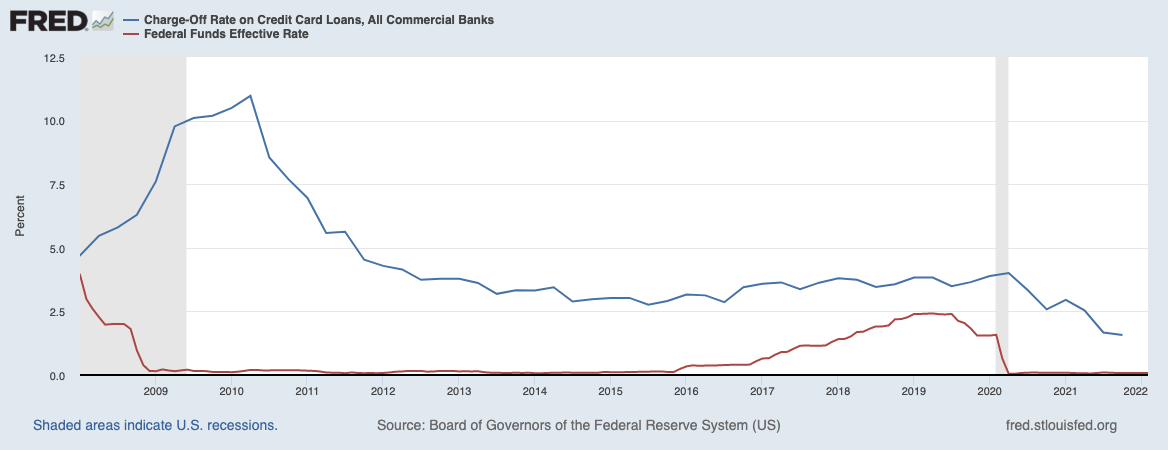
Image source: Federal Reserve.
In the chart above, the blue line shows credit charge-offs as a percentage of all credit card loans at commercial banks. The red line is the federal funds rate. Starting on the left-hand side of the chart in 2008 in the midst of the Great Recession, there is a bit of a disconnect between the federal funds rate and the credit card charge-off rate. The economy was in disarray, so credit card charge-offs were rising even as the Fed sought to stimulate the economy by lowering the federal funds rate to close to zero, which brings down the cost of debt and incentivizes consumers to spend and businesses to borrow.
It can take consumers more time to recover from a financial crisis, which is why the federal funds rate and credit card charge-off rate aren't always moving in a perfectly correlated manner throughout history. As the economy began to recover, credit card charge-offs began to decline from an extremely high peak of close to 11% in 2010 down to below 3% at the end of 2014.
Then with the economy having recovered some, the Fed began raising the federal funds rate and credit card charge-offs increased from a decade low of 2.76% to roughly 3.80% when the federal funds rate reached its high in the last rate cycle, which was close to 2.5%. Keep in mind there is a lag effect. When the Fed raises interest rates, it doesn't impact the economy right away but often sets in gradually and takes at least several months to see an effect. That is likely why you see credit card charge-offs rising at a slower pace than the federal funds rate between 2016 and 2019 and keep rising even after the Fed lowered the federal funds rate in mid-2019.
Then COVID-19 hit, the Fed lowered rates to zero again, and credit card charge-offs dropped to historic lows of just over 1.5% at the end of 2021, in large part due to the government's efforts to aid consumers and businesses amid the pandemic.
Investors, however, are concerned that this interest rate hike cycle could be different. For one thing, it's coming quicker. The Fed now projects a total of 11 rate hikes through 2023, which would bring the federal funds rate to around 2.75%. The last time it was in a rate-boosting cycle, it took the Fed more than three years to lift the federal funds from near-zero to 2.5%. Inflation is also a lot higher than it was between 2015 and 2019. The Fed is also looking to gradually shrink its balance sheet, which grew enormously as it supported the economy over the past two years. But reducing its bond holdings will effectively remove liquidity from the economy, which could have other consequences.
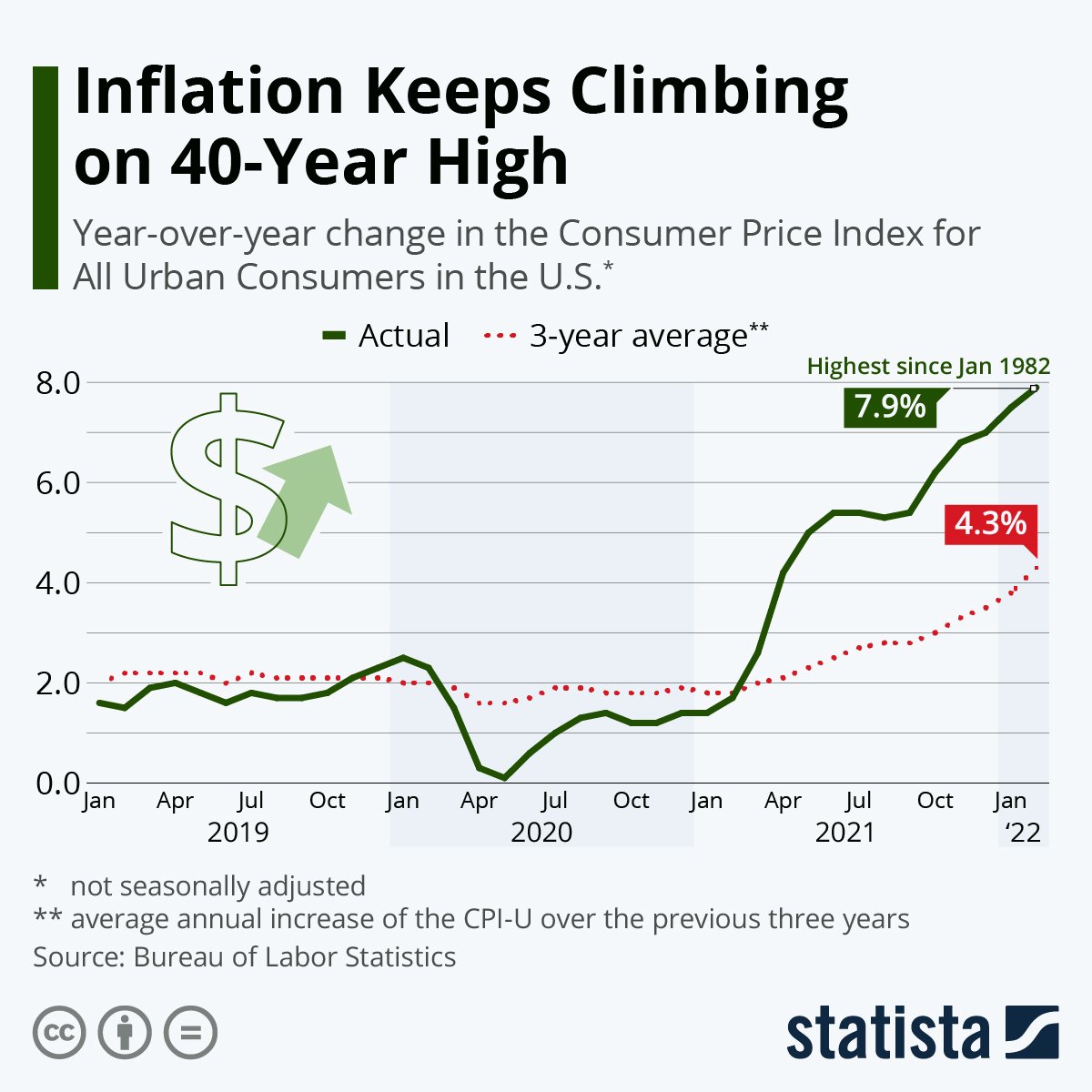
Image source: Statista.
It's a different situation this time
Ultimately, in a rising-rate environment, history and the experts warn us that the consumer will feel more financial pain. The Fed's goal with rate hikes is to bring inflation back down. It's normal for charge-offs to go up in a rising interest rate environment. What's different this time around is that there is higher inflation, leading some experts to be concerned that the U.S. could enter a recession or a period of stagflation marked by high inflation, high unemployment, and slow economic growth. The consumer is coming into this period in a position of strength. The question is whether the combination of high inflation and rising interest rates will leave them in a less resilient place than they occupied from 2015 to 2019 when the Fed was last attempting to lift the federal funds rate back toward its more usual levels.