Realty Income (O +0.59%) has evolved over the years. The real estate investment trust (REIT) has grown from its foundation of investing in freestanding U.S. retail properties secured by long-term net leases to become a much more diversified platform. It has steadily expanded into new investment verticals, significantly increasing its total addressable market opportunity.
The leading global REIT could look quite different in 2030. Here's where Realty Income appears to be heading over the next five years.

Image source: Getty Images.
Building an even better REIT
Five years ago, Realty Income primarily invested in freestanding retail and industrial properties across the U.S. and U.K. It has since expanded into seven other European countries, added gaming and data centers to its portfolio, and started making credit investments (real estate-backed loans and preferred equity).
These new investments have significantly diversified the REIT's portfolio. Today, it owns more than 15,500 properties leased to over 1,600 clients in nine countries. It has a well-diversified portfolio by property type, geography, client, and tenant industry:
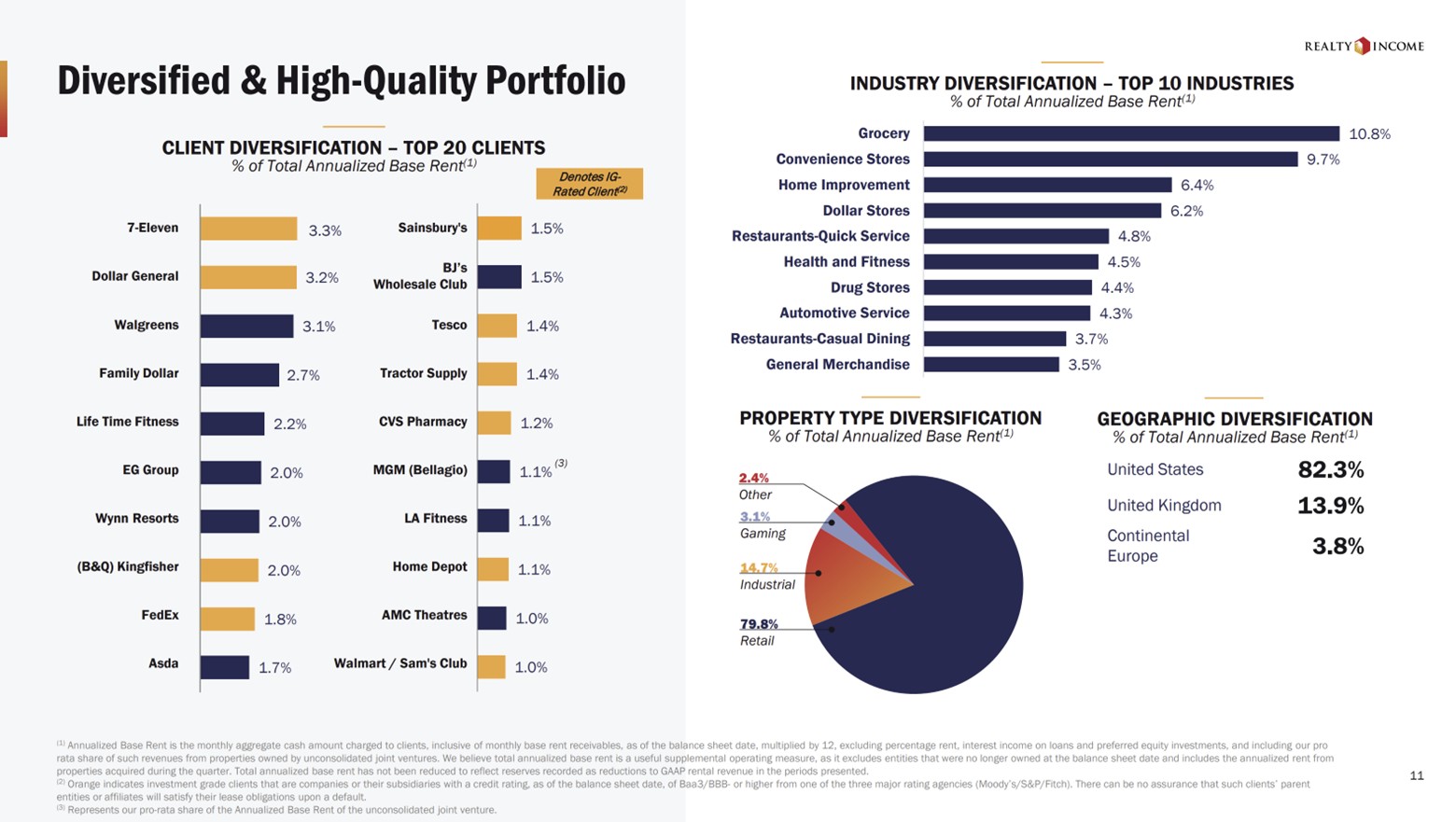
Image source: Getty Images.
Image source: Realty Income Investor Presentation.
The company's increased diversification has lowered its risk profile, expanded its total addressable market opportunity, and enhanced its investment flexibility. Realty Income's expansion into Europe has opened the doors to an estimated $8.5 trillion investment opportunity. Meanwhile, recent investments in data centers and gaming properties added a $900 billion investment opportunity. Add in the U.S. freestanding retail and industrial property investment markets, and Realty Income has a $14 trillion total addressable market opportunity.
The company's increasing diversification has given it more investment flexibility. It can focus on investing in property types or markets where it sees the best returns. For example, during the third quarter, it closed $1 billion of the investments in Europe (compared to $380 million in the U.S.). It focused on international investments because they offered much higher returns (8% initial weighted average cash yield versus 7% for U.S. investments).

NYSE: O
Key Data Points
Where Realty Income seems headed over the next five years
Realty Income spent the past five years diversifying its platform by geography and property type. The REIT will likely continue to diversify its portfolio over the next five years.
Further international expansion seems likely. It could expand into additional European countries to capitalize on the massive investment opportunity on that continent. Realty Income could also expand into other North American countries as well as other international markets. The diversified REIT already has existing relationships with clients that own properties around the world, potentially opening the doors to new market opportunities.
For example, last year, Realty Income closed its first pan-European sale-leaseback transaction with Decathlon, buying 82 retail properties across Germany, France, Spain, Italy, and Portugal. That was a tiny sliver of Decathlon's portfolio, which features over 1,750 stores in more than 70 territories, including 27 European countries, 14 in Asia, and four in Latin America. Future sale-leaseback deals with existing clients, such as Decathlon, could enable the REIT to continue its international expansion.
Realty Income could also continue adding new net lease property types to its portfolio. For example, while it owns a couple of gaming properties, the REIT could expand further into experiential real estate by investing in properties such as golf resorts, theme parks, and eat & play venues. It could also start investing in healthcare real estate, such as hospitals or senior housing properties secured by long-term net leases.
The REIT could also launch additional private capital funds. Realty Income is currently in the process of launching its inaugural U.S. private fund business. This strategy will enable it to tap into the massive $18.8 trillion U.S. private real estate market, allowing it to leverage its platform to invest more capital while also earning recurring management fee income. The REIT could launch additional U.S. funds focused on investing in specific property types and potentially expand this platform internationally.
Realty Income could be even more diversified (and bigger) in five years
Realty Income has significantly expanded and diversified its platform over the past five years, adding new countries and property types to its portfolio. The REIT is likely to become even more diversified over the next five years. This increased diversification should enable it to continue growing its dividend and shareholder value, making it an excellent long-term investment.