

It is becoming clearer how the battle lines will be drawn in the war over artificial intelligence (AI) supremacy. On one side, you have Alphabet (GOOG +1.74%) and its vertically integrated AI strategy powered by Gemini. On the other, you have a combination of Microsoft (MSFT 1.44%), OpenAI, and Nvidia building various AI tools.
When trying to serve both consumers and enterprise use cases, Alphabet and Microsoft are competing with their Gemini and Copilot products. Both tools already have millions of customers and are expanding every quarter. But which product will help the aforementioned technology giants grow revenue by 100% first?
The answer gets clearer if you look at the underlying data.

NASDAQ: MSFT
Key Data Points
Gemini's recent ascendance
After starting behind in the race, Alphabet's Gemini model has been breaking through the pack and gaining market share, especially with its recent Gemini 3 launch. Its distinct mobile app is now the second most popular on the App Store -- behind ChatGPT -- and has seen a rapid increase in downloads.
Alphabet management estimated that last quarter Gemini reached 650 million monthly active users (MAUs), making it one of the fastest-growing consumer internet products in history. ChatGPT is still estimated to be used more, but Gemini is gaining quickly because of Alphabet's ability to distribute and market the product to the billions of users of Google Search and its associated services.
Right now, Gemini direct revenue is segmented within the Google subscriptions line. This is one of the fastest growing segments for Alphabet's business, growing 21% year over year last quarter to $12.87 billion. However, Alphabet is generating more than just direct revenue from Gemini, as it is now powering software services in Google Cloud and more traditional Google Search results.
Google Search generated $56.6 billion in revenue last quarter, while Google Cloud generated $15.1 billion and is growing 34% year over year. These are indirect sources of Gemini revenue.
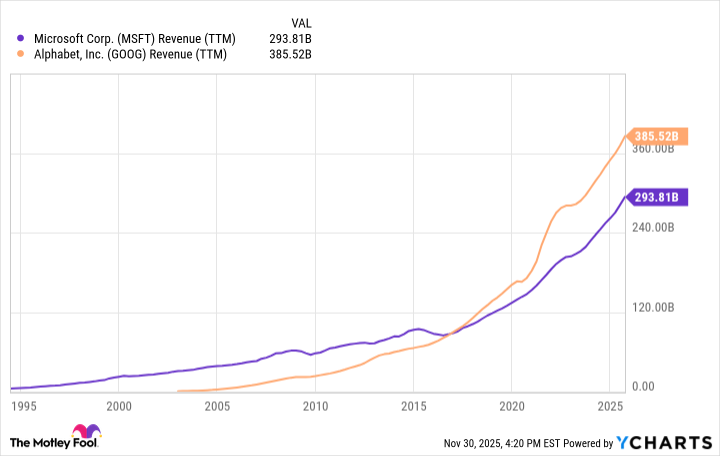
MSFT Revenue (TTM) data by YCharts
Microsoft's holistic AI growth
Copilot is Microsoft's AI assistant that integrates within Office 365 products, and is powered by OpenAI's large language model, the same one that powers ChatGPT. As of the last quarterly conference call, Microsoft claimed it had 150 million monthly users of Copilot across Microsoft products.
When taking a direct comparison to Gemini, Copilot has much fewer active users. Copilot has not gained traction among general consumers, but it is popular among Microsoft's enterprise customers, who are buying expensive licenses to layer on these AI chatbots across their existing Microsoft ecosystems.
Microsoft's AI revenue coming from Copilot may be low, as apps like ChatGPT and Gemini take over mainstream consumption. This is not Microsoft's sole AI revenue driver, though. It has a large relationship with OpenAI, which has contracted $250 billion in future spending on Microsoft Azure cloud computing. The division is growing 40% year over year for Microsoft, which is faster than Google Cloud and at a larger revenue size.

Image source: Getty Images.
Which is the better AI growth driver?
When looking at direct comparisons between Gemini and Copilot, it is likely that the former will contribute 100% revenue gains for Alphabet first, given its lead in users and easy distribution through the existing Google ecosystem. Gemini looks to be well on its way to 1 billion users, and the recent launch of Gemini 3 could be a game changer.
But if you take a look across the entire AI sector, Microsoft may have a larger revenue opportunity simply due to its relationship with OpenAI. This is a riskier proposition and makes its growth reliant on one start-up, but the contractual obligations for Azure could lead to potentially hundreds of billions of dollars in new revenue over the next decade.
In fact, if we look at Microsoft as a whole vs. Alphabet, it is growing faster right now. Revenue was up 17% year over year in constant currency last quarter compared to 15% growth for Alphabet. Both of these stocks will be strong beneficiaries of AI spending over the rest of this decade.
