Artificial intelligence (AI) stocks have hit a rough patch of late. The Global X Artificial Intelligence and Technology ETF, which is the largest AI-focused exchange-traded fund (ETF), is down over 5% since the beginning of November.
Concerns about AI being in a bubble, high valuations, and the huge amounts of debt that certain companies are taking on to build AI infrastructure have been weighing on investors' minds of late. This explains why prominent AI names such as Nvidia (NVDA 0.32%) and Palantir Technologies (PLTR +0.07%) have been pulling back after hitting 52-week highs in the past couple of months.
Investors will now be wondering if AI stocks can witness a turnaround in their fortunes in the new year. Let's check if there is a possibility of a big rally in this sector in January that could set up AI stocks for a solid 2026.
Image source: Nvidia.
The sell-off shouldn't last for long
The recent weakness in AI stocks can be attributed to the high valuations of companies in this sector. However, the good news for investors is that they can buy some of the top names in this industry at an attractive valuation right now.

NASDAQ: NVDA
Key Data Points
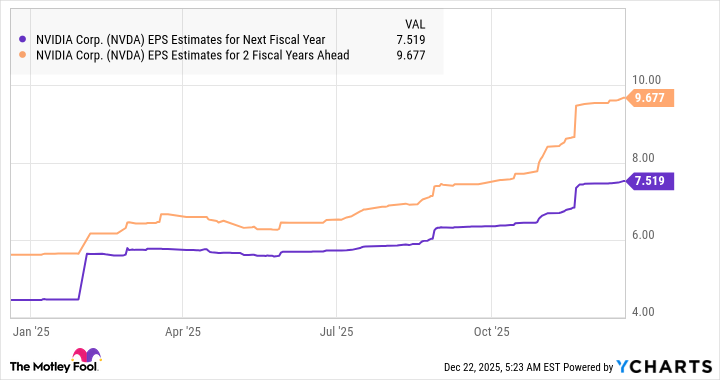
Nvidia, for instance, is trading at just 24 times forward earnings, which is well below the tech-laden Nasdaq-100 index's earnings multiple of 32 (using the index as a proxy for tech stocks). That's quite attractive for a company that's expected to deliver a 60% jump in earnings next year, especially considering that Nvidia has the potential to clock a bigger jump in earnings.
That's because spending on AI infrastructure is likely to increase even further in 2026. Goldman Sachs estimates that hyperscalers are set to spend $527 billion on data center infrastructure next year, up by 34% from 2025's projected spending. However, it is worth noting that these estimates have moved significantly higher of late.
Goldman Sachs notes that hyperscalers were initially expected to spend $465 billion in 2026, according to estimates at the beginning of the third quarter. However, that number has increased substantially. A key reason why that's the case is because of the payoff that AI is bringing for its adopters. For instance, customers using Palantir's Artificial Intelligence Platform (AIP) to connect their data and operations with generative AI tools are witnessing healthy productivity improvements.
One of them points out that a problem that earlier took weeks to solve can now be tackled in just five minutes, while another added that a process that used to take nine days to complete is now executed in just seconds. These gains aren't surprising. Market research firm IDC points out that "every new dollar spent on AI solutions and services by adopters is expected to generate an additional $4.9 in the global economy."
So, it is easy to see the terrific expansion in Palantir's customer base. Its overall customer count increased by 45% year over year in the third quarter of 2025. More importantly, the customers who start using Palantir's offerings tend to go for enterprise-wide deployment of its solutions to maximize productivity gains.
This is the reason why Palantir won new contracts worth a record $2.8 billion in Q3, up by 151% from the prior year. For comparison, the company's revenue increased by a relatively slower pace of 63% to $1.18 billion, suggesting that it is winning new business at a faster pace than it can fulfill existing contracts. This situation should ideally lead to an acceleration in its growth in the future, especially considering how much value each dollar spent on AI services could generate for users.
And that, in turn, should lead to stronger demand for chips that companies like Nvidia manufacture. Nvidia CFO Colette Kress remarked on the company's November earnings call that the "demand for AI infrastructure continues to exceed our expectations." She added that the three generations of its data center graphics processing units (GPUs) -- Ampere, Blackwell, and Hopper -- are at full utilization.
In other words, hyperscalers and AI companies are poised to spend more money on GPUs to train and deploy AI models and inference applications in the cloud. Nvidia itself projects that AI infrastructure spending will increase at a compound annual growth rate (CAGR) of 40% through the end of the decade, landing between $3 trillion and $4 trillion in 2030.
This is the reason why Nvidia's earnings estimates for the next couple of years have moved significantly higher, a trend that's likely to continue as hyperscalers spend more money to bring online more AI infrastructure to utilize the technology's productivity gains.
NVDA EPS Estimates for Next Fiscal Year data by YCharts
Why January could be a breakout month for AI stocks
AI stocks have played a central role in driving the stock market higher. Again, that's not surprising as the likes of Palantir and Nvidia have jumped nearly 3,000% and 1,000% in the past three years.
BlackRock, the world's largest asset management firm, anticipates AI to keep driving markets higher in 2026. The firm notes that stocks in this sector are likely to perform well despite periods of volatility. Even Dan Ives of Wedbush Securities, a noted tech bull, is expecting AI stocks to rally higher in 2026. And that rally could start as soon as next month when key AI infrastructure companies such as Lam Research (LRCX +1.35%) and ASML Holdings (ASML +0.35%) release their results.
Both companies are expected to release their results on Jan. 28, 2026. There have been solid signs of strong demand for their chipmaking equipment of late, fueled by AI. Lam Research, for instance, reported a solid increase of 27.5% in revenue in the last reported quarter. Management pointed out on the earnings call that it expects "the surge in AI data center demand creating billions of dollars of served available market expansion and share gain opportunity for Lam in the coming years."
On the other hand, Dutch semiconductor giant ASML also posted a bigger-than-expected increase in its bookings in Q3, fueled by AI demand. With the demand for advanced semiconductor manufacturing equipment used for making AI chips expected to grow in double digits over the next three years, ASML seems poised to deliver healthy guidance.
So, a solid set of results from Lam and ASML, along with the healthy guidance that they are likely to deliver, should instill confidence in AI stocks as these companies act as a barometer for the sector, which is why it would be a good time to buy the names discussed above before they go on a bull run next month.