Shares of artificial intelligence (AI) chip pioneer Nvidia (NVDA 1.45%) delivered a solid performance in 2025, rising by nearly 39%. However, several concerns weighed on the stock throughout the year, including intensifying concerns about a potential AI bubble and the risk posed by the circular financing deals prevalent in the sector.
These factors explain why Nvidia underperformed the PHLX Semiconductor Sector index's 42% gain last year. Additionally, restrictions imposed by President Donald Trump on the company's ability to sell its chips into the Chinese market in April led to the company losing a significant amount of business. However, Trump's recent decision to allow Nvidia to sell its advanced chips to "approved customers" in the Chinese market could set the stage for the stock to beat the market in 2026.
Image source: Nvidia.
Nvidia is reportedly witnessing terrific demand from China
In December, President Donald Trump announced on his social media platform, Truth Social, that Nvidia would be able to sell its advanced H200 processors to select customers in China. However, it will have to pay 25% of its revenue from those sales to the U.S. government. This is good news for a company that seemed on track to clock $30 billion in revenue from the Chinese market in the current fiscal year before Trump's previous restrictions kicked in.

NASDAQ: NVDA
Key Data Points
A recent report from Reuters revealed that Nvidia could start shipping its H200 data center processors, which are around 6 times more powerful than the downsized H20 chip it was previously selling there, in mid-February. And now, another exclusive Reuters report indicates just how strong the demand for the H200 processors is in China.
The latest article reports that Chinese tech companies have placed orders for more than 2 million H200 chips, which are based on the previous-generation Hopper architecture. Given that Nvidia has only about a third of that amount in stock, it has reportedly asked its foundry partner, Taiwan Semiconductor Manufacturing, to boost production so it can fulfill the demand from Chinese customers.
Reuters' source added that TSMC will reportedly start producing the additional China-bound chips in the second quarter. Also, Nvidia is reportedly going to price the H200 chips at $27,000 each for the Chinese market. After deducting the 25% that Nvidia will need to pay to Washington, it would receive just over $20,000 from the sale of each H200 chip to Chinese customers.
Assuming that the company indeed sells 2 million H200 processors to China, it could generate $40 billion in revenue from that market in 2026. That could pave the way for more upside in Nvidia stock in the new year.
The Chinese business could help Nvidia crush expectations in 2026
Wall Street's consensus revenue estimate for Nvidia's fiscal 2027 (which begins near the end of this month) stands at $320 billion, 50% more than the current fiscal year's expected revenue.
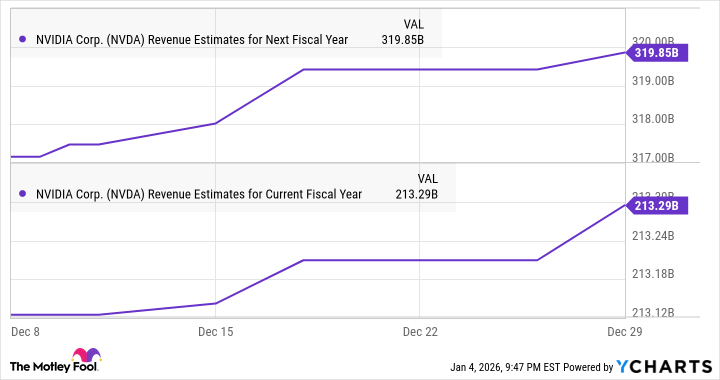
NVDA Revenue Estimates for Next Fiscal Year data by YCharts.
However, the chart above indicates that analysts haven't yet factored in the revenue that the company could generate from China. Trump's announcement and Reuters' reports have all arrived in the past month, and the revenue estimate line for the next fiscal year hasn't moved substantially in the wake of those developments.
So, if Nvidia indeed generates $40 billion in revenue from China in its fiscal 2027, its top line could hit $360 billion, which would be a jump of 69%. Nvidia today trades at a forward price-to-sales ratio of 21. It could continue to trade at that premium a year from now, as it is likely to deliver a stronger top-line jump than analysts' expectations.
Based on those numbers, Nvidia's market cap could hit $7.5 trillion next year, which would amount to upside of 63% from its current level. All of this indicates that it is likely to remain a top AI stock in the new year.