You might have noticed that the S&P 500 (^GSPC 1.31%) is on a roll. The widely followed index just wrapped up three consecutive years of gains of 16% or more. Such a streak has occurred only five times in the last 98 years. The S&P 500 is off to a good start in the new year as well.
Investors seeking to capitalize on the S&P 500's momentum have several exchange-traded funds (ETFs) to choose from. But what's the best S&P 500 ETF to invest $5,000 in as 2026 begins?
Image source: Getty Images.
Top contenders
Let's first introduce the top contenders in the S&P ETF market.
First on the list is the SPDR S&P 500 ETF Trust (SPY 1.27%). Managed by State Street (STT 2.28%), this ETF is the most popular S&P 500 ETF based on trading volume. It's also the oldest ETF in the U.S., with its inception dating back to January 1993.
The SPDR S&P 500 ETF Trust isn't the largest S&P 500 ETF based on assets under management (AUM), though. That honor belongs to the Vanguard S&P 500 ETF (VOO 1.23%), with an AUM of over $840 billion.
Financial services giant BlackRock (BLK 3.16%) manages the iShares Core S&P 500 ETF (IVV 1.27%). This fund also has more AUM than the SPDR S&P 500 Trust and runs neck-and-neck with the Vanguard S&P 500 ETF based on average daily trading volume over the last three months.
State Street offers investors another S&P 500 ETF option, the State Street SPDR Portfolio S&P 500 ETF (SPYM 1.30%). It's a much smaller sibling to the SPDR S&P 500 ETF Trust.
The Invesco S&P 500 Equal Weight ETF (RSP 1.00%) offers a distinct approach. This ETF owns the same S&P 500 stocks as the other ETFs discussed. However, each stock is equally weighted, rather than being weighted by market capitalization.
How they compare
As you might expect, these five S&P 500 ETFs are quite similar. The biggest differentiating factors between them are annual expense ratios and liquidity. Here's how they compare on these two fronts:
|
ETF |
Annual Expense Ratio |
Average Trading Volume Last 3 Months |
|---|---|---|
|
SPDR S&P 500 ETF Trust |
0.0945% |
80,222,453 |
|
Vanguard S&P 500 ETF |
0.03% |
9,060,471 |
|
iShares Core S&P 500 ETF |
0.03% |
9,111,643 |
|
State Street SPDR Portfolio S&P 500 ETF |
0.02% |
10,488,768 |
|
Invesco S&P 500 Equal Weight ETF |
0.20% |
16,873,428 |
Data sources: ETF websites, ETFDb.
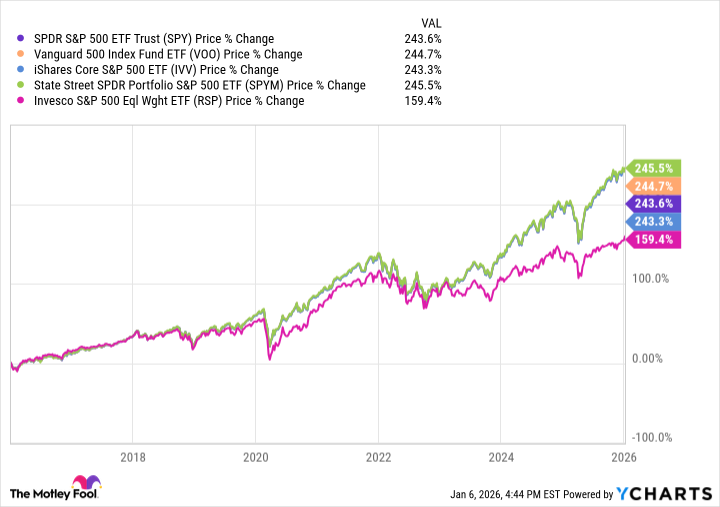
There's also a significant gap in performance between the four market-cap-weighted and the Invesco S&P 500 Equal Weight ETF. Over the last decade, market-cap-weighted funds have delivered similar returns. However, the equal-weighted ETF's returns have been much lower. This is primarily due to the sizzling gains generated by the so-called "Magnificent Seven" stocks and other large growth stocks.
The best of the bunch
Which of these S&P 500 ETFs is the best pick? My vote goes to the State Street SPDR Portfolio S&P 500 ETF.
This fund boasts the lowest expense ratio of the five ETFs. Even a tiny advantage can make a difference financially over the long term. Liquidity isn't an issue for the State Street SPDR Portfolio S&P 500 ETF, either. (Actually, it isn't an issue for any of these S&P 500 ETFs.)
There is at least one scenario, though, where the Invesco S&P 500 Equal Weight ETF could outperform the rest of the pack in 2026. If the artificial intelligence (AI) boom wanes, stocks such as Nvidia (NVDA 1.48%), Apple (AAPL 2.03%), Microsoft (MSFT 0.51%), Amazon (AMZN 1.43%), and Alphabet (GOOG 1.42%) (GOOGL 1.43%) will likely underperform. Because these stocks comprise significant percentages of the market-cap-weighted ETFs' portfolios, a softening of AI demand could give the equal-weighted S&P ETF, which has less exposure to these megacap stocks, an advantage.