The S&P 500 (^GSPC 1.33%) has advanced 15% since President Donald Trump took office, despite his administration upending decades of trade-policy precedent with severe tariffs. However, while artificial intelligence (AI) spending has so far kept the economy in growth mode, those tariffs are shaping up to be an economic headwind.
- The unemployment rate increased from 4% in January 2025 to 4.6% in November 2025, the highest level since September 2021.
- The U.S. economy added an average of 55,000 jobs per month through November 2025, the lowest number (excluding the pandemic) since the Great Recession in 2009.
- Consumer sentiment recorded its lowest annual average in history in 2025. For context, the University of Michigan started collecting data in 1952.
Unfortunately, investors recently got more bad news about President Trump's tariffs, and the timing is particularly bad because the S&P 500 just flashed a warning not seen since the dot-com crash.
Here's what you need to know.
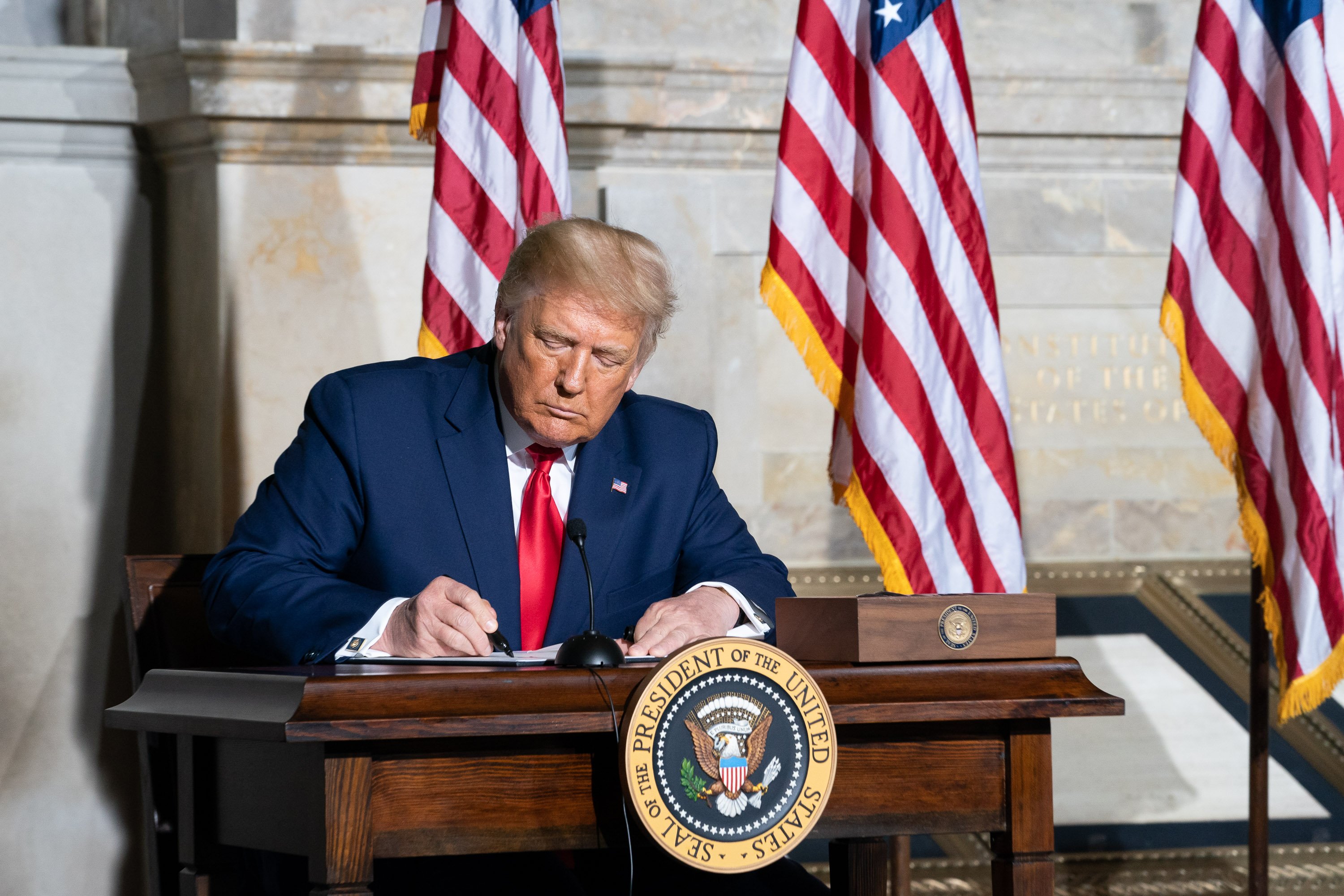
Image source: Official White House Photo by Joyce N. Boghosian.
Here's the latest bad news about President Trump's tariffs
Last year, President Donald Trump imposed tariffs ranging from 10% to 50% on dozens of countries. In turn, the average tax on U.S. imports has since increased to about 16%, the highest level since the 1930s, according to JPMorgan Chase.
"Foreign nations will finally be asked to pay for the privilege of access to our market," Trump asserted in April, implying that exporters would absorb price increases created by his trade policies. "Jobs and factories will come roaring back into our country."
However, recent economic data refutes those claims:
- In total, U.S. companies and consumers paid 82% of the tariffs in October 2025, according to Goldman Sachs. The investment bank says that figure will still be 75% by July 2026. So, contrary to what Trump implied, foreign exporters are not absorbing the cost increases.
- The Institute for Supply Management (ISM) says U.S. manufacturing activity contracted in December, the 10th consecutive decline. Susan Spence, chair of the ISM Manufacturing Business Survey Committee, highlighted uncertainty caused by tariff costs. So, contrary to what Trump claimed, tariffs have not led to a manufacturing renaissance.
- The Bureau of Labor Statistics (BLS) says the ratio of unemployed persons to job openings reached 1.1 in November, the highest level since 2021. And monthly job openings averaged 7.4 million through November, the lowest level since 2020. So, contrary to what Trump claimed, tariffs have actually made it more difficult for Americans to find work.
Here's the big picture: President Trump's tariffs are being paid for by Americans, and they have so far coincided with a reduction in manufacturing activity and a weakening labor market. If those trends continue, tariffs could be a significant headwind to economic growth. Indeed, the Tax Foundation estimates tariffs could reduce GDP by 0.5% over the next decade.
The S&P 500 flashes a warning last seen during the dot-com crash
The S&P 500 had an average cyclically adjusted price-to-earnings (CAPE) ratio of 39.9 in December, the highest level since the dot-com crash in October 2000. In fact, the S&P 500 has only attained an average CAPE multiple above 39 in 25 months since it was created in 1957.
Unfortunately, the stock market has generally performed poorly under such conditions. The chart lists the S&P 500's best, worst, and average returns over different time periods following incidents when its monthly CAPE ratio exceeded 39.
|
Time Period |
S&P 500's Best Return |
S&P 500's Worst Return |
S&P 500's Average Return |
|---|---|---|---|
|
Six months |
16% |
(20%) |
0% |
|
One year |
16% |
(28%) |
(4%) |
|
Two years |
8% |
(43%) |
(20%) |
Data source: Robert Shiller. Table by author.
As shown, an elevated CAPE multiple does not mean a sharp drawdown is imminent. Following past incidents where the S&P 500's CAPE multiple topped 39, the index has dropped by an average of 4% in the next year, but its returns have ranged from positive 16% to negative 28%.
However, a high CAPE ratio does hint at weak long-term results. Notice that the S&P 500's best, worst, and average returns get progressively worse as the time period lengthens. In short, history says the index will fall 4% by December 2026 and 20% by December 2027.
Of course, historical data does not guarantee future results. Investors may tolerate higher CAPE multiples today if they expect artificial intelligence (AI) to increase profit margins and accelerate earnings growth in the future. In that scenario, the S&P 500 could keep moving higher while its CAPE ratio drops to a more reasonable level.
However, Trump's tariffs could diminish AI's beneficial impact to some degree. As mentioned, U.S. companies and consumers paid 82% of the tariffs in October 2025, according to Goldman Sachs. Corporate earnings likely suffer in both scenarios; margins fall if companies absorb the costs, or sales likely slow if companies pass the costs to consumers.
What investors can do
History says the stock market is headed lower over the next two years, so investors should make prudent decisions. Limit your stock purchases to your highest-conviction ideas, sell any stocks in which you lack confidence, and consider building a cash position in your portfolio.