Peter Thiel is a legend in Silicon Valley. He was one of the founders of PayPal, after which he went on to co-found Palantir. He was also one of the first outside investors in Facebook (now Meta Platforms), so he also has a sharp eye for investment opportunities.
When someone with a track record like that makes a move, investors should pay attention. In the third quarter, Thiel made some jaw-dropping trades that sent a clear signal to investors about where he thinks the artificial intelligence (AI) market is headed in 2026.

Image source: Getty Images.
Thiel sold one of AI's most prominent stocks
We know what Thiel's activities were during Q3 thanks to his Form 13F. Federal law requires money managers with greater than $100 million in assets under management to report their end-of-quarter holdings to the Securities and Exchange Commission (SEC) no later than 45 days after the quarter in question ends. That information is then quickly passed on to the public.
So, the most recent snapshot we have of Thiel's portfolio tells us what he held as of Sept. 30 -- he could have shifted his investments around again since then. However, he only had three holdings in his portfolio at that point, which suggests he isn't doing a lot of trading.
In Q3, he sold his entire stake in Nvidia (NVDA +0.84%). This turned out to be a fairly smart move because the chipmaker was flat during Q4. He also sold a hefty amount of his Tesla stock, which rose a mere 1% in Q4.
With some of the proceeds from those sales, he made big bets on two other stocks: Microsoft (MSFT -2.04%) and Apple (AAPL -2.51%). Their Q4 performance was mixed, as Apple stock rose 7% while Microsoft's tumbled 7%. However, Thiel likely made this trade for other purposes, and we shouldn't judge its success based on one quarter.

NASDAQ: AAPL
Key Data Points
The pivot from Nvidia to Microsoft and Apple is a notable one, as it could signal that Thiel believes that artificial intelligence application investments are going to perform better in 2026 than hardware plays like Nvidia.
Are Microsoft and Apple better stock picks than Nvidia?
Although my track record isn't nearly as impressive as Thiel's (it's not even in the same ZIP code), I question why he made these trades. Nvidia's graphics processing units (GPUs) remain in such high demand that management claimed they were sold out of cloud GPUs in its Q3 earnings report. Furthermore, demand for AI computing units is expected to rise, as Nvidia forecasts global data center capital expenditures will rise to $3 trillion to $4 trillion by 2030.
Microsoft is a large buyer of these computing units, as it's an AI facilitator. On its Azure Foundry platform, a cloud computing product, developers can choose from a wide variety of generative AI models to build applications on. While this is a great business, it isn't growing nearly as fast as Nvidia is.
While I like Microsoft as an investment, I find Apple to be less promising. Apple's AI strategy has fallen flat, and many of the innovations it promised years ago still haven't panned out. Apple hasn't launched an innovative product in some time, and its sales growth has been relatively weak as a result. If you compare their revenue growth rates, it's clear Apple doesn't belong in the same conversation with Nvidia and Microsoft.
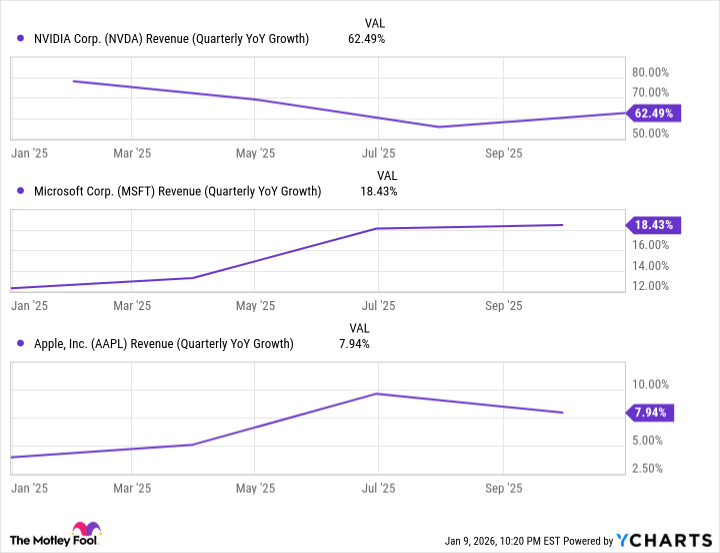
NVDA Revenue (Quarterly YoY Growth) data by YCharts.
According to the analysts' consensus, Apple's growth isn't expected to accelerate anytime soon, and Microsoft and Nvidia's growth rates are expected to remain elevated. As a result, when you look at the forward valuations of these stocks, Apple appears more expensive than the other two.
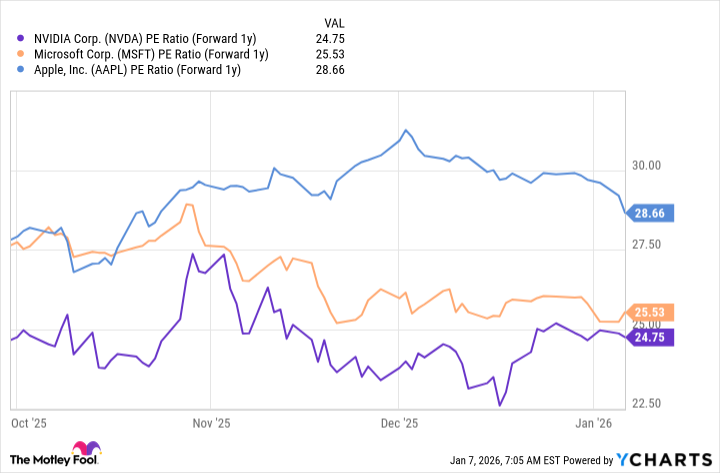
NVDA PE Ratio (Forward 1y) data by YCharts.
Although Thiel's Q3 moves may have surprised many investors, I don't think they were the right ones. There is still plenty of momentum in the AI infrastructure buildout, and I think Nvidia is the hardware maker best positioned to profit from it. Microsoft is also a solid stock pick, as it gives investors exposure to a different side of AI. However, I don't think Apple will be a great stock to own unless it can solve some of its AI problems and launch some new products that can drive increased sales.