In December 2024, I made the prediction that Nvidia (NVDA +0.74%) -- then carrying a $3.4 trillion market cap -- would reach a $5 trillion market cap in 2025. This came true in October, although the stock has pulled back since then, and the company's value today sits at about $4.5 trillion. Now, I think that it can reach $6 trillion easily in 2026.
To do that, the stock would have to rise by at least 33%, making it an obvious pick to scoop up now.
Image source: Getty Images.
AI tailwinds keep getting stronger
Nvidia's rise to being the world's largest company has been made possible by previously unheard-of levels of spending on artificial intelligence computing equipment. Nvidia's graphics processing units (GPUs) are the most popular hardware for many applications, and this has shown up in its results.
During Nvidia's fiscal 2026 third quarter, which ended Oct. 26, its revenue rose 62% -- an acceleration from the prior quarter.
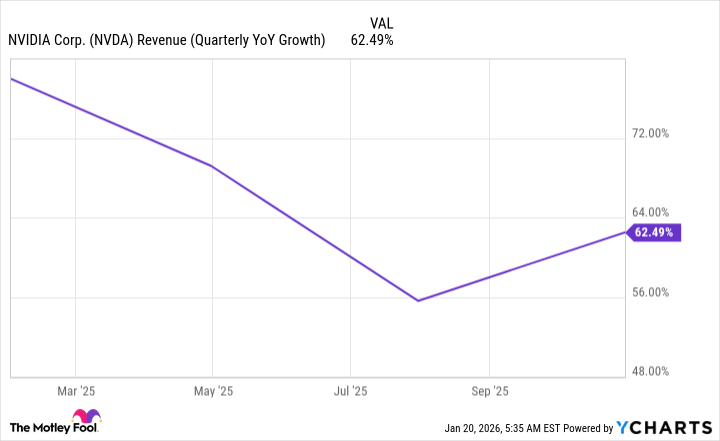
NVDA Revenue (Quarterly YoY Growth) data by YCharts.
Wall Street analysts expect even faster revenue growth of 66% during its fiscal fourth quarter. Considering how ludicrous Nvidia's growth rates were over the past few years, few could have predicted this would still be occurring, but it's what's happening.
Because demand for AI computing hardware is so high, Nvidia remains in control of pricing. This allows it to make a ton of profit from each GPU and platform that it sells. But just how high can its stock go?
Why Nvidia should easily clear $6 trillion in 2026
Right now, Nvidia trades at 40 times expected forward earnings. Most big tech stocks trade at around 30 times forward earnings, so the chipmaker carries a premium over its peers. However, considering its growth rates, I think it has earned it.
If Nvidia is still trading at 40 times forward earnings at this time next year, based on analysts' consensus forecast, it would be priced at nearly $350 per share. That would actually equate to an $8.4 trillion market cap.
That's an optimistic projection, but it reflects what Wall Street analysts project for Nvidia's fiscal 2028. Even if the market revalued the stock to take away its relative premium, leaving it trading at 30 times forward earnings, Nvidia would have a market cap of $6.3 trillion.
That's a wide potential range of values for the chip giant to land on at the end of this year. But any result in that range would amount to an impressive return for investors, suggesting that Nvidia will be a great stock to own again in 2026.