In September of 2025, Intel (INTC 5.72%) created a new group to handle custom chip design for external customers. The Central Engineering Group, led by a Cadence Design Systems veteran Srini Iyengar, formalized the company's efforts to break into the custom silicon market.
While Intel's fourth-quarter results and guidance fell short of expectations, sending the stock tumbling on Friday morning, there was plenty of good news for investors to chew on. The success of the custom chip business and its massive long-term potential should make Intel investors excited about the future.
Image source: Intel.
A $100 billion market opportunity
Intel management didn't have a lot to say about its custom chip business during the fourth quarter earnings call, but what CFO Dave Zinsner said was certainly notable. Intel's custom ASIC business surged by more than 50% in 2025 and grew by 26% sequentially in the fourth quarter. The business exited the year with an annualized revenue run rate exceeding $1 billion.
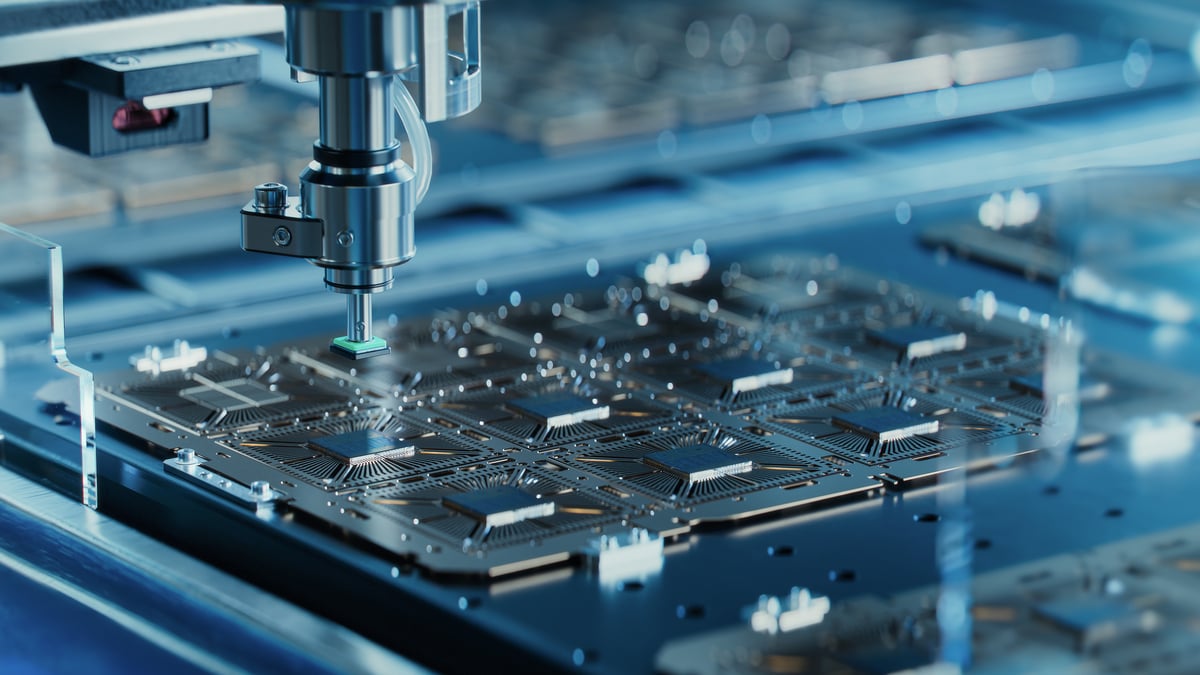
ASICs, or application-specific integrated circuits, are chips designed at the hardware level for specialized purposes. That contrasts with a CPU, which is a general-purpose processor that can perform a wide variety of tasks. ASICs can be far more efficient than general-purpose processors, making them a popular choice for applications such as networking and AI acceleration.
Zinsner noted that Intel's custom ASIC business growth was partly driven by demand for networking chips related to the ongoing AI infrastructure build-out. While it's not clear exactly what chips are responsible, Intel has a few deals in place that could be contributing. In 2023, Intel inked a deal with Ericsson to manufacture custom 5G SoCs on its Intel 18A process. In 2024, Intel agreed to produce custom AI fabric chips for Amazon Web Services using Intel 18A, as well as custom Xeon 6 CPUs using Intel 3.
The total addressable market for custom ASICs is around $100 billion, according to Intel. The company faces formidable competition from Broadcom and Marvell, but Intel has a key advantage. Unlike its competitors, Intel can offer custom chip design services, its proprietary x86 technology, and in-house manufacturing and packaging services bundled together.
When speed to market is important, Intel acting as a one-stop shop could be extremely appealing. "Our combination of design services, IP building blocks, and manufacturing capabilities positions Intel well to resolve specialized problems at scale," said Intel CEO Lip-Bu Tan during the earnings call.
A CEO with the right experience
Tan spent more than a decade leading Cadence Design Systems. Cadence sells electronic design automation tools that are widely used throughout the semiconductor industry to design chips. During Tan's tenure, Cadence transformed into a customer-centric organization and more than doubled its revenue.
Speaking about Intel's custom chip business, Tan said: "This is not a new area for us, although it is one that I'm committing significantly more focused resources and investment dollars, including leveraging my own experience at Cadence Design, supporting and growing this market."
With Intel having less than a 1% share of a $100 billion market, Tan's experience positions the company to grow its custom ASIC business into an industry powerhouse.

NASDAQ: INTC
Key Data Points
Feeding into the foundry business
One major benefit of winning customers for custom chip designs is that it gives Intel the opportunity to sell those customers on manufacturing and advanced packaging services. The Intel 18A process is currently scaling up, and Intel 14A is expected to be ready by the end of 2027. For Intel's foundry business to be sustainable, it needs a steady flow of external customer wins to justify the mountainous costs of developing leading-edge semiconductor manufacturing processes. The custom chip business could help provide those customers.
With Intel currently facing manufacturing capacity shortages, it will take time for the custom chip business to drive meaningful business to the foundry. But over the next few years, the custom chip business is likely to be a key component of the company's comeback and grow into a multi-billion-dollar business in its own right.